
As a person working in any part of the food manufacturing industry in India, chances are high that you must be familiar with the concept known as HACCP. The abbreviation for Hazard Analysis Critical Control Points, HACCP is a globally accepted food safety standard that ensures the delivery of safe food products by businesses.Considering that there are thousands of food production facilities of varying sizes in India, having a HACCP certification India is important for any company trying to grow and expand.
In this guide, we will discuss everything from what HACCP is to how you can attain a HACCP certification, the cost involved, and other relevant information.
What is HACCP Certification India
The acronym HACCP stands for Hazard Analysis and Critical Control Points. The concept of HACCP refers to the scientific analysis of possible risks associated with the contamination of foods and the implementation of preventive measures at critical stages during production. HACCP was first introduced by NASA when dealing with food safety for its space program in the 1960s.
Today, it is one of the major pillars of food safety. The following types of hazards are distinguished within the scope of HACCP certification programs:
- Biological hazards – include bacteria, viruses, and parasites
- Chemical hazards – include pesticides, cleaning substances, and allergens
- Physical hazards – include foreign bodies, such as glass and metal
Thus, HACCP certification for food safety in India means that an organization has implemented an approved HACCP system. It usually becomes a prerequisite for ISO 22000, FSSC 22000, and BRC Global Standards.
Why HACCP Certification India Matters for Your Business
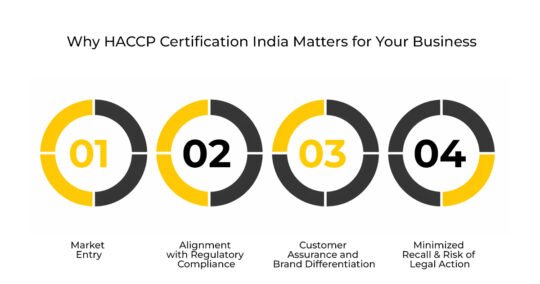
The Indian food sector is amongst the largest worldwide; with escalating consumer demands and growing exports, food safety has become imperative for all companies dealing within this sector. Below are the reasons why HACCP certification India has become crucial for companies:
- Market Entry
From local supermarket chains, hotel chains to export destinations, most buyers request companies to provide evidence that they have undergone HACCP certification as the basic criteria. No buyer would like to consider you without an HACCP certificate.
- Alignment with Regulatory Compliance
Under FSSAI (Food Safety and Standards Authority of India), Indian food regulations promote HACCP certification for achieving food safety certification. Although FSSAI does not mandate HACCP certification directly, it does help in achieving better compliance especially when companies aspire for higher tiers of licensing.
- Customer Assurance and Brand Differentiation
For any company operating within the Indian market, HACCP food safety certification India ensures differentiation among other products and assures buyers of the safety of their product.
- Minimized Recall & Risk of Legal Action
By adopting a well-established HACCP program, companies minimize chances of contamination of their products which means no recalls, reputation losses, and liabilities.
>Helpful Guide:- ISO 22000 Certification Mistakes: 10 Common Causes of Certification Failure in India and How to Avoid Them
Who Needs HACCP Certification India
The sectors that would benefit greatly from and even require HACCP certification are:
- The food industry (dairy, meat, seafood, baked goods, snack items, beverages, edible oils, and others)
- Sellers of packaged foods who deliver to organized retail outlets, online shopping portals, or international destinations
- Cold storage and food logistics companies
- Contract manufacturing firms that manufacture food or food products
- Hotel kitchen operations and caterers providing services to corporate houses, healthcare institutions, airlines, and similar establishments
- Suppliers of food ingredients and additives
- Agricultural produce exporters who process or package their produce either at the farm itself or at another facility
In other words, if you deal with food production in any form, whether at a particular point along the supply chain or not, then HACCP certification India should be considered seriously.
The 7 Principles Behind HACCP Certification India
Learning about the background behind HACCP can help companies understand the process behind certification. HACCP operates based on seven main principles:
- Perform a Hazard Analysis – List all biological, chemical, and physical hazards associated with each stage of manufacturing.
- Determine Critical Control Points (CCPs) – Determine where control measures are needed to avoid, eliminate, or minimize hazards.
- Determine Critical Limits – Set the maximum or minimum threshold value (temperature, pH, etc.) that should be achieved for each CCP.
- Determine Monitoring Measures – Develop monitoring procedures that will continuously check each CCP.
- Determine Corrective Measures – Outline procedures for taking action when a CCP is outside its critical limit.
- Determine Verification Procedures – Verify whether the HACCP system is operating effectively.
- Determine Record Keeping and Documentation – Maintain records that show the system is working properly.
Getting certified in HACCP India means proving to the certification authority that your organization follows the above seven principles strictly.
HACCP Certification Process for Food Manufacturers India
Knowledge of the HACCP certification procedure for food industry India is key to organizing your schedule and finances. Following is a brief outline of the steps involved:
Step 1: Management Commitment
HACCP cannot be implemented successfully without top-level management commitment. This will include resource allocation, assignment of tasks, and promotion throughout the organization.
Step 2: HACCP Team Formation
This is a multi-disciplinary team consisting of members from quality assurance, manufacturing, engineering, and logistics departments. Some companies hire an outside HACCP consultant due to lack of in-house knowledge.
Step 3: Product Description and End Use
List all products along with their components, process, packaging, shelf-life, and target consumers, including vulnerable groups where applicable.
Step 4: Process Flow Diagram
Create a diagram detailing all aspects of the manufacturing process starting from receipt of raw materials through dispatch. The process flow chart will serve as the basis for hazard assessment.
Step 5: Hazard Analysis
Analyze all hazards associated with each step of the process flow chart, identifying biological, chemical, and physical hazards. Identify any significant hazards requiring controls.
Step 6: CCP Identification and Control
Using decision tree or any other similar technique, CCPs will be determined with appropriate control methods.
Step 7: Implementation and Training
Implement your HACCP Plan and make sure the relevant personnel are aware of his/her role according to the plan. Proper training records must be maintained.
Step 8: Internal Audit
Perform an internal audit to validate whether the system complies with your expectations and to detect weaknesses in the HACCP plan before the actual certification process.
Step 9: Selection of Certification Body and Application
Choose an accredited certification body – Bureau Veritas, SGS, Intertek, DNV, or any other NABCB accredited certification body – and apply for the certification. Submit relevant documents as required.
Step 10: Stage I and Stage II Audits
An accreditation body normally performs two phases of auditing which include documentation review (Stage I) and an audit at your site (Stage II). Non-compliances must be corrected before issuing the certificate.
Step 11: Certification and Surveillance
After successful completion of the auditing process, you will be granted a certificate. Surveillance audit is usually done once in a year.
>Helpful Guide:- ISO 22000 Certification Cost In India – Expert Cost Breakdown
HACCP Certification India: Cost Breakdown
There are several considerations for determining the ultimate quotation for the certification body:
- Complexity of the Facility: Size and complexity of the manufacturing facility itself.
- Scope: Total scope of products and manufacturing procedures to be certified.
- Certification Body: The fee will depend on the size and reputation of the auditing firm.
- Support: Hiring of a third party consultant for the initial set-up.
- Logistics: Costs associated with the auditor’s travels.
The following tables summarize the estimated costs and key factors influencing HACCP certification pricing in India.
| Business Type | Estimated Cost Range (INR) |
|---|---|
| Small Businesses | ₹50,000 – ₹1,00,000 |
| Medium-sized Manufacturers | ₹1,00,000 – ₹2,00,000 |
| Large or Multi-site Operations | ₹2,00,000 – ₹3,00,000+ |
Any consulting fees will be charged separately, if applicable. A lot of companies hire consultants for their assistance in hazard assessment, documentation, and other preparations prior to the audit, particularly in the first cycle of certification. The fee for hiring a consultant varies between INR 30,000 and INR 1,50,000.
How Long Does HACCP Certification Take
HACCP certification in India will largely depend on your organisation’s level of preparation at the start of the procedure. For food manufacturers, generally:
- Preparation and Implementation: 1 – 3 Months
- Internal Audit and Closure of Gaps: 2 – 4 Weeks
- Certification Body Audit: 2 – 6 Weeks
On the whole, the entire HACCP certification process in India for food manufacturers usually takes a period of between 2 – 4 months. Organisations that are properly prepared for this process will take less time than 4 months, while those who have no idea what they’re doing may take around 4 – 6 months.
Choosing the Right Certification Body for HACCP Certification India
Choosing a competent and certified certification body is key. Choose one that:
- is accredited by NABCB or any IAF-member body
- has experience in your particular food industry
- has clear audit and pricing policies
- has positive recommendations from other businesses like yours
HACCP Certification India vs FSSC 22000 and ISO 22000
Many food companies are uncertain about whether they should seek HACCP alone or proceed straight to other standards such as ISO 22000 or FSSC 22000. The following is a straightforward guide:
- The HACCP system is strictly for hazard analysis and critical control points. This system forms the backbone of all food safety management systems today.
- The ISO 22000 standard is the combination of HACCP with management systems, including PRPs (prerequisites programmes).
- The FSSC 22000 standard is a refinement of ISO 22000 and has additional requirements for different sectors. It is one of the most stringent food safety certifications available worldwide.
Food companies that have not yet started food safety certification may begin by implementing HACCP. Food businesses that require GFSI certification or wish to sell their products to large international retailers should consider the FSSC 22000 standard, which includes the HACCP system.
Key Takeaways
- HACCP certification in India assists the food industry in identifying and controlling biological, chemical, and physical risks throughout the process of production.
- The HACCP certification food safety India has global recognition among buyers, retailers, and regulating authorities and thus is important for export firms.
- To get certified using the HACCP method in food manufacturing in India, the procedure usually takes between 2 to 4 months.
- Although it is not always mandatory to adopt HACCP by law, in certain cases, many food processing organizations have no option but to follow it.
- The cost of getting HACCP certification in India varies between INR 50,000 to 3,00,000 or more
>Top Trending Guide:- BRC Full Form, Meaning, Certification Process & Cost in India (2026 Guide)
.
Frequently Asked Questions
What is HACCP certification in India?
HACCP certification in India confirms that a food business has implemented a Hazard Analysis and Critical Control Points system to identify, evaluate, and control food safety hazards throughout production.
Is HACCP certification mandatory in India?
HACCP is not legally mandatory for all businesses, but many exporters, retailers, and buyers require it as a contractual condition, especially in high-risk food categories.
How to get HACCP certification in India?
Start by forming a HACCP team, developing and implementing a HACCP plan, conducting an internal audit, and then undergoing Stage 1 and Stage 2 audits by an accredited certification body.
How long does HACCP certification take?
HACCP certification typically takes 2 to 4 months depending on your facility size, operational complexity, and readiness of documentation and systems.
What is the HACCP certification process for food manufacturers in India?
The process includes forming a HACCP team, conducting hazard analysis, identifying critical control points (CCPs), establishing monitoring systems, implementing controls, performing internal audits, and completing external certification audits.
Who needs HACCP certification in India?
Food manufacturers, processors, packagers, exporters, cold chain operators, and food service providers often require HACCP certification, especially when supplying to organized retail or export markets.
How much does HACCP certification cost in India?
The cost typically ranges from ₹50,000 for small businesses to ₹3,00,000 or more for large facilities, depending on size, complexity, and the certification body.