

Now, food safety is not only desirable but it has become mandatory for all food businesses functioning in India. No matter whether you operate a small scale food processing factory or a large scale manufacturing firm, it becomes absolutely necessary that you understand and follow the 7 principles of HACCP.
This ultimate guide gives you detailed information about each principle of HACCP and how you can successfully implement these principles in your Indian food business operation. If you have always wanted to know what are the 7 principles of HACCP, then here’s the best possible answer you could get.
What Are the 7 Principles of HACCP: An Overview
HACCP means hazard analysis critical control point. HACCP is a globally accepted scientific tool for identifying and managing potential safety risks, i.e., biological, chemical, and physical hazards in food products before any adverse impact on health. HACCP originated from NASA in the 1960s. Since then, it has become a global phenomenon, including India, with its FSSAI guidelines.
Under the HACCP principles food safety india, food manufacturing units have to consider all types of risks associated with their processes from start to finish, i.e., from procurement of inputs to delivery of finished goods. The strength of this model lies in prevention rather than detection after production. Therefore, HACCP becomes highly efficient.
Below are seven HACCP steps that constitute the framework of this tool:
Principle 1: Perform a Hazard Analysis
Hazard analysis is the first of the 7 principles of HACCP. During the hazard analysis, your HACCP team will identify all biological, chemical, and physical hazards that can happen during each phase of your food manufacturing process.
What is a Hazard in HACCP?
A hazard refers to an agent that may lead to adverse effects on consumers. Some examples of such hazards for the Indian food industry include:
- Biological hazards: Salmonella contamination of chicken products, E. coli contamination of ready-to-eat foods, or aflatoxin contamination of grain products under humid conditions.
- Chemical hazards: Pesticide contamination of fruits and vegetables, contamination with cleaning agents in the food processing facility.
- Physical hazards: Bone pieces in meat products, metal shavings from machinery, or glass pieces.
Your HACCP team needs to document all these hazards, analyze their probability of occurrence, and evaluate their consequences. Your hazard analysis will form the basis of your whole HACCP plan. As an Indian food manufacturer, you need to be especially wary of biological and chemical hazards, especially for products like spices and dairy products.
Principle 2: Identify Critical Control Points (CCP)
Following identification of potential hazards, the second principle among the 7 principles of HACCP involves identifying Critical Control Points, that is, the particular points within your manufacturing process where controls are possible, and where they will ensure that a hazard is prevented, eliminated, or reduced to an acceptable level.
Steps in Identifying a CCP
Follow the CCP Decision Tree. Ask yourself questions:
- Is a control possible here?
- Will a control eliminate or reduce the hazard to an acceptable level?
- Is this point where the hazard is specifically controlled/eliminated?
Based on these questions, you will determine whether a CCP should be identified and properly documented.
CCPs in the Indian food industry could include pasteurization of milk to destroy all pathogenic microorganisms, the temperature at which meat products are cooked, and metal detection in packaged snacks. Accurate identification of CCPs is essential to the implementation of HACCP principles in India.
>Helpful guide:- HACCP Certification Cost in India: Complete Fee Breakdown 2026
Principle 3: Determination of Critical Limits
Critical limits are the set of boundaries within which a CCP needs to be controlled. It is one of the seven principles of HACCP, entirely science-based in nature. Each CCP requires at least one critical limit, a measure that defines what can be considered as safe and unsafe production.
Examples of Critical Limits
The determination of critical limits is science-based and may rely upon either regulatory guidelines, research studies, or industry standards. Some critical limits for the food manufacturing companies in India are:
- The pasteurisation temperature of milk should not be lower than 72°C in 15 seconds (HTST pasteurization).
- pH of fermented foods must not exceed 4.6 to avoid microbial growth.
- The water activity of dried spices and grains should be lower than 0.85 to minimize chances of mold development.
Incorrect or vague critical limits are among the most frequent mistakes made by those who implement the HACCP plan. The determination of critical limits in the Indian food industry must conform to FSSAI Food Safety Standards.
Principle 4: Monitoring of CCP
It’s not enough to know the critical limits; you must constantly monitor each CCP in order to ensure that these limits are maintained. It is the fourth principle among the 7 principles of HACCP and it encompasses determining who monitors, what gets monitored, how, and how often?
Methods of Monitoring
The method of monitoring might either be continuous (such as using temperature sensors on an automatic control device in cold rooms) or periodic (such as checking temperatures manually every two hours). What’s important here is that monitoring must always be recorded.
For instance, in a ready-to-eat food manufacturing facility in India, a production line supervisor will check the internal temperature of the prepared food products regularly in each batch and maintain records of his/her findings in the company’s logbook. This becomes important during any FSSAI audit or internal verification process. In terms of the HACCP 7 steps, monitoring forms the core of this process.
Principle No. 5: Develop Corrective Actions
Even the best-run facilities experience deviations. Principle No. 5 states that in order to have an effective system, there is a need to plan corrective actions what to do if a problem arises and the process is out of control as per monitoring results.
What Constitutes a Proper Corrective Action Plan
A proper corrective action plan will involve: identifying and correcting the root cause of the problem; determining how to handle the affected products (keep them aside, reprocess or destroy); and documenting all of the above actions. The corrective measures should specifically address each of the CCPs.
As an example, suppose a batch of pasteurized milk does not get up to 72°C. A proper corrective action would consist of stopping the process, re-pasteurizing the batch, inspecting the heat exchanger and its recalibration, notifying the Quality Manager. It becomes very crucial to have such plans when working in the Indian dairy industry due to cold chain problems.
Principle 6: Verification
Verification refers to the process by which you check if the HACCP system has been implemented effectively. The sixth of the 7 principles of HACCP extends past the day-to-day monitoring aspect and encompasses regular audits and tests of the HACCP system as a whole.
Forms of Verification
Verification activities include:
- Examination of monitoring data for any patterns or recurring instances of non-compliance.
- Testing or calibration of monitoring equipment such as temperature gauges, pH meters, and weight scales.
- Bacteriological analysis of the product after processing or environmental swabs.
- Conducting internal HACCP audits with specially trained staff.
- Official audits and inspections by FSSAI officials or third party organizations.
For food businesses operating in India that wish to export their goods to other countries, especially to the European Union, United States, or Gulf countries, it is very common for foreign buyers to conduct supplier audits and review HACCP verification documentation. Principle 6 is therefore considered to be among the most important principles of HACCP in commercial terms for food industry exporters.
Principle 7: Documenting and Keeping Records
Finally, the seventh and least appreciated principle of the 7 principles of HACCP involves documentation. Without proper documentation, your HACCP system is both legally and functionally non-existent. You need to have all of your HACCP plan elements recorded properly, including the hazard analysis sheets, the CCP monitoring logs, and the corrective action logs.
Which Records Should You Maintain
According to FSSAI and HACCP standards, you should maintain the following records:
- HACCP Plan Document (including the hazard analysis sheet, CCPs, critical limits, and monitoring procedures).
- The CCP Monitoring Logs (including the dates, times, readings, and signatures).
- The Corrective Action Logs (including the product disposition information).
- The Verification and Audit Reports (including the findings and corrective actions).
- The Employee Training Records (for HACCP-related training programs).
These records must be kept for a minimum period of two years (or as per the FSSAI rules).
>Helpful Guide:- HACCP Certification in India: Meaning, Process, Cost & Who Needs It
Why are the 7 principles of HACCP important for Indian Food Manufacturers
India is among the world’s top producers of food items and also the leading exporter. With changes in consumer trends and an increase in trade with other countries, there has never been a greater need for Indian food manufacturers to have internationally recognized food safety management systems.
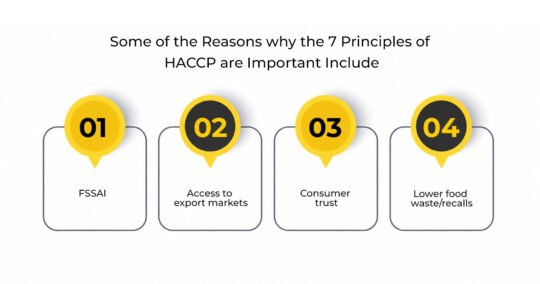
Some of the reasons why the 7 principles of HACCP are important include:
- FSSAI: Under the FSS Act, Schedule 4 makes it mandatory for certain food businesses to put in place food safety management systems based on HACCP principles.
- Access to export markets: Food products being exported to countries such as the USA, EU, and Australia must comply with HACCP certification requirements.
- Consumer trust: Urban consumers in India are more conscious about food safety and trust products that have been certified.
- Lower food waste/recalls: HACCP is a preventive system that avoids costly recalls and product rejection thus improves profits.
- System Scalability: HACCP develops systems that can be scaled up as a business expands.
Implementing the 7 Principles of HACCP into Food Business in India
Learning to implement the 7 principles of HACCP into food business involves a systematic and teamwork-driven process. Below is a step-by-step guide for Indian food producers:
- Step 1: Form a HACCP team: Choose team members who represent production, quality assurance, engineering, and procurement departments. At least one person on the team should be trained in HACCP.
- Step 2: Describe the product and intended use: Provide information about product formula, processing technique, type of packaging, shelf-life, and consumer.
- Step 3: Draw up a flow chart of the process: Outline each step starting from receiving raw materials to delivering products to customers. Confirm the accuracy of the flow chart by verifying it on the premises.
- Step 4: Apply the 7 principles of HACCP: Proceed with all 7 principles of HACCP in sequence: from hazard analysis to record keeping.
- Step 5: Evaluate the HACCP plan: The plan needs to be evaluated prior to its application. Try to get some external evaluation if possible.
- Step 6: Ensure that all relevant employees have been trained: HACCP will only work when all employees know what is expected of them. Train employees on a regular basis.
- Step 7: Update the HACCP plan: The plan should be reviewed at least once a year or if any major changes have occurred.
>Top Trending Guide:- BRC Full Form, Meaning, Certification Process & Cost in India (2026 Guide)
Frequently Asked Questions
What are the 7 principles of HACCP?
The 7 principles of HACCP are: hazard analysis, identifying Critical Control Points (CCPs), setting critical limits, monitoring CCPs, taking corrective actions, verification, and maintaining records and documentation.
How to apply the 7 principles of HACCP in a food factory?
Apply them by conducting hazard analysis, identifying CCPs, setting limits, monitoring operations daily, defining corrective actions, verifying effectiveness, and documenting all processes.
Can you explain the 7 HACCP principles with an example?
In a spice processing unit: hazards include contamination; CCP could be steam sterilization; critical limit may be 110°C for 30 seconds; monitoring is temperature checks; corrective action is reprocessing; verification is record review; documentation ensures traceability.
Is there a practical HACCP implementation guide for manufacturers in India?
Yes, FSSAI provides FSMS guidelines aligned with HACCP principles. These can be integrated with BIS standards and ISO 22000 for comprehensive food safety management.
How to implement HACCP principles with limited resources?
Start with a small HACCP team, focus on high-risk products, and use free FSSAI food safety resources to gradually implement all 7 principles.
Why are the 7 principles of HACCP important for Indian exporters?
They demonstrate compliance with international food safety standards, which is essential for exporting to markets like the EU, US, and Gulf countries.
How often should HACCP principles be reviewed?
HACCP systems should be reviewed at least annually or whenever there are changes in products, processes, suppliers, or regulatory requirements.