
Running a food business in India? You’ve probably encountered the terms GMP and HACCP on many occasions. While both are critical concepts in food safety practices, they play distinct roles within your business and apply at different phases in your journey. Knowing how GMP differs from HACCP is more than just ticking a box on regulatory requirements; it is a prerequisite for setting up a food business with food safety practices that are robust, scalable, and audit-ready.
In this blog, we compare GMP and HACCP and explain their differences in easy-to-understand terms, provide a direct comparison between GMP and HACCP in India, and help you choose which to implement first, along with other recommendations.
What Is GMP: A Quick Overview of GMP vs HACCP Basics
Good Manufacturing Practices (GMPs) refers to the standard guidelines for ensuring that the produced food is safe and quality. Such standards cover aspects such as plant construction, personnel hygiene, equipment maintenance, pest control, water quality, and proper waste disposal. The other aspects that GMP covers include supplier controls and proper storage.
In India, GMP is covered under Schedule 4 in the Food Safety and Standards (Licensing and Registration) Regulations, 2011. In the country, FSSAI makes GMP obligatory for all food operations that need a Central or State licence. Manufacturers, especially, cannot do without the GMP standards.
GMP is basically the starting point of any manufacturing operations. You have to ensure that your operations adhere to the basic quality and hygiene standards even before moving forward with food safety measures. Without the implementation of GMP, it becomes impossible to implement HACCP, which makes up a part of the gmp vs haccp debate.
>Helpful Guide:- GMP Certification in India: Process, Cost, Documents & Who Needs It
What Is HACCP: Understanding the GMP vs HACCP Risk Approach
HACCP is a scientific food safety management system that assesses biological, chemical, and physical hazards throughout your production process and implements controls during critical times when these hazards can be controlled, prevented, reduced, or even eliminated entirely.
HACCP originated when NASA wanted to guarantee safe food in space for its astronauts. The process is widely accepted and forms the core of standards such as ISO 22000, FSSC 22000, and BRC. In India, HACCP systems are encouraged and even required for certain products according to the Food Safety and Standards (Food Safety Management Systems) Regulations.
The 7 principles of HACCP are:
- Conduct a hazard analysis.
- Identify CCPs.
- Establish critical limits.
- Monitor CCPs.
- Establish corrective actions.
- Verify the procedures.
- Maintain records.
Clearly, HACCP takes a far more structured and analytical approach to food safety management than GMP, which is an essential difference that any business doing a gmp haccp comparison in India needs to understand.
GMP vs HACCP: A Direct Comparison for Food Businesses in India
The following is a side-by-side comparison to aid your understanding on how GMP differs from HACCP:
| Feature | GMP | HACCP |
|---|---|---|
| Focus | General hygiene & facility standards | Specific food safety hazards |
| Approach | Preventive / Operational | Risk-based / Analytical |
| Documentation | Basic (SOPs, cleaning logs) | Detailed (HACCP plan, CCPs) |
| Mandatory in India | Yes (FSSAI requirement) | Yes (for most categories) |
| Implementation Order | First | Second (built on GMP) |
| Suitable For | All food businesses | Mid to large-scale manufacturers |
| Cost of Implementation | Low to Moderate | Moderate to High |
The following is one of the most important aspects of the gmp vs haccp for food manufacturers india comparison: GMP creates the right environment, whereas HACCP controls the right process. The two do not compete; rather, they complement each other.
The Difference Between GMP and HACCP
Scope and Coverage in GMP vs HACCP
Whereas GMP is very wide-ranging and touches upon all aspects of operations in the facility, from hand-washing practices among workers to the storage of raw materials, HACCP, by contrast, is much more focused on processes. It identifies key stages within production procedures when there may be potential food safety threats.
Documentation Requirements in GMP vs HACCP
GMP documentation is done on SOPs, cleaning and sanitization schedules, pest management logs, and training logs. On the other hand, HACCP documentation involves more thorough steps; it is made up of a HACCP plan, hazard analyses, CCP records, corrective actions, and verification reports. This is perhaps one of the best examples of differences between GMP and HACCP that is useful for operations purposes.
Regulatory Standing in India: GMP vs HACCP
With respect to FSSAI guidelines, GMP compliance (Schedule 4) is a must for those who have received a license to produce food items. The HACCP system for food safety management should be in place for companies engaged in processing of dairy products, meat and poultry, packaged drinking water, and other export-oriented establishments. For the rest of the enterprises, HACCP certification (ISO 22000 or FSSC 22000) is highly advisable.
GMP vs HACCP: Which Comes First for Your Food Business
The answer is unequivocal – GMP is first, always.
It’s important to remember that HACCP relies heavily on prerequisite programs – and GMP is arguably the most crucial of these. Without an efficient and sanitary environment to work within, HACCP becomes meaningless. You can have all the critical control points you want in your production process, but if you don’t have proper pest management, hygiene, equipment sanitation, etc., then your product may be contaminated regardless.
In simple terms of gmp vs haccp, think of it like this: GMP constructs the building, and HACCP locks the doors. You cannot lock a building that hasn’t been constructed.
For new businesses or those obtaining an FSSAI license, the suggested process should be:
- Step 1: Set up your GMP protocols (facility, hygiene, equipment, personnel, pest control, traceability).
- Step 2: Conduct an internal audit of your GMP systems and correct deficiencies.
- Step 3: Initiate your HACCP process – conduct a hazard analysis through your production process.
- Step 4: Determine your CCPs, critical limits, and monitoring protocols.
- Step 5: Train staff members, implement HACCP, and integrate into GMP protocols.
Can You Have GMP and HACCP Together
The answer is not only a ‘yes’ but is highly advised and frequently mandatory.
GMP and HACCP were meant to complement each other as part of a food safety system that uses layers. By implementing both of them, you can:
- Have a good hygiene control program (your GMP), thereby reducing the risks of contamination and, hence, the number of CCPs you need to control within your HACCP plan.
- Have a dependable foundation for your HACCP plan. Any violation at a CCP will mean a serious process problem since you can be sure that you will not run into it due to your insufficient GMP.
- Make auditors, regulators, and buyers of your products see the implementation of an entire system of food safety management in place rather than two separate sets of checks.
- Have your staff follow an interlinked set of protocols. Your GMP SOP will help you monitor your HACCP and vice versa.
For companies seeking certification for their food products under such systems as ISO 22000 or FSSC 22000, both your GMP (also known as ‘prerequisite programs’) and HACCP plan must be implemented in your company.
>Helpful Guide:- HACCP Certification Cost in India: Complete Fee Breakdown 2026
GMP vs HACCP: Practical Guidance for Indian Food Manufacturers
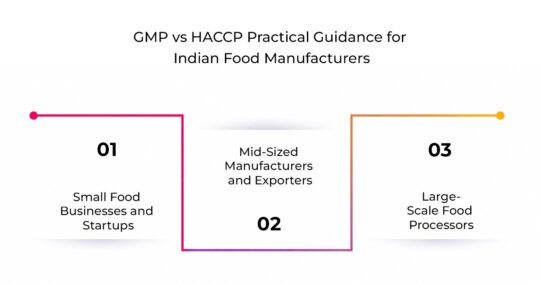
This is how to go about gmp vs haccp for food manufacturers india depending on where your company stands:
Small Food Businesses and Startups
Pay attention to GMP initially. Get your FSSAI certificate, meet the standards of Schedule 4, and prepare your SOP. Perhaps you don’t need an HACCP program at the moment, but you definitely should document your hazard control knowledge for further use.
Mid-Sized Manufacturers and Exporters
Probably, you require both. Your FSSAI conformity, requirements of the buyer, and export destination food safety management will necessitate a food safety system based on HACCP principles. Begin with assessing gaps in GMP, and afterwards, perform research to develop a HACCP program.
Large-Scale Food Processors
For large companies, the typical solution is to develop a Food Safety Management System combining all components mentioned above. The gmp vs haccp issue at this level is not about selecting GMP or HACCP, but about creating the FSMS with their integration in the Quality Management System.
Common Mistakes in GMP vs HACCP Implementation in India
- Skipping GMP and moving directly into HACCP: You need good GMP practices for your HACCP program. Sort out the pre-requisites first.
- Seeing GMP as just an audit tool: GMP needs continuous training, monitoring, and record keeping. GMP cannot be taken lightly as a once-in-a-life audit tool.
- Doing HACCP in paper only: This can be dangerous. Many Indian companies have their HACCP plans ready which are not reflective of the actual production happening at their factories.
- Not training employees on both systems: Your employees are your greatest asset. Training on GMP and HACCP is very important to protect food safety.
- Not doing regular reviews: Any change in the process, products, or even regulations requires review of both systems.
Key Takeaways
- The standards of Good Manufacturing Practices provide the base for hygiene practices that all food organizations need to follow.
- The system of HACCP or Hazard Analysis Critical Control Point analysis is a scientifically established system that ensures control over food hazards.
- For India, both GMP and HACCP standards related to food safety are mandatory according to FSSAI laws, but it depends on the size and type of your business.
- Always remember that GMP comes before HACCP as HACCP is an extension of GMP standards.
- Thus, you will get a complete food safety system when GMP and HACCP are implemented together.
>Read Also:- BRC Full Form: All 3 Meanings Explained – Food, Export and Education (2026 Guide)
Frequently Asked Questions
What is the difference between GMP and HACCP?
GMP provides basic requirements related to hygiene, facilities, and operations, while HACCP is a risk-based system that identifies and controls food safety hazards. GMP acts as the foundation, and HACCP builds on it as an analytical approach.
Which comes first GMP or HACCP?
GMP comes first. HACCP is built on GMP as a prerequisite program, meaning effective GMP implementation is required before applying HACCP.
Do you need both GMP and HACCP?
Yes, in most cases both are required. GMP is mandatory under FSSAI regulations, while HACCP is strongly recommended or required for advanced food safety systems and exports.
GMP vs HACCP: which is better for food business in India?
Both are essential and complementary. GMP ensures hygiene and operational standards, while HACCP focuses on controlling food safety hazards. Together, they create a complete food safety system.
Can you have GMP and HACCP together?
Yes, they are designed to work together. Most food safety standards, including ISO 22000, integrate both GMP and HACCP into a unified system.
What does GMP vs HACCP for food manufacturers in India involve?
It involves complying with FSSAI Schedule 4 guidelines (GMP) and implementing a HACCP plan as part of a Food Safety Management System for regulated food businesses.
How are GMP and HACCP different from ISO 22000?
GMP and HACCP are foundational practices, while ISO 22000 is a certification standard that integrates both into a comprehensive Food Safety Management System.