
In today’s world where global trade is becoming more complicated, securing the supply chain has become one of the most important considerations for exporters across the globe. When it comes to Indian companies seeking growth opportunities in the American market, knowing C-TPAT certification India is not just an advantage but a must-have strategy. The Customs-Trade Partnership Against Terrorism (C-TPAT) is a CBP’s voluntary program that enhances international supply chains and secures the borders.
Our guide on C-TPAT certification India takes you through all the details you need to know regarding the application procedure, audit requirements, costs involved, and its competitive benefits.
What is C-TPAT Certification India
C-TPAT is an acronym that means Customs-Trade Partnership Against Terrorism. It is a private-public initiative programme introduced by the U.S. CBP in 2001 in reaction to the 9/11 terror attacks. The programme seeks to improve the security level of the supply chain in private companies against the risks of terrorism and smuggling.
When talking about C-TPAT certification India, we mean the Indian participants in the programme who have opted to take part in C-TPAT. They are mainly Indian manufacturers, exporters and logistics service providers, and through this programme, they show American importers that their operations comply with internationally accepted standards of security.
The programme consists of various industries like importers, carriers, consolidators, licensed custom brokers and foreign manufacturers among others. Among Indian firms focusing on exports, it is the foreign manufacturer category.
Why C-TPAT Certification India Matters for Indian Exporters
India is among the leading exporters worldwide with the US as its largest trading partner. For Indian companies exporting in various industries including garments, drugs, engineering products, IT hardware, etc., obtaining C-TPAT certification India would provide them with an important advantage.
CBP has been pressuring US importers to secure their shipments for several years now. Therefore, US importers prefer to deal with international suppliers who possess certification that meets the CBP’s standards. Otherwise, Indian exporters may expect increased scrutiny, port delays, and reduced credibility before the buyers.
Besides the US, having C-TPAT certification India demonstrates professionalism and readiness for international compliance – and this is important when dealing with buyers in Europe, Middle East, and Australia.
Eligibility Criteria for C-TPAT Certification India
Not all organizations are automatically eligible for C-TPAT certification India. There are certain requirements set forth by CBP, which the applicant must satisfy before being eligible to apply for C-TPAT certification India:
- Must be an organization that is registered with the government in India as a business entity.
- It must have ongoing dealings with a C-TPAT certified importer from the United States.
- There must be sufficient evidence available to prove their compliance with US customs regulations.
- There should not be any customs violations or pending penalties against the organization.
These are the requirements before applying for C-TPAT certification India.
C-TPAT Certification Process India: Step-by-Step
An insight into the C-TPAT certification process in India is essential before a company begins its application process. The application procedure involves steps that can be completed only after proper preparation on the part of the Indian organization. They include the following:
Step 1: Pre-Assessment and Gap Analysis
Companies must perform an internal gap analysis before submitting an application for C-TPAT certification in India. This involves analyzing whether your security measures meet the requirements of the Minimum Security Criteria (MSC).
Step 2: Online Application via the C-TPAT Portal
The official application is done online through the Customs and Border Protection’s (CBP) C-TPAT portal. Applicants create a profile and submit their Security Profile outlining their current security measures under various MSC categories.
Step 3: Security Profile Review by CBP
When the Security Profile has been submitted, CBP’s C-TPAT experts examine the document to determine whether the reported security procedures satisfy the minimum requirements. If weaknesses are identified, CBP will require further explanation and supporting documents.
Step 4: Conditional Approval and Validation
Following the acceptance of the Security Profile, conditional approval is awarded to the applicant. Subsequently, CBP organizes a site inspection at the Indian company’s facility. As part of the C-TPAT audit India, a CBP supply chain expert, along with a local CBP official, conducts the inspection to confirm that the reported security procedures are indeed in place and operational.
Step 5: Full Certification
Following a successful C-TPAT audit India, CBP certifies the company as compliant with C-TPAT standards. Certification is valid for as long as the organization sustains its security practices and updates them regularly.
What Does the C-TPAT Audit India Involve
The C-TPAT audit India forms an essential part of the entire certification process. Most Indian exporters tend to be unaware about the extent of the examination during C-TPAT audit India.
The various points of concern for CBP validators in the C-TPAT audit India include:
- Physical Security – Fencing, access controls, security camera system, lighting and container examination procedures.
- Personnel Security – Checking backgrounds of employees and visitors and training programs for personnel.
- Information Technology Security – IT systems security, password control, access tracking and cybersecurity measures.
- Conveyance & Container Security – Procedures for seal verification, checking container security and documentation.
- Procedural Security – Document control, accurate manifests and audit trails.
It would be wise to perform a mock C-TPAT audit India prior to the CBP audit. Many consulting companies in India provide such services.
C-TPAT Certification Cost and Benefits India
One of the most frequently asked questions by Indian companies concerns the cost and benefits of C-TPAT certification India. The CBP does not charge an application fee for this program; it is voluntary and free of charge. Nevertheless, there are many expenses involved in becoming C-TPAT certified:
-
Consulting and Documentation Costs
A majority of Indian companies usually prefer engaging consultants specialized in providing C-TPAT consultancy services who will assist them in preparing a Security Profile, conducting gap analyses and help them go through the process of how to get C-TPAT certification India. The cost of consultancy in India will be within a range between INR 1.5 lakhs to INR 5 lakhs depending on the level of services required.
-
Infrastructure and Security Upgrades
In order to be in compliance with the Minimum Security Criteria set by CBP, many Indian enterprises may have to spend some money to improve their infrastructure and increase the security of the enterprise. The expenses here may vary between INR 5 lakhs and INR 25 lakhs or even more.
-
Training and Internal Compliance Costs
Employee training, documentation procedures, and compliance management procedures will cost you additional expenses. Annual recurring expenses related to compliance will be considered as well.
Benefits of C-TPAT Certification India
Benefits for exporters of C-TPAT benefits India far exceed its costs provided that these exporters are committed to doing business in the United States. Main advantages of being a C-TPAT benefits India company are as follows:
- Fewer CBP Inspections: Companies that are C-TPAT compliant will undergo far fewer cargo checks by the Customs and Border Protection.
- Cargo Released Sooner: Expedited processing at CBP lines will ensure faster deliveries and happier customers.
- Relationships With Buyers: Many buyers in the U.S. demand that their Indian suppliers be certified under C-TPAT.
- Advantage Over Competitors: It shows that the company operates at a very high level of professionalism.
- Access To C-TPAT Community: Certification provides access to a special CBP members’ portal.
How to Get C-TPAT Certification in India: Practical Tips
In case your company wants to know how to obtain C-TPAT certification in India, there is no other option but to prepare well. Below are some guidelines for you:
- Conduct an internal security audit based on the CBP’s publication titled Minimum Security Criteria, which is publicly available on their website.
- Consult a qualified C-TPAT advisor accredited by CBP who knows India’s regulations and the requirements of CBP as well.
- Your U.S. importer must be supportive because CBP considers the buyer-seller partnership when evaluating the application.
- Be detailed. In terms of Security Profile, the more details, the better for CBP’s initial evaluation.
- Train your staff on security protocols, creating a culture of safety in your organization.
C-TPAT Certification Process for Indian Exporters: Common Challenges
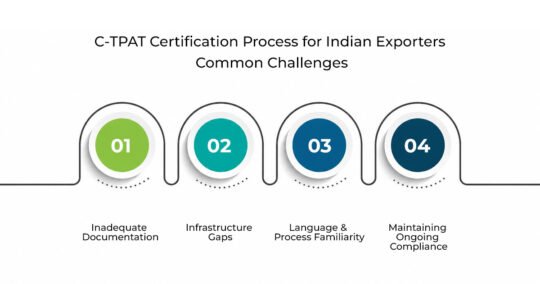
There are several challenges associated with the C-TPAT certification process for Indian companies, which should be considered in advance:
Inadequate Documentation
The biggest problem that most Indian companies have concerns the volume of required documentation. The CBP requires well-structured and documented policies and procedures in regard to all aspects of physical security, as verbal agreements or other types of informal approach would not suffice.
Infrastructure Gaps
It is important to note that many older manufacturing plants in India do not have the necessary physical security infrastructure. Therefore, bringing such facilities into line with CBP requirements can take quite some time and money.
Language and Process Familiarity
It should be admitted that there is always the challenge of understanding the language of CBP and the requirements associated with C-TPAT. Here local consulting services come into play.
Maintaining Ongoing Compliance
C-TPAT certification is not something that you can achieve once and for all. On the contrary, CBP conducts periodic re-validation of certified companies, while the security environment changes over time.
How Long Does C-TPAT Certification Take for Indian Companies
Another common query is the duration of time required to attain C-TPAT certification. It depends upon where the company begins the journey. A reasonable timeframe for Indian companies seeking certification would be 6 to 12 months from the time of assessment to certification completion.
The submission and CBP evaluation of the security profile will take 2 to 4 months. The scheduling of the onsite validation visit – known as C-TPAT audit India – will extend this period by another 2 to 6 months based on CBP availability and geographical location of the applicant firm.
Key Takeaways
- The C-TPAT program is a voluntary scheme of the U.S. CBP that recognizes foreign exporters and manufacturers as secure in their supply chains.
- Indian companies that obtain a C-TPAT certification in India enjoy fewer U.S. customs examinations, faster clearance of goods, and better business connections.
- The C-TPAT certification procedure in India comprises an application, a security profile submission, and a site visit by the CBP.
- Although participation in the C-TPAT program is voluntary, major U.S. importers usually require or prefer their Indian trading partners to get certified.
- Fees required for C-TPAT certification in India depend on consultants’ charges, security improvements, and compliance preparations.
Frequently Asked Questions
What is C-TPAT certification in India?
C-TPAT certification in India refers to voluntary participation in the Customs-Trade Partnership Against Terrorism program. It ensures that an exporter’s supply chain security meets international standards defined by US Customs and Border Protection (CBP).
Is C-TPAT certification mandatory for export to the USA?
No, C-TPAT certification is not legally mandatory for exporting to the USA. However, many large US importers prefer or require their suppliers to be C-TPAT compliant.
How long does C-TPAT certification take?
The certification process typically takes 6 months to 1 year, depending on the company’s preparedness and the time required for CBP review and validation.
How to get C-TPAT certification in India?
To obtain C-TPAT certification, a company must submit a Security Profile through the CBP portal, undergo review, receive conditional approval, and pass a physical validation audit. Many businesses engage consultants to streamline the process.
What is the C-TPAT certification process for Indian exporters?
The process includes gap analysis, preparing and submitting a Security Profile, CBP review, conditional approval, on-site validation audit, and final certification.
What are the C-TPAT certification cost and benefits in India?
There is no official application fee. However, costs may include consultant fees (₹1.5–5 lakhs), security upgrades (₹5–25 lakhs), and operational improvements. Benefits include faster customs clearance, reduced inspections, and improved global credibility.
What is the C-TPAT audit process in India like?
The audit involves an on-site validation by CBP officials to verify that the company has effectively implemented the security measures described in its submitted Security Profile.