
When it comes to international trade, there are few things as important as supply chain security and customs compliance. There are two major programs that play a crucial role when discussing the issue of trusted traders, and these are: C-TPAT or Customs-Trade Partnership Against Terrorism and AEO or Authorised Economic Operator. Being familiar with the differences between C-TPAT and AEO is crucial for Indian exporters trying to operate in the international market place.
Knowing the difference between C-TPAT and AEO will allow you to save a lot of money, time, and energy when trying to build long-term business relationships with other nations.
C-TPAT vs AEO: Understanding the Basics
What Is C-TPAT
C-TPAT stands for the Customs-Trade Partnership Against Terrorism and is a voluntary program established by US Customs and Border Protection after the terrorist attack in September 2001. This program aims at enhancing security in international supply chains as well as strengthening border security in the US. Under the C-TPAT program, participants must be willing to collaborate with the CBP in protecting the security of the supply chain.
The program requires eligible organizations to undertake security measures aimed at safeguarding the supply chain. These organizations include US importers, carriers, consolidators, licensed customs brokers, and foreign manufacturers. In India, participation in the program usually results from requests by US importers to their Indian suppliers to participate in the program.
What Is AEO
The AEO, which stands for Authorised Economic Operator, is a certification system that is internationally recognized and was developed by the World Customs Organization (WCO). Businesses certified as AEOs are regarded as reliable and law-abiding partners by the customs authorities, ensuring fewer checks and easier and quicker clearance and international trade processes.
India’s AEO programme is run by the CBIC, which stands for the Central Board of Indirect Taxes and Customs. Indian companies can become AEO-T1, AEO-T2, or AEO-T3 operators, each providing different levels of benefits. The AEO programme of India is structured on international guidelines of the WCO, and there are MRAs with many countries.
C-TPAT vs AEO: A Detailed Comparison
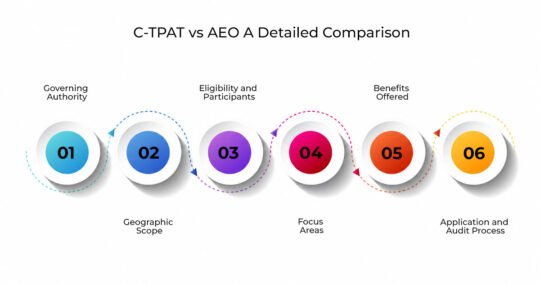
Understanding the C-TPAT AEO comparison india context means looking at both programs side by side. Here is a structured breakdown of the key differences:
- Governing Authority
It must be noted that C-TPAT regulations are regulated only by the US Customs and Border Protection (USCBP), a federal government agency of the United States Department of Homeland Security. In comparison, AEO regulations are based on WCO guidelines and are implemented at a national level, such as CBIC (Central Board of Indirect Taxes and Customs) in India. The importance of such information lies in the fact that C-TPAT is focused on the USA, while AEO can be implemented anywhere globally.
- Geographic Scope
One of the most important criteria in making a choice between AEO and C-TPAT is geography. Namely, C-TPAT will be relevant for exports to the USA only, while AEO can be used across several countries and regions, in particular, if the countries are WCO members and have an MRA with other countries.
- Eligibility and Participants
For the C-TPAT program, there are specific participants from the field of international business like US importers, carriers, freight forwarders, customs brokers, and foreign manufacturers. In terms of Indian exporters, they will participate in C-TPAT under the category of foreign manufacturers when asked by their US clients. On the other hand, the AEO program for India allows participation from importers, exporters, transporters, custodians of cargo, customs brokers, and warehouses.
- Focus Areas
The differences between C-TPAT and AEO certification India also become clear with respect to their areas of key focus. For example, C-TPAT is a security-based program that checks physical security, personnel security, procedural security, and even cyber-security within the supply chain network. However, AEO is not only limited to security issues but focuses on many other aspects including customs compliance history, financial stability, proper documentation procedures, safety, and security measures.
- Benefits Offered
The benefits offered by both systems are substantial, but there is a difference between what is being offered. The C-TPAT program provides its participants with lessened inspection of their shipments, expedited customs clearance, FAST lane eligibility, and even a dedicated supply chain security expert. The AEO certified exporters from India enjoy such benefits as decreased rates of inspection by customs officers, priority treatment, permission for self-sealing, direct delivery and clearance, and waiver of some of the procedures.
- Application and Audit Process
The C-TPAT program obliges applicants to provide a document outlining the security aspects of the supply chain and to allow the verification of this information by the officers of CBP. This procedure may be quite difficult for a foreign manufacturer to complete. An application to become an AEO is submitted online through the CBIC portal and the application is then reviewed and audited.
C-TPAT vs AEO: Which Is More Relevant for Indian Exporters
However, for many Indian exporters, the immediate response would be determined by what market they are exporting to. In case, the major exporting destination is the US, then it would be essential to adhere to C-TPAT guidelines, irrespective of certification. The reason being that most US importers expect their suppliers from India to follow C-TPAT guidelines during procurement or supplier onboarding.
In contrast, for Indian exporters who want to establish themselves as compliant across multiple international markets, it would pay them better to get AEO certification. This is because, with India now having MRAs with many countries, Indian AEOs are entitled to mutual recognition in the relevant market.
The best approach for a high volume exporter who deals in both domestic and US markets is to obtain AEO certification at home while following C-TPAT security protocols for exports going out of the country.
>Read Also:- C-TPAT Audit Checklist 2025: Step-by-Step Guide for Certification
C-TPAT vs AEO: Common Misconceptions
Is AEO the same as C-TPAT
The answer to this is simply no. Both the programs seek to establish trusted traders and simplify procedures related to customs clearance but differ in many aspects such as governing body, jurisdiction, eligibility, coverage, and benefits. AEO is an international program established by the WCO while C-TPAT is a US program that incorporates stringent counterterrorism objectives. However, both programs have several similarities in terms of securing the supply chain.
Do Indian Exporters Need Both
This may not always be the case. A manufacturer in India who sells products only in Europe will definitely consider AEO as an option. On the other hand, if he exports only to the United States, then C-TPAT becomes a more appropriate choice for him. But there will be cases where exporters have diversified into other regions, which can be helped greatly by both certifications.
C-TPAT vs AEO: Steps for Indian Exporters to Get Started
Should you be an Indian exporter contemplating either or both these certifications, the following would be my recommendation:
- Start by analyzing your major export markets: If your target markets are primarily the US, then you should begin your assessment with C-TPAT security requirements and a gap analysis of your supply chain. Otherwise, your best start is to obtain the AEO certification from the CBIC.
- Analyze your compliance records: An AEO certification necessitates a good customs compliance track record, which means that your import-export documentation, duties, and other regulations must be in place.
- Consult a trade compliance expert: Since obtaining the above certifications involve rigorous documentation and procedures, it is important to work with an expert who will assist you in the process.
- Apply for AEO online at the CBIC website: As a first step towards obtaining your AEO certification, you may want to apply for AEO-T1. The online portal will allow you to track your progress.
- Work with your suppliers and partners: Both C-TPAT and AEO certifications require that your supply chain be aligned to these standards.
C-TPAT vs AEO: The Future of Trusted Trader Programs in India
There have been rapid developments on India’s side in its trade aspirations, and much effort is being put into infrastructure creation for trade facilitation purposes. The scope of the AEO initiative has steadily increased, and India has entered MRAs with other leading trading partners. In order to realize India’s goal of becoming a USD 2 trillion export economy, trusted trader programs will be key players.
Regarding AEO vs C-TPAT for exporters, it is evident that in the future, the two programs are likely to converge. The WCO is seeking harmony of the various trusted trader programs globally. There has been much collaboration between the C-TPAT and the AEO-certified bodies in their respective countries. That makes investment in AEO today equivalent to investment in C-TPAT in future US trade.
For Indian exporters who seek to join the trusted trader club either way, developing a culture of compliance will be important. Developing good practices in record-keeping, security, and financial management is what will help your business grow internationally through both programs.
C-TPAT vs AEO: Key Takeaways
- C-TPAT is a security-based program of the United States Customs and Border Protection (CBP), while AEO is a globally accepted standard under WCO for being a trusted trader.
- C-TPAT certification would be more beneficial for Indian exporters whose destination market is the US, whereas AEO certification would prove beneficial for Indian exporters who export goods to the EU or other member countries of WCO.
- AEO (India) is administered by CBIC and provides quicker customs clearance and fewer checks to Indian exporters.
- Both programs are not contradictory, and a company can apply for both programs based on its volume of trade.
- While C-TPAT emphasizes security measures, AEO covers a wide range of issues, such as compliance, financial stability, and safety measures.
Frequently Asked Questions
What is the difference between C-TPAT and AEO?
C-TPAT is a US-based security program regulated by CBP and focused on anti-terrorism measures. AEO is a global trusted trader program based on WCO guidelines and regulated nationally, such as by CBIC in India, covering compliance, security, and financial sustainability.
Is AEO same as C-TPAT?
AEO and C-TPAT offer similar trusted trader benefits but differ in scope. AEO covers broader compliance requirements, whereas C-TPAT specifically focuses on supply chain security for trade with the United States.
Which is better: C-TPAT or AEO for Indian exporters?
The better option depends on export destinations. C-TPAT is important for exporters supplying to the United States, while AEO is more suitable for exporters trading across multiple international markets.
C-TPAT vs AEO: which is better for Indian exporters with multiple markets?
For exporters targeting both US and international markets, combining C-TPAT security practices with AEO certification is often the best strategy because the programs complement each other.
What is the difference between C-TPAT and AEO certification in India in terms of application?
AEO certification in India is processed through the CBIC portal and assessed by Indian customs authorities. C-TPAT participation is managed through US CBP systems and usually initiated based on US buyer requirements.
Do Indian exporters need C-TPAT or AEO to export to the US?
Indian exporters are not legally required to obtain C-TPAT or AEO certification to export to the United States. However, many US buyers prefer suppliers with trusted trader or supply chain security compliance programs.
In the C-TPAT vs AEO comparison in India, which program offers faster customs clearance?
AEO certification offers faster customs clearance benefits within India through Indian customs authorities, while C-TPAT advantages mainly apply to cargo movement and inspections at US customs checkpoints.