

As a person working in any part of the food manufacturing industry in India, chances are high that you must be familiar with the concept known as HACCP. The abbreviation for Hazard Analysis Critical Control Points, HACCP is a globally accepted food safety standard that ensures the delivery of safe food products by businesses. Considering that there are thousands of food production facilities of varying sizes in India, having a HACCP certification is important for any company trying to grow and expand.
In this guide, we will discuss everything from what is HACCP Certification to how you can attain a HACCP certification, the hazard analysis critical control points, and other relevant information.
What Is HACCP Certification and Why Is It Important
HACCP certification is the official acknowledgement that the establishment has established a food safety management system based on HACCP and that the system has been implemented and maintained. The certification comes from a third party body which is accredited to certify HACCP systems.
So, why HACCP certification and why should we care? It is important because problems related to food safety can be catastrophic for all concerned. This could involve everything from outbreaks of illnesses, products being recalled from consumers’ possession, financial costs and legal ramifications of the problems. HACCP certification means having a system in place which prevents the problems occurring rather than having procedures in place for handling the problem once it has occurred.
HACCP certification shows that you take your food safety seriously; it is not just good practice but something that must be demonstrated.
What Does HACCP Stand For in Food Safety
What does the term HACCP mean in food safety? The full meaning of HACCP is Hazard Analysis and Critical Control Points. Here is what each letter means:
- Hazard Analysis is the comprehensive process of identifying all possible hazards that may pose any danger to the safety of the food product, which may be either biological, chemical, or physical.
- Critical Control Points are the particular processes in the food production line where hazard controls can be implemented to either prevent, minimize, or remove the hazards from the food product. This includes the temperature during cooking, chilling times, and pH balance.
Thus, HACCP stands for the basic framework of HACCP food safety – a scientific approach to monitoring the safety hazards at all stages of the food production line. The idea behind HACCP was initially introduced in the early 1960s by NASA’s space food program.
What Is the HACCP System Explained: The 7 Principles
For a clear understanding of what is HACCP certification, one must understand the HACCP concept through the seven fundamental principles of HACCP. These principles provide the foundation for the creation of any HACCP program:
- Conduct a Hazard Analysis
Conduct an assessment of all hazards that may arise in every stage of the food processing operation, from raw material to finished product.
- Identify Critical Control Points (CCPs)
Identify the stages in the process that are essential to control the hazards. The decision tree method is usually applied to determine if the step can be considered a critical control point.
- Establish Critical Limits
Specify the critical values at which each critical control point operates, such as a minimum temperature of 75°C for poultry products.
- Establish Monitoring Procedures
Establish a way to monitor each critical control point regularly to meet critical limits.
- Establish Corrective Actions
Determine how you are going to deal with situations when the monitoring process shows that the Critical Control Point is no longer within control, e.g., throwing away an improperly cooked batch of food.
- Establish Verification Procedures
Ensure that your HACCP plan is effective by means of conducting internal audits, performing more tests, and checking monitoring records.
- Establish Record-Keeping and Documentation
Keep all records pertaining to all stages of the HACCP system implementation process. These documents are necessary for passing a certification audit.
>Helpful Guide:- HACCP Certification Cost in India: Complete Fee Breakdown 2026
What Does HACCP Certification Mean for a Business
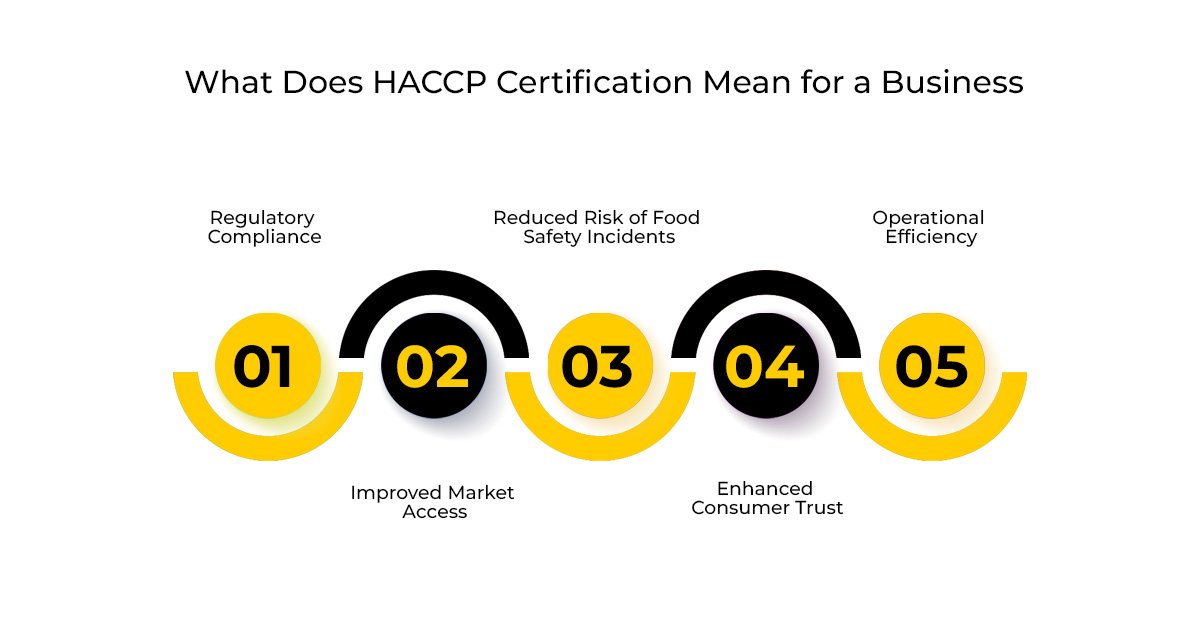
The implications are widespread and affect all aspects of the business operation.
Regulatory Compliance
In several countries, including most in the EU and UK, food safety management using HACCP systems is mandatory for all food businesses. HACCP certification will ensure that you are in compliance with relevant requirements and ready to pass any inspection by the relevant authorities.
Improved Market Access
Large-scale retailers, grocery stores, and restaurants have strict supplier policies in place that mandate the certification of their suppliers according to the HACCP guidelines. Consequently, certification may serve as the key factor to establish new business opportunities.
Reduced Risk of Food Safety Incidents
With the implementation of the HACCP model, firms may effectively anticipate possible risks and ensure timely intervention before any contamination takes place, as well as prevent expensive product recalls and potential public relations scandals.
Enhanced Consumer Trust
At present, consumers’ awareness concerning food safety matters is at a historically high level. As such, certification represents tangible evidence for clients to trust businesses and appreciate their commitment to following HACCP food safety principles.
Operational Efficiency
The necessity of establishing a HACCP management system encourages organizations to improve their overall performance through enhanced employee training, efficient work procedures, improved product quality, and waste reduction.
>HelpFul Guide:- HACCP Certification in India: Meaning, Process, Cost & Who Needs It
What Is the Purpose of HACCP Certification in the Food Industry
Firstly, it can be seen that HACCP serves primarily as a preventative measure. Unlike other methods that rely solely on solving issues once they have emerged, the HACCP system aims to ensure that hazards do not get through to consumers at all.
Moreover, the role of HACCP in the food industry can also be explained by the nature of the concept itself. Being an umbrella term, HACCP offers a consistent approach to food safety regardless of whether we are talking about production, manufacturing, packaging, transportation, or retail sectors.
Finally, it should be noted that HACCP certification helps to communicate important information regarding food safety practices in the company. By demonstrating the ability to obtain independent verification, one can ensure that food safety is a priority for their firm.
What Is the Difference Between HACCP and Food Safety
One area where many people often confuse themselves is how HACCP and food safety differ from each other. Food safety is the general term referring to all aspects involved in ensuring that food is safe to be eaten by humans. These may range from hygiene rules, allergens control, labeling, storage and so forth.
HACCP, in its turn, is a particular approach used to ensure food safety. In other words, it is one of the ways in which food safety can be ensured. HACCP involves systematic identification and controlling hazards occurring at particular stages of food production. In this way, HACCP should be regarded as a particular method through which food safety is achieved.
Thus, one may compare food safety and HACCP to destination and a vehicle taken to reach it accordingly.
Who Needs What Is HACCP Certification
The HACCP certificate is applicable to many organizations such as:
- Food producers and processors
- Companies providing catered services
- Importers and exporters of foods
- Retail grocery stores
- Companies dealing with cold storage and logistics of foods
- School cafeterias and institutions providing food service
In certain jurisdictions and industries, a HACCP certificate is a necessary legal requirement. On other occasions, a HACCP certificate may be optional but highly recommended. In all cases, regardless of whether HACCP is a legal requirement or not, HACCP is regarded as best practices for any organization handling foods.
>Read Also : – BRC vs HACCP: Difference Between BRCGS and HACCP and Which One Your Food Business Needs (2026)
How to Achieve What Is HACCP Certification: The Process
The HACCP certification process usually follows these steps:
- HACCP Team Formation: The HACCP certification process should be led by an inter-disciplinary team comprising experts from food science, production, quality assurance, and hygiene.
- Product Description and Process Description: The entire product range, ingredient list, process description, and distribution process should be detailed.
- Performing Hazard Analysis: All the hazards linked to each processing stage should be identified.
- CCP Identification and Control: The HACCP principles should be used to establish critical limits, monitoring practices, and corrective measures.
- Implementation of HACCP: The HACCP should be implemented within the organization.
- Internal Audit: An internal audit should be conducted to ascertain that everything is in order before allowing third-party auditors to visit.
- Third-Party Auditing and Certification: An independent certification agency will conduct the third-party audit. Certification will be granted if the HACCP system is found to meet the requirements.
Key Takeaways
- It involves an internationally recognized science-based system which analyzes and controls the risks of biological, chemical, and physical hazards.
- HACCP certification implies that the organization is following a systematic, preventive approach towards food safety; it implies much more than inspection.
- The HACCP system is based upon seven main principles starting from hazard identification and ending at verification.
- Every business engaged in the production, processing, handling, and distribution of food products can benefit from or be obliged to obtain HACCP certification.
- Obtaining HACCP certification will not only allow a company to comply with regulations but will also help to establish trust with consumers and expand into other markets.
Frequently Asked Questions
What is HACCP certification and why is it important for my food business?
HACCP certification is an official recognition that a food business has implemented a food safety management system based on internationally accepted HACCP principles. It is important because it helps prevent food safety risks, improves legal compliance, and increases customer confidence.
What does HACCP stand for in food safety?
HACCP stands for Hazard Analysis and Critical Control Points. It is a scientific and systematic approach used to identify, evaluate, and control food safety hazards during food production and processing.
What does HACCP certification mean for a business looking to expand into new markets?
HACCP certification helps businesses enter new domestic and international markets because many retailers, distributors, and export buyers require HACCP compliance as part of their supplier approval process.
What is the purpose of HACCP certification beyond regulatory compliance?
Beyond legal compliance, HACCP certification helps improve operational efficiency, reduce food wastage, strengthen supplier relationships, and establish a strong food safety culture within the business.
What is the purpose of HACCP in the food industry for small businesses?
HACCP helps small food businesses establish a structured food safety system that reduces the risk of contamination, product recalls, customer complaints, and financial losses.
What is the difference between HACCP and food safety management more broadly?
Food safety management is the overall system used to ensure safe food production, while HACCP is a specific methodology within that system focused on identifying hazards and controlling critical points in the process.
How long does HACCP certification last, and does it need to be renewed?
HACCP certification is generally valid for one to three years depending on the certification body. Annual surveillance audits are usually required, followed by a re-certification audit at the end of the certification cycle.