Your new US/European buyer sends over your onboarding package, and one of the lines says “Sedex or WRAP.” No further clarification. No indication whatsoever of what they really want.
This is why the topic of Sedex versus WRAP Certification comes up time and again for garment manufacturers in Tiruppur, Noida, Ludhiana and Bengaluru. They are both popular apparel social compliance schemes that are worlds apart in their approach, and getting it wrong will cost you precious months and a round of audit expenses.
This comparison of Sedex and WRAP by Legal4sure will help you choose the right one before you engage an auditor.
What Is the Difference Between Sedex and WRAP Certification?
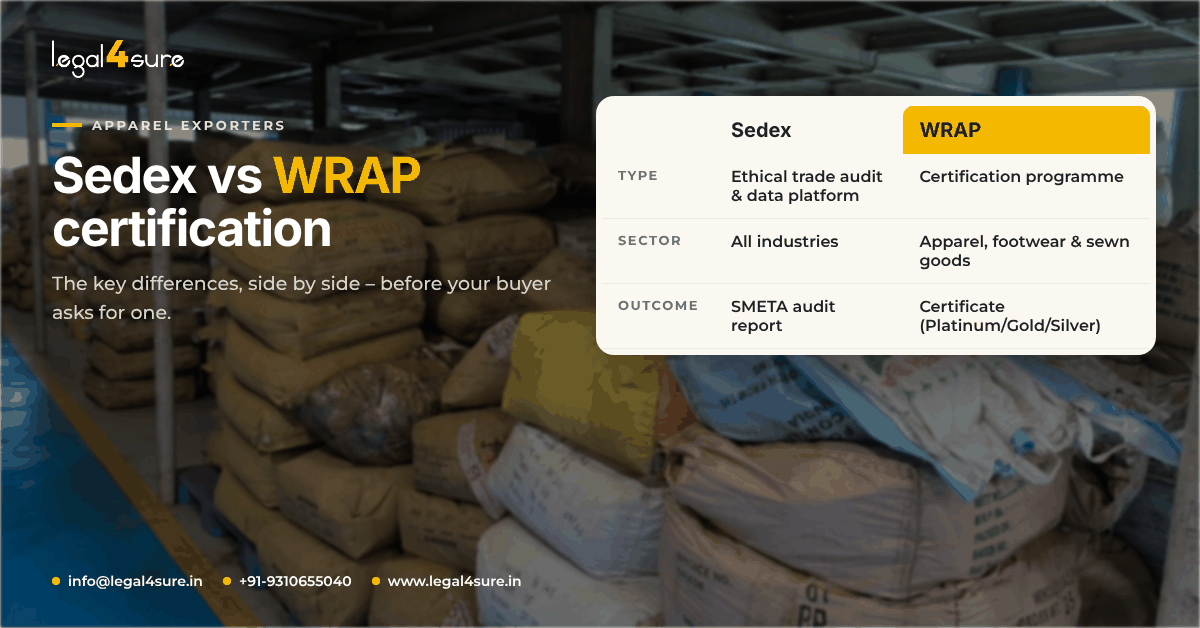
The Sedex is a platform for exchanging ethical audit reports, primarily SMETA audits, between suppliers and buyers. The WRAP (Worldwide Responsible Apparel Production) is an apparel industry certification scheme offering silver, gold, or platinum certification based on the 12 Principles of WRAP.
The biggest difference is what the programs actually are. Sedex is a membership service with SMETA audit approach and without any kind of certificate. WRAP is a certification scheme specific to apparel, footwear and sewn products with the result of the certificate that is valid from 6 months up to two years.
There are three main differences:
- Output: Sedex delivers an audit report with conclusions. WRAP delivers a certificate.
- Scope: Sedex helps to audit the food, packaging, pharma and garment industries. WRAP works only for the sewn-products supply chain.
- Decision-maker: In Sedex each buyer company comes to a conclusion about the report. In WRAP the program makes a decision whether the company received certification or not.
You may often hear about “Sedex certification.” It is a common way to speak for buyers, but technically there is no such thing as a Sedex certificate. You are a member of Sedex with an audit on file.
How a Sedex Audit for Apparel Exporters Works
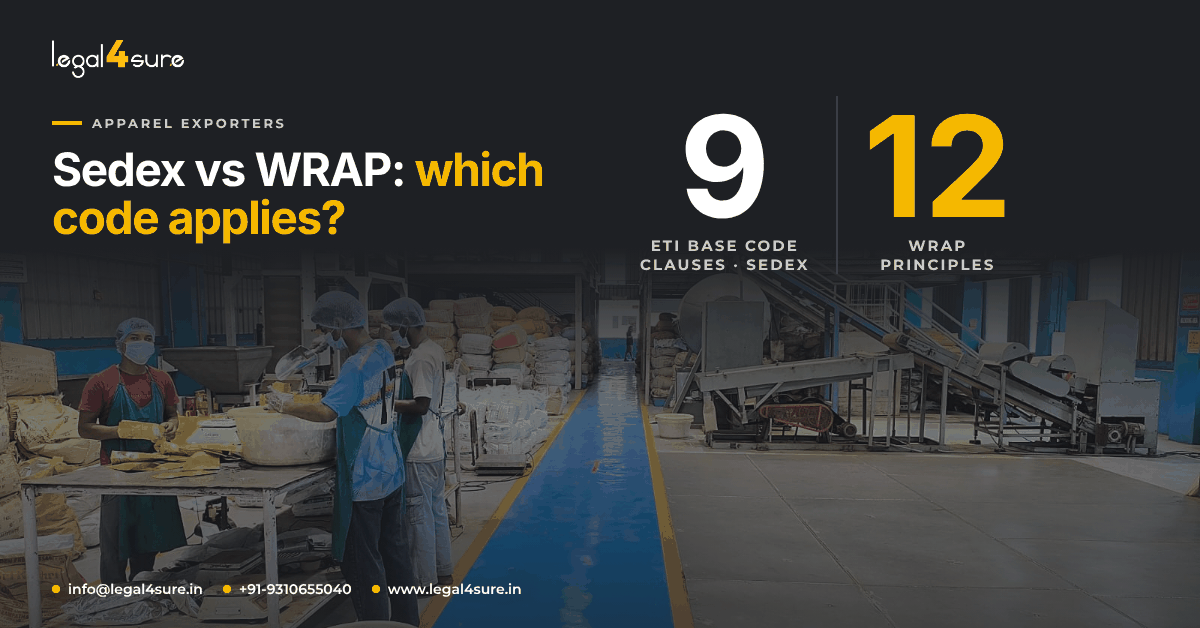
The Sedex audit for the exporter of apparel products begins by registering your manufacturing facility with Sedex as a supplier member and filling out the Self-Assessment Questionnaire. After that, you book a SMETA audit from an approved third party who audits the facility based on the ETI Base Code.
What a SMETA audit covers
- Labour Standards: Wages, working hours, child labour, forced labour, freedom of association and discrimination.
- Health and Safety: fire exits, machine guarding, chemical storage and worker housing (if applicable).
- Environmental and Business Ethics: waste management, energy consumption and bribery control. The latter are exclusive to the 4-Pillar code.
What you receive after the audit
No certificates are issued; instead, you get a report of your findings, non-conformities, and a Corrective Action Plan Report (CAPR) that needs to be closed within the agreed time periods. Any buyers associated with your account can view the report and the process of closing.
Re-audit date is not decided by Sedex; rather, it is decided by the buyers, who usually request re-audits annually or bi-annually.
Strengths and limits of Sedex
- A single report can be used by many related purchasers, and hence duplication of audit is avoided.
- In the 4-Pillar model, both the environment and ethics of the company are included and not only labor.
- Limitation: The certificate cannot be displayed, as each purchaser makes his/her own judgment about the report.
WRAP Certification for Garment Manufacturers: What to Expect
WRAP certification for garment manufacturers is a facility-level program run by Worldwide Responsible Accredited Production. A WRAP-accredited monitor audits your factory against 12 Principles, and WRAP issues a Silver, Gold or Platinum certificate based on your compliance record.
The 12 WRAP Principles
Topics covered include compliance with laws, forced labor, child labor, harassment and abuse, compensation and benefits, hours of work, discrimination, health and safety, freedom of association, environment, customs compliance, and security.
Customs compliance and security are rarely included in social compliance policies. These aspects are important for exporters who ship into the US, since consumers care equally about the security of their supply chains and their labor practices.
WRAP certification levels
- Silver: a six-month certification, normally for sites which still require corrective actions to be taken.
- Gold: a one-year certification for sites which satisfy the Principles.
- Platinum: a two-year certification, obtained after an ongoing record of Gold certification performance.
How the WRAP process runs
- Register yourself in WRAP and pay for the program.
- Do the self-assessment.
- Engage the monitor accredited by WRAP for conducting on-site audit.
- Rectify the issues raised by the monitor.
- Wait for the final decision of WRAP.
The certificate comes from WRAP itself, not from the auditing firm. That’s a key reason buyers treat it as a standalone proof point.
Strengths and limits of WRAP
- It is an established certification that has its own expiration date.
- Coverage for customs and security applies to shipments going to the United States.
- The catch? It is clothing only and cannot help with non-clothing buyers, and it also has additional fees besides the auditor’s fee.
Sedex vs WRAP Certification: Side-by-Side Comparison
Here’s how a Sedex vs WRAP audit compares on the points buyers and factory owners ask about most.
| Factor | Sedex (SMETA) | WRAP |
|---|---|---|
| What it is | Membership platform plus audit methodology | Certification program |
| Industry scope | Cross-industry | Apparel, footwear and sewn products |
| Output | Audit report with findings and a corrective action plan | Silver, Gold or Platinum certificate |
| Standard used | ETI Base Code | 12 WRAP Principles |
| Who decides the result | Buyers read and judge the report | WRAP reviews and issues the certificate |
| Topics covered | 2-Pillar (labour, health and safety) or 4-Pillar (adds environment and business ethics) | Labour, safety, environment, plus customs compliance and security |
| Validity | Set by each buyer’s re-audit cycle | Six months to two years |
| Typical buyer base | Often UK and European retailers and brands | Often US apparel brands and retailers |
| Main cost drivers | Sedex membership fee, auditor man-days | WRAP program fees, monitor audit fee |
Where Both Fit Among Apparel Social Compliance Standards
However, Sedex and WRAP are not the only social compliance standards that apply to apparel vendors. The list includes amfori BSCI, SA8000 and Fair Wear. GOTS and OEKO-TEX are exceptions in that they concern organic composition and safety of products, not the working environment.
The good news is that most of them require information on forced labour, wages, working hours and health and safety. Documentation that you have prepared for one audit will be helpful during the other audit.
EcoVadis is another exception, because it assesses the sustainability management system of a company rather than audits its site. To learn more about the differences between Sedex vs EcoVadis, see our article comparing them.
Do Apparel Exporters Need Sedex or WRAP Certification?
Neither one is required by any law. They are business requirements made by your customers and typically appear in a code of conduct for suppliers or vendors. If your customer specifies either one, use that one. If not, put it in writing before making any investment.
Sedex or WRAP Certification for Garment Manufacturers: How to Decide
Work through these five steps in order:
- Look at each buyer’s code of conduct. If Sedex or WRAP is mentioned, then the choice is easy.
- Know where your orders are coming from. US-facing plants will be approached by WRAP; UK/EU-facing plants will be approached by Sedex.
- Count your buyers. You need only one Sedex audit report to cover many inter-related buyers, avoiding repetitive audits.
- Find out if you require an auditable certificate for bids or marketing. WRAP gives that but Sedex does not.
- Compare yearly and annual costs. Sedex audit cost guidelines include both membership fees and man day charges.
Picture a Tiruppur knitwear factory that ships to a UK retailer and a US brand. The retailer asks for a 4-Pillar SMETA audit on Sedex, while the brand accepts WRAP Gold. Running both costs more upfront, but each buyer gets the proof it recognises.
Choose Sedex when
- A number of buyers desire visibility into the one audit.
- Your buyers buy food, packaging or home goods.
- Buyers demand environmental and ethical information.
Choose WRAP when
- Your primary buyers require or accept WRAP certification in writing.
- You would like a certification that shows compliance immediately.
- Customs compliance is important for your shipments to the US.
Some factories have both because the customers are different. This is okay because the two are not substituting for each other. But do not begin either before you get confirmation from the customer.
Common Mistakes Apparel Exporters Make
- Considering Sedex as a certificate to show, and later discovering that the buyer wants the report and whether it is closed or not.
- Booking a SMETA audit even before establishing if it is 2-Pillar or 4-Pillar.
- Using a WRAP monitor without verification of his credentials.
- Disregarding subcontractors. Subcontractor issues come up often during apparel audits.
- Taking care of payroll, overtime, and age records at the time of the audit.
Readiness Checklist Before Either Audit
A test audit highlights shortcomings when there is still time to remedy them, and many consultancies such as Legal4sure will use this as a starting point. Whatever path you choose, you should begin with these documents:
- Proof of age checking and work hours records.
- Wage and overtime records corresponding to attendance records.
- Fire safety certificates and escape plans.
- Chemical handling, PPE and machine guarding documentation.
- Anti-harassment, grievance and disciplinary policies.
- A current list of contractors/subcontractors.
Key Takeaways
- Audit results are shared by Sedex with its buyers while WRAP certifies the factory based on 12 principles.
- There is no Sedex certification but there is a WRAP certification which is valid for up to six months to two years.
- Neither of these is required by law, only your buyer’s code of conduct.
- Your buyer’s location and number of buyers will determine the decision.
- Audit evidence is shared in both cases, ensuring the requirement in writing before booking.
Conclusion
There is no “winner takes all” in Sedex vs WRAP certification. The deciding factor here is what your buyers accept and how many buyers you have. While Sedex gives you one audit report for sharing, WRAP provides you with a certificate that comes with an expiration date.
Begin with buyer requirements in writing, choose the right route, and get your records ready once. Should you need a second expert opinion prior to booking the audit, Legal4sure can help with mapping the requirement to the audit route.
Choose the Right Social Compliance Program for Your Business
Not sure whether to choose Sedex or WRAP? Legal4Sure can help you understand buyer requirements, identify documentation gaps, prepare for SMETA audits or WRAP assessments, and organize compliance records so your garment manufacturing business can approach audits with greater confidence.
Frequently Asked Questions
What is the difference between Sedex and WRAP certification?
Sedex is an online system for sharing SMETA audit results and does not give any certification. WRAP is a certification for the apparel industry giving Silver, Gold or Platinum status.
Do apparel exporters need Sedex or WRAP certification?
No, but by buyer’s requirement, please see your vendor manual and get confirmation in writing.
Which is better: Sedex or WRAP certification for garment manufacturers?
None dominates all cases. Please follow your buyer’s requirement, and if there is more than one buyer, you may keep both.
Is there a difference between Sedex and WRAP certification for apparel exporters in audit scope?
Yes, SMETA has environment and business ethics added to 4-pillar audit and WRAP has 12 Principles adding customs compliance and security.
Can a factory hold both Sedex and WRAP?
Yes, they do not exclude each other, and common documents such as payroll and safety files reduce preparations efforts.
How long is a WRAP certificate valid?
Six months for Silver, one year for Gold and two years for Platinum.
How often does a Sedex audit need to be repeated?
The buyer decides how often, usually every one-two years.