
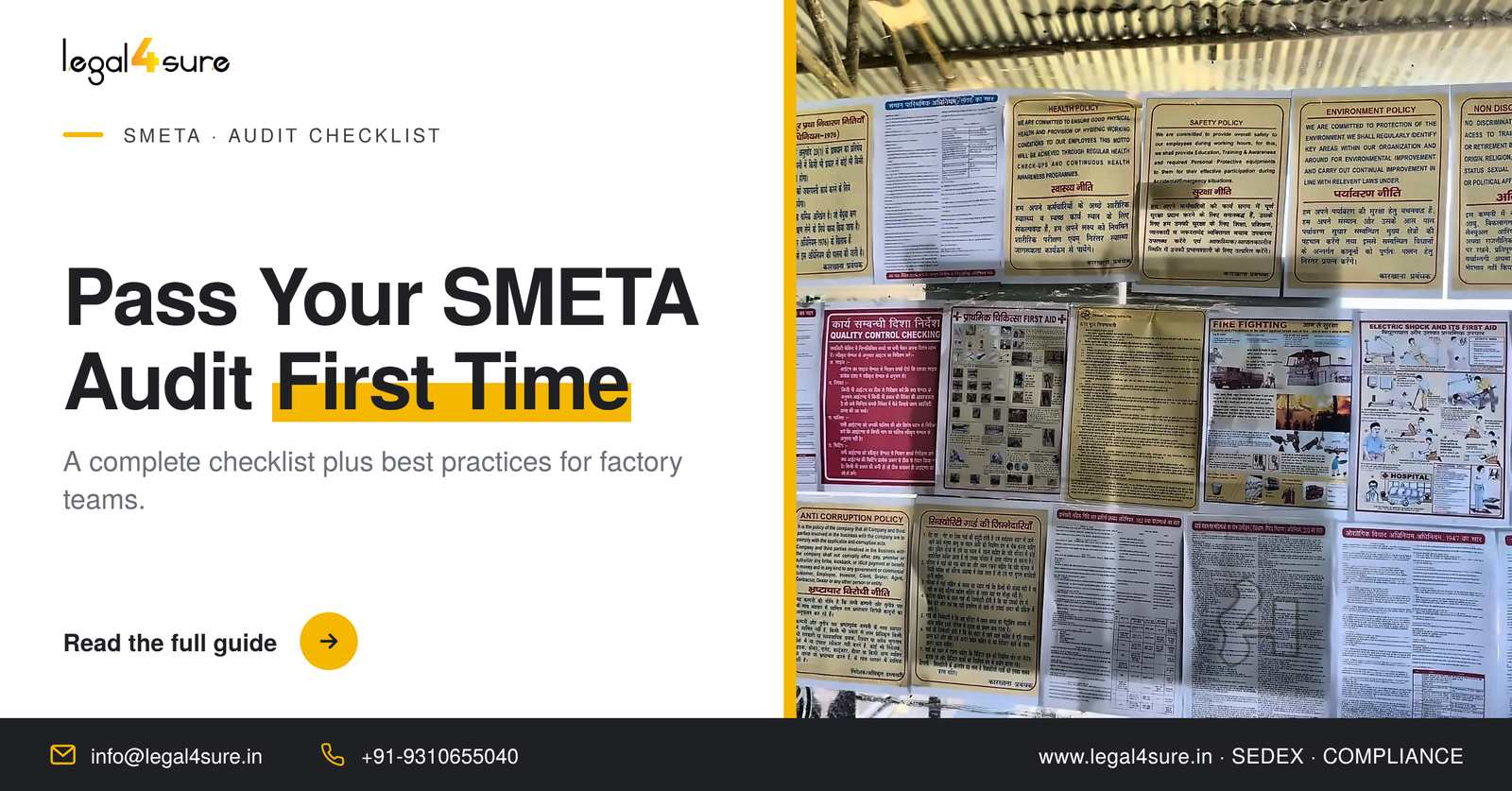
Preparing for a SMETA audit properly can make the difference between a smooth audit and a stressful one. Start preparing 30 to 45 days in advance. Begin with a gap analysis using the Sedex audit checklist, fix any issues you find, and make sure your managers and employees understand what is expected of them.
It is not that most Indian factories fail because they are negligent. Rather, the fact is that the wage register and attendance register do not match and were discovered only at the time of audit.
This guide follows the process as a seasoned compliance team would have it done. At Legal4sure, we see the same gaps repeating themselves for apparel, food, packaging and engineering exporters alike. That is why the checklist below highlights the issues that arise repeatedly.
What Is a SMETA Audit and What Do Auditors Look For?
SMETA audit (Sedex Members Ethical Trade Audit) is an ethical audit that assesses your site for conformity with the ETI Base Code and national legislation. Two-Pillar audit includes aspects of labour practices and health and safety. Four-Pillar audit includes additional pillars of environmental protection and business ethics.
Audit team members are appointed by Sedex-approved audit companies. They examine documents, inspect the facility and talk to employees and management in one or several days, based on the size of your company. After that, the audit report is uploaded to the Sedex platform.
SMETA audit requirements fall into four buckets:
- Labour: Wages, working hours, child labor, forced labor, freedom of association, discrimination and disciplinary actions.
- Health & Safety: Fire safety, machinery, chemicals, first aid, drinking water, canteen and dormitory.
- Environment (4-Pillar Approach): Permits, waste disposal, emissions, energy and water consumption.
- Ethics (4-Pillar Approach): Anti-corruption measures, transparency and sub-contractor management.
Can You Actually Pass or Fail a SMETA Audit?
SMETA. No certificate or pass mark is provided by SMETA. The auditor will identify non-conformances and prioritize them according to their severity, and you will develop a corrective action plan. Passing in reality means that there are no critical findings, only a few minor ones and an acceptable corrective action plan.
The critical ones pose the real threat. For example, child labor or the use of forced labor and situations that directly threaten the safety of employees can cause the escalation of the buyer, and in some instances, even delisting.
How Do I Prepare for a SMETA Audit? A 6-Step Plan
To prepare for SMETA Audit, it is necessary to clarify the scope of audit from the buyer, do a gap analysis internally, rectify document/site gaps, train the management and staff, and conduct a practice audit one week prior. It generally takes between 30 to 45 days.
In case you have been wondering how to do SMETA audit preparation in India, the process remains the same everywhere but the relative importance given to statutory documents such as PF, ESI, Factory License, and Contract Labour documents.
- Clarify audit scope and type. Verify from your client whether it is a 2-pillar or 4-pillar audit. Also clarify if the audit will be announced, semi-announced, or unannounced. If unannounced is possible, then you must be prepared every day.
- Name a single owner. Appoint a single HR or compliance head and have separate owners for payroll, safety, and environment.
- Conduct a gap assessment. Rate each and every checklist item below either compliant, partially compliant, or missing.
- Prioritize high-risk items. Wage/hours, age documentation, fire exits, chemical storage, and contract labor documentation take precedence over cosmetic improvements.
- Brief your team. Brief your supervisors/managers on how the audit will proceed. Ensure that the workers know of the audit and have freedom to talk.
- Conduct a mock audit. Five to seven days before, conduct a walk-through of the facility as per the auditors and trace back one of the workers’ payslips to attendance/overtime and bank transfers.
SMETA Audit Preparation Checklist for Indian Factories
This SMETA audit India preparation checklist for Indian factories covers the paperwork, the shop floor and the management systems auditors test. Use it as your Sedex audit checklist for the gap assessment in step three.
What Documents Are Required for a SMETA Audit?
Auditors usually require legal registration, payroll, attendance, age proof, policy manuals, safety certificates, training manuals, and environmental permits, generally for the last 12 months. Organize all documents in one indexed file, which is current and up-to-date.
| Area | Documents auditors typically request | Where gaps usually appear |
|---|---|---|
| Legal and registration | Factory licence, trade licence, GST registration, contract labour licence where relevant | Expired licences; contractor licence missing |
| Wages and hours | Payslips, wage registers, bank transfer proof, attendance and overtime records | Attendance doesn’t match payslips; overtime paid below the legal rate |
| Statutory benefits | PF and ESI challans, bonus, gratuity and leave records | Late deposits; contract workers left out |
| Worker records | Age proof, appointment letters, ID records, agency worker lists | No age verification; missing appointment letters |
| Policies | Child labour, forced labour, discrimination, discipline, grievance, anti-bribery, POSH | Policies exist but workers have never been told |
| Health and safety | Fire NOC, building stability certificate, fire drill logs, PPE issue logs, machine and electrical inspections | Blocked exits, expired extinguishers, no drill records |
| Environment | State pollution control board consent, waste disposal records, energy and water data | Incomplete hazardous waste records |
Wages and Working Hours
This is where most findings land. Where Indian law and the ETI Base Code differ, auditors apply whichever gives workers more protection.
- Standard working hours should not exceed 48 per week, while the total number of hours, including overtime, should not exceed 60, except in unusual cases.
- Overtime has to be voluntary and remunerated at the premium rate.
- Employees have to be given at least one day off every seven days.
- Deductions should be made legally, documented, and communicated to the employee.
Site and Health and Safety Checks
- Fire exits are clear, labeled, and accessible during work periods.
- Extinguishers are tagged, dated, and properly placed at the correct height.
- First aid boxes are full, and first aiders have been trained.
- Machine guards are installed, and electric boards are properly labeled.
- Chemical substances are labeled and stored with safety data sheets.
- Toilets, drinking water, canteen, and any available dormitory are clean.
Management Systems, Environment and Ethics
- An individual nominated for social compliance and documented responsibilities.
- Risk assessment document and procedure to review the policies.
- Controls over subcontractors and agencies and their labor documentation.
- Environmentally approved licenses, where waste and energy are measured monthly.
- Documented anti-bribery policy, which management has actually read.
SMETA Worker Interviews: How to Get Your Workforce Ready
SMETA Worker interview under audits are confidential discussions either individually or in a group setting where the auditor seeks information on wages, working hours, safety, treatment, and grievance mechanisms. Management is not present, and the responses are verified against your records.
The auditor determines the sample size, and this could include temporary, migrant, and night shift workers if you have any. The aim is not to influence the responses but ensure that the workers are comfortable talking and know their rights.
- Inform employees in advance about the coming audit and the fact that they can talk freely.
- Allow some employees to leave the production line without asking any questions.
- Arrange for them a quiet room where no one can hear what they say.
- Instruct supervisors in advance about retaliatory actions.
- Ensure that employees understand how you handle grievances.
Common SMETA Audit Mistakes That Lead to Non-Conformances
- Coaching employees in their responses. Auditors always detect coached responses, and it undermines the entire audit process.
- Backdating records from the previous night. The use of forged records is viewed very differently than missing records.
- Allowing discrepancy in attendance, payroll, and overtime books.
- Failing to include agency and contract workers in their obligations.
- Maintaining policies in writing but never communicated.
- Overlooking licence renewals and safety certificate expiry.
- Leaving it all to one overstretched HR employee.
SMETA Corrective Actions: What Happens After the Audit
SMETA corrective actions are the fixes you agree for each non-conformance, recorded in the Corrective Action Plan Report (CAPR). Each entry states the finding, root cause, action, owner and deadline, and the CAPR is shared with buyers through Sedex.
Findings are rated critical, major or minor, so start with the highest severity.
- Find out what the real problem is. “Retrained the supervisor” is not as strong as “resolved the overtime authorization process issue.”
- Set realistic deadlines because failure to meet them is negative for your management system.
- Produce closure documentation in the form of photos, new policies, payments, or attendance records.
- Close your CAPR while closing issues, not in the last week.
Should You Prepare In-House or Hire a Consultant?
Both routes work. The right choice depends on your team’s experience and how close the audit date is.
| Factor | Prepare in-house | Bring in a consultant |
|---|---|---|
| Best when | You’ve been audited before and records are in good shape | It’s your first SMETA audit or the date is close |
| Strength | Lower cost and deep knowledge of your operations | Outside view, mock audit experience, faster gap closure |
| Risk | Blind spots after years of doing things the same way | Over-reliance, if your team doesn’t learn the process |
In case you choose external assistance, find a service provider that will conduct a proper gap analysis and mock audit, and not just document analysis. Legal4sure offers factory assistance during all these processes, along with the closing phase of CAPR after the audit.
Key Takeaways
- Start preparing for the SMETA audit 30 to 45 days prior, and ensure that the scope and audit type are agreed on by your buyer first.
- There is no pass/fail with the SMETA audit; the aim is having zero critical findings and a credible CAPR.
- Records of wages, attendance, and overtime should agree with one another as these are the most frequent areas for findings.
- Do not coach employees or backdate documentation as confidential interviews will be checked against your documentation.
- Consider the CAPR as a living document and back up all closed findings with proof.
Conclusion
Good SMETA audit preparation is not about trying to appear flawless during the audit. It is about operating a factory where everything about the factory, from its documentation, to the site itself and even its people all tell the same truthful story.
Just do this and you won’t need to fear audits anymore. In case you would like a second opinion before the auditor comes calling, Legal4sure can help you out with a gap analysis and mock audit.
Prepare Your Factory for a Successful SMETA Audit
Get ready for your SMETA audit with Legal4sure. Our experts help you conduct gap assessments, review compliance documents, prepare workers for interviews, and fix compliance gaps before the audit.
Frequently Asked Questions
How do I prepare for a SMETA audit?
Make sure to confirm scope with the buyer, conduct a gap analysis, address record keeping and site issues, educate employees and conduct a mock audit one week prior to the SMETA audit.
What documents are required for a SMETA audit?
Licences, payroll and attendance sheets, age proofs, policies, safety certificates, training and environmental licenses for 12 months.
How to prepare for a SMETA audit in India if our team is new to Sedex?
It involves following the same 6 steps of audit preparation but putting additional focus on PF, ESI, Contract labour details and licensing requirements specific to the state.
Is there a SMETA audit preparation checklist for Indian factories?
Yes. The checklist above is applicable to documents, wages & working hours, site safety and management systems of Indian factories.
How long does SMETA audit preparation take?
For most teams, it takes between 30 and 45 days, but might take longer in case of record and safety system reorganization.
Can you fail a SMETA audit?
No pass/fail. It consists of graded non-conformances and corrective action agreement.
Can management sit in on SMETA worker interviews?
No. Interviews are confidential, and pressure on workers can be recorded by the auditor as an integrity concern.