
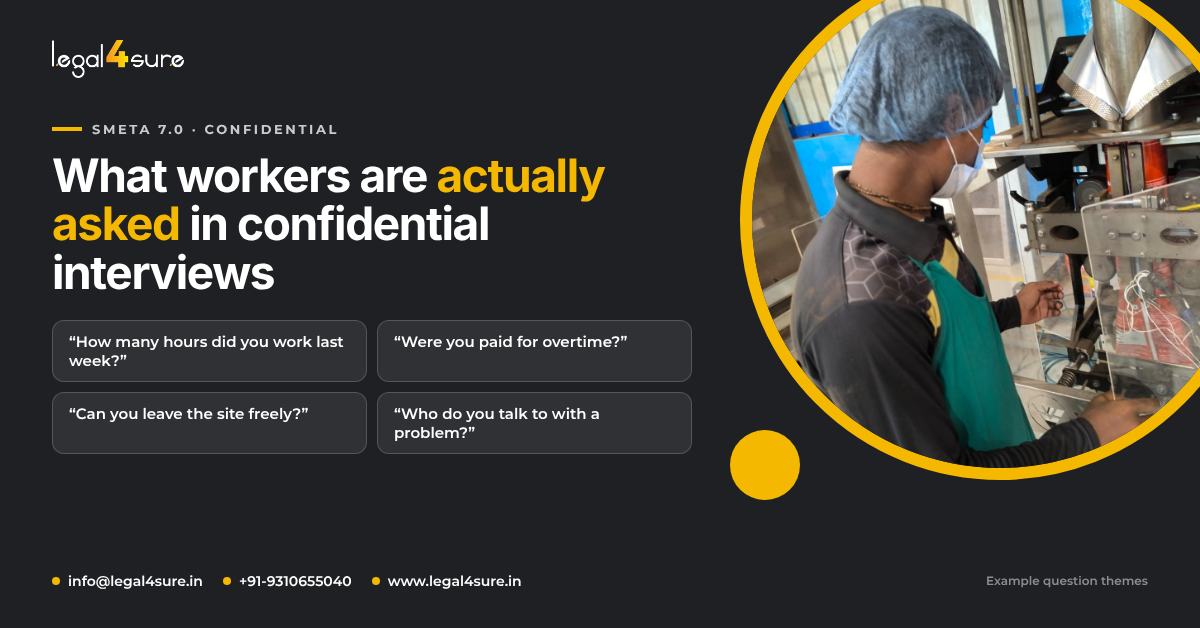
Worker interviews during a SMETA 7.0 audit are private discussions between an auditor and a small group of your employees. Worker interviews aim at cross-examining information provided by your documents and managers through employees’ experiences.
Factories usually pay much attention to worker interviews because nothing is heard by the management. Workers also become anxious about the discussion but they may even be more worried than factories. Neither of the parties usually has any knowledge about questions which will be raised.
This article will discuss questions which are raised by workers, procedure of interviewing, actions which managers may and may not undertake and preparation without giving any instructions to anyone. Legal4sure offers services to factories in order to prepare for SMETA audits. Worker interviews are the main source of anxiety during such audits.
What Are SMETA 7.0 Worker Interviews?
The SMETA worker interview is a confidential, auditor-conducted interview with randomly selected workers on issues of recruitment, remuneration, working hours, health and safety, treatment, and complaint raising mechanism. The answers obtained will help auditors to confirm the document review and the management interview.
Interviews are a part of the initial meeting, inspection, management interview, and documentation review. Auditors may conduct individual interviews or group interviews with workers. The interview procedure of one of the certification bodies emphasizes the importance of interviews in confirming document and management information.
According to the independent opinion about the methodology currently used, SMETA 7.0 pays great attention to the quality of worker interviews and grievance mechanisms. This is one of the reasons why the Sedex worker voice became so popular among suppliers.
How Are Worker Interviews Conducted in a SMETA 7.0 Audit?
Auditors randomly choose workers, interview them individually in a language they understand, emphasize confidentiality, and match what they hear with documentary evidence and observations. Managers do not observe the interviews, nor do they determine whom to interview.
Here’s how the process usually unfolds:
- Initial meeting. The auditor tells how interviews will be conducted, requests a proper room and stresses confidentiality. Representatives of the workers should be requested.
- Selection. The auditor selects workers based on the complete list of workers, trying to select workers from different departments, shifts and contractual arrangements.
- Setting. Interviews are conducted in a private room without any supervisors nearby. When required, an interpreter is used in order to help workers express themselves in their own language.
- Introduction. The auditor introduces himself or herself, explains purpose of the interview and stresses its confidentiality.
- Questions. Open-ended questions starting with questions about routine work and then moving to more delicate questions.
- Conclusion. Workers are offered a confidential contact person if they wish to say anything more after leaving the site.
- Validation. The auditor cross checks the answers against payroll, timesheets, contracts and observations on the shop floor.
Individual interviews vs group interviews
| Format | Best for | Limits |
|---|---|---|
| Individual | Sensitive topics such as pay, recruitment fees, harassment or fear of reprisal | Takes more time, so fewer workers can be reached |
| Group | General conditions, canteen, transport, accommodation and training | Quieter workers may hold back in front of colleagues |
| Worker representatives | Committee roles, consultation and how complaints are handled | Representatives’ views alone don’t reflect the whole workforce |
What Questions Are Asked in a SMETA Worker Interview?
Open-ended questions on various topics are asked by auditors, with each topic being associated with one of the themes of the ETI Base Code. The questions vary from site to site and should be regarded as examples, not as a script.
The following SMETA worker interview questions give the example of how questions are posed to the worker during a SMETA 7.0 interview:
| Topic | Typical question style | What the auditor is checking |
|---|---|---|
| Recruitment | How did you get this job? Did you pay anyone to get it? | Recruitment fees, agents, freely chosen employment |
| Contracts | Do you have a copy of your contract? Who keeps your documents? | Written terms, document retention |
| Wages | How is your pay worked out? Do you get a payslip? Are there deductions? | Accurate payment, deductions, payslip clarity |
| Working hours | How many hours did you work last week? Do you get a rest day? Is overtime your choice? | Hours, overtime, voluntary work |
| Health and safety | Do you feel safe here? What training have you had? Do you have the protective equipment you need? | Training, PPE, emergency awareness |
| Treatment | How do supervisors talk to workers? Has anyone been disciplined unfairly? | Harsh treatment, discrimination |
| Worker representation | Is there a worker committee? How were members chosen? | Freedom of association, consultation |
| Grievances | If you had a problem, who would you tell? Has anyone raised one? | Access to and trust in the grievance mechanism |
How a conversation actually flows
The interview process is seldom checklist-like. An auditor may start with the statement, “Describe a typical week for you.” The questions will naturally arise from there.
If an employee describes finishing work late on Thursdays, then an auditor may inquire how often this occurs, if it is paid, and if they can say no. From one question arises three others. This is why it is important to have consistent records rather than consistent answers.
Confidential Worker Interviews in SMETA: What Is Protected
Confidentiality plays a crucial role in the process. The auditing process instructs the auditors to emphasize it in the initial meeting as well as while talking to the employees. Best practice recommends the auditors to provide employees an opportunity for confidential input aside from the interview.
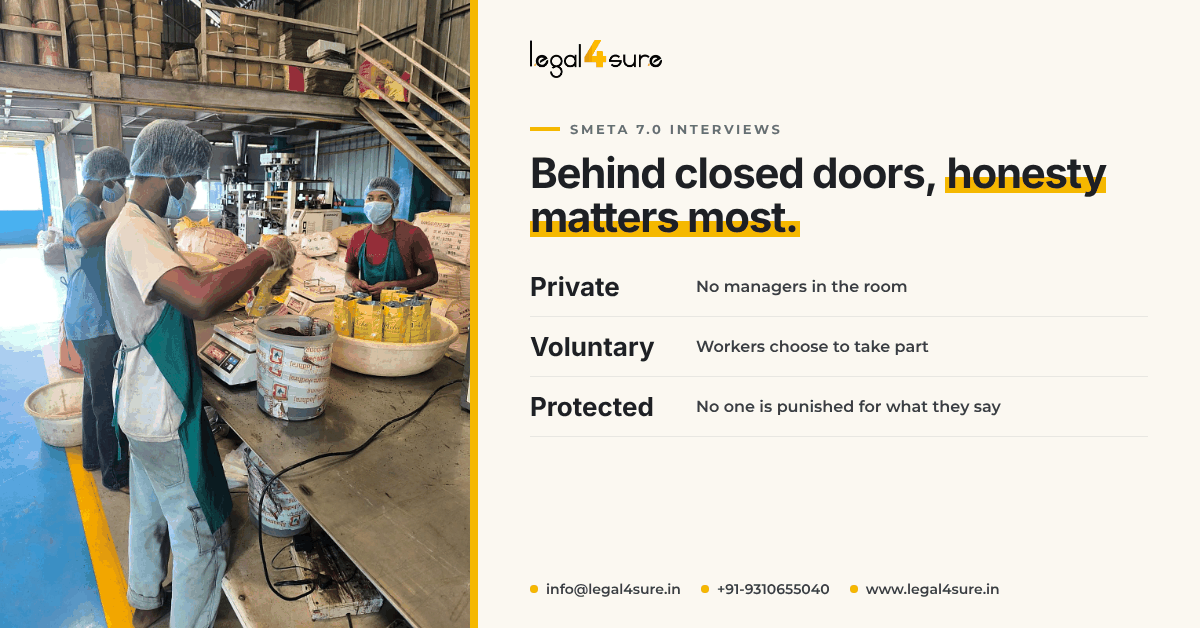
The SMETA report contains a summary of the worker interviews but not transcripts. The findings of the process are based on patterns and corroborated facts but not attributions.
What managers can and can’t do
- Can: create a precise list of workers, offer a private room and time for workers to participate.
- Can: allow workers’ representatives to take part in the opening and closing sessions.
- Cannot: select the interviewees.
- Cannot: observe or listen from the door, nor ask workers about what they have discussed.
- Cannot: prompt answers or punish people for anything they have said.
Breaking these rules is far more damaging than anything a worker might say. It can turn a routine audit into a serious finding.
Why Auditors Rely on Worker Interviews
Paperwork may be perfect and yet inaccurate. The timesheets may be altered, the payslips forged and the policy created just the week prior to the audit. There is little incentive on the part of workers to alter any paperwork.
And that’s why the interviews have become so important. They allow auditors to catch things that cannot be caught from paper – unofficial hiring fees, undocumented overtime, intimidation against speaking out, discriminatory behavior of superiors towards certain groups of people, and more. It is through interviews that auditors discover whether or not there is only a poster available regarding the existence of the grievance procedure.
There are some limitations to interviews, though. What one worker says may not constitute evidence. Auditors have to detect patterns through multiple sources in order to record a violation. An isolated complaint will not bring down a facility.
SMETA 7.0 Worker Engagement Beyond the Interview
7.0 SMETA Worker Engagement does not stop once the audit is done. Interview is only a snapshot of 1-2 days. The auditors will consider if there are long-term mechanisms for engaging the workers such as the committee, grievances system, and communication from the management.
Another element in the equation is survey tools. A pilot study by Sedex and Ulula was conducted in which surveys were sent to workers prior to an audit being conducted through QR Codes, Website Links, and telephone voice response systems to identify issues that come up repeatedly. Whether your buyer uses something like this is entirely up to them, so you will need to find out.
The SMETA Report also segments the workforce data by male and female, so interviews also need to be reflective of this. For first-timers in this method, our guide to the SMETA Audit will prove helpful.
SMETA Worker Interview Requirements for Your Site
Your task is to enable the honest interviews; that is, ensure that there is a correct list of workers, privacy, languages, release from work without being penalized and a strict no-reprisal policy. The auditors take care of the rest.
- Have an updated list of all employees, including temporary, migrant, seasonal, and night workers.
- Create a private room free of any supervision and cameras.
- Make sure there are interpreters in case the workers speak different languages.
- Ask for permission to relieve selected employees from their duties without punishment.
- Bring in representatives of the workers for the meeting at the start and end of the day.
- Warn the supervisors in writing about any repercussions.
How to Prepare Workers Without Coaching Them
There’s a fine line between informing workers and scripting them. The first helps. The second tends to show.
- Keep up-to-date information on all the workers, such as those that are temporary, migratory, seasonal, and nighttime workers.
- Prepare a room which is completely isolated from any form of monitoring and cameras.
- Make sure you have interpreters in case they speak a different language.
- Request authorization to relieve selected workers from their responsibilities without any punishment.
- Invite the workers’ representatives in for the discussion at the start and at the end of the day.
- Warn the supervisors about the consequences in writing.
Auditors are experienced at spotting rehearsed answers, especially when several workers use the same phrases.
Common Mistakes Factories Make
- Presenting the auditor with a selected group of employees.
- Placing the supervisor near the interview room.
- Questioning employees about their interviews later.
- Providing employees with “correct” answers.
- Excluding agency or foreign workers from the employee roster.
- Allowing documentation to state something different than what the workers say.
This is perhaps the most important. There is no pass or fail in the SMETA process; however, discrepancies between interviews and documentation can result in more detailed examination and could possibly become part of the action plan. Check out our guide to Sedex corrective action plan for more information.
Key Takeaways
- Worker interviews conducted by SMETA 7.0 are strictly confidential and conducted randomly by the auditor.
- The interviews consist of open-ended questions and involve aspects of recruitment, remuneration, working hours, safety, treatment, and grievances.
- Managers should not choose workers to be interviewed nor should they participate in questioning workers after the interview.
- Workers should be made aware of the audit without preparing their responses.
Conclusion
SMETA 7.0 worker interviews are no trap; they are no ritual either. This is where theory meets practice, as it becomes clear how accurate your documentation is. Places that operate proper payroll and working conditions along with effective workers’ complaints channels have nothing to worry about.
Begin with checking if your data will agree with a randomly selected worker. Do you want a dry run of the audit beforehand? Let Legal4sure do that for you by interviewing all your workers and analyzing your paperwork.
Prepare Your Factory for SMETA 7.0 Worker Interviews
Get your factory audit-ready with expert support for SMETA audit preparation, worker interview requirements, documentation review, grievance mechanisms, and compliance gap assessment. Legal4Sure helps you strengthen audit readiness while ensuring workers can speak honestly and confidentially.
Frequently Asked Questions
What questions are asked in a SMETA worker interview?
Open questions concerning recruitment process, contracts, wages, working hours, safety, treatment, and worker committees.
How are worker interviews conducted in a SMETA 7.0 audit?
Interviews are performed by auditors who select interviewees randomly, guarantee confidentiality, and check answers with documents.
What are workers asked during a SMETA 7.0 interview?
Mainly routine questions about their work, wage, working hours, safety conditions, and attitude of supervisors.
What are typical confidential worker interview questions for a SMETA 7.0 audit?
For instance, hiring process, wage calculation method, and whom they would consult about a problem.
What are the SMETA worker interview requirements for a site?
A list of workers that should be correct, interviewing area, language translation, release from work, and non-retaliation.
Can managers sit in on SMETA worker interviews?
No, interviews are private, and managers shouldn’t choose participants and ask about an interview.
Do worker interviews decide whether a site passes a SMETA audit?
SMETA doesn’t have a pass/fail system, interviews are aimed to check information provided before and detect possible contradictions.