If you are running a food business and are looking to expand operations in the global arena, the BRC certification process is something you cannot afford to miss. The BRCGS (Brand Reputation Compliance Global Standards) certification is the benchmark for food safety, and its relevance is growing rapidly in the Indian market, as more and more food manufacturers and exporters are looking to cater to the requirements of international buyers.
This article will take you through the entire BRC certification process in india, and everything you need to know is included in the following sections.
What Is BRC Certification and Why Does It Matter for Indian Businesses?
BRC, also known as BRCGS (Brand Reputation Compliance Global Standards), is a food safety and quality certification standard accepted around the globe. Although its origin is in the UK, its acceptance among retailers and buyers in 130 countries and counting is a true reflection of its international standing.
For food companies in India, especially those who wish to export to countries like the UK, Europe, and North America, BRCGS certification has become a necessity imposed by buyers as a condition to do business with them. For local players, especially food retail and food service companies, BRCGS certification has also started to become a necessity.
The BRC standard covers food safety management, HACCP, hygiene, traceability, allergens, and product authenticity, among other areas. To begin building a credible food company, especially one with export ambitions, one has to first understand the steps to BRC certification.
>Top trending Guide:- BRC Full Form: All 3 Meanings Explained (Food, Education & Export) 2026
Understanding BRC Requirements India
Before going into the BRC certification process, it is essential to determine the correct BRCGS standard for your business category:
- BRCGS Food Safety (Issue 9) for food manufacturers and processors
- BRCGS Packaging Materials (Issue 6) for manufacturers of packaging materials
- BRCGS Storage & Distribution (Issue 4) for logistics and cold storage companies
- BRCGS Agent & Broker Standard for companies trading in food without handling it
Most food businesses in India would require the BRCGS Food Safety standard. If you are still unsure, you can consult a BRCGS certified consultant who can determine your category.
The BRC Certification Process Step by Step India: A Complete Walkthrough
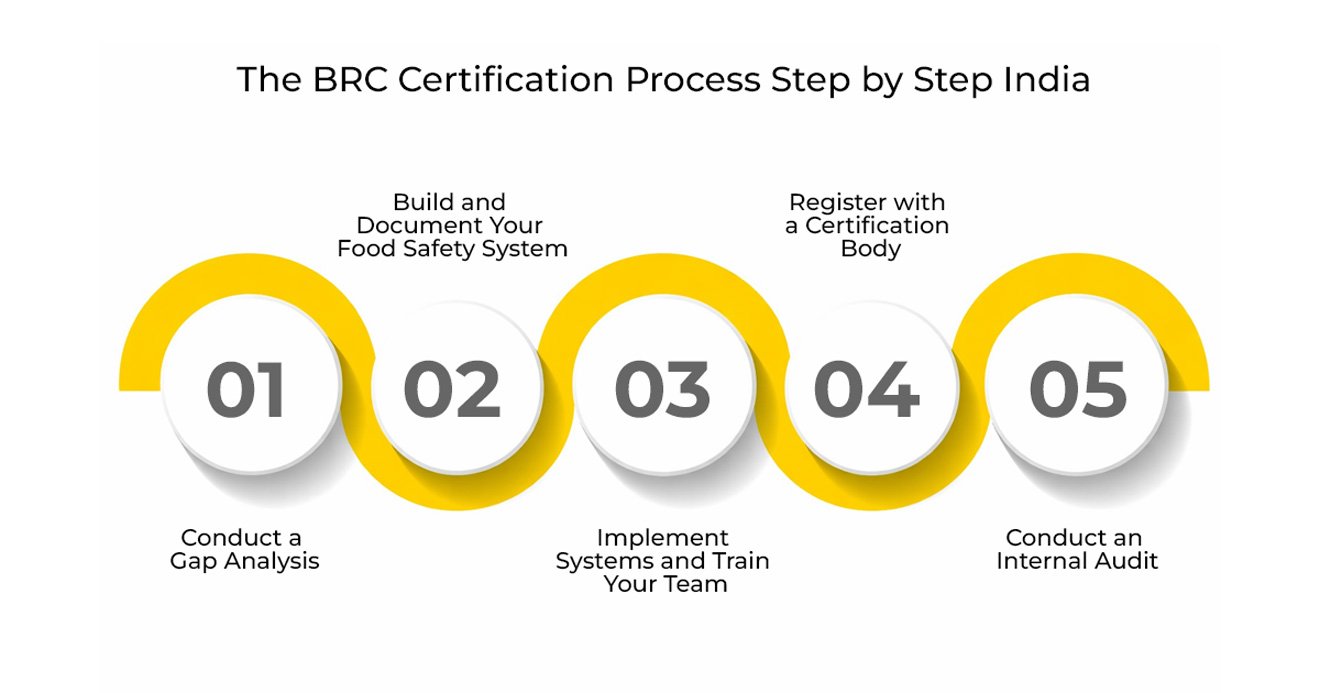
Step 1: Conduct a Gap Analysis
The first step in the BRC certification process involves measuring your current food safety practices against BRCGS requirements. This step, also known as a gap analysis, involves measuring your current food safety practices, such as documentation, hygiene, HACCP, and supplier management, against each requirement in a relevant BRCGS standard.
In this step, you are likely to realise areas that need improvement before you can consider applying for certification. The gap analysis may take 2 to 5 days depending on your operation size and complexity. You may also consider hiring a third-party consultant to perform a gap analysis for your company.
Step 2: Build and Document Your Food Safety System
After identifying the gaps, the next step in BRC certification involves developing a completely documented food safety management system. This process takes the longest time and demands internal dedicated staff.
The BRC required documents that you will be required to develop include:
- HACCP Plan — Hazard Analysis and Critical Control Points
- Food Safety Policy and Quality Manual
- Standard Operating Procedures (SOPs) for all critical operations
- Cleaning and Disinfection Schedules
- Allergen Management Procedures
- Supplier Approval and Monitoring Procedures
- Traceability and Recall Procedures
- Pest Control Records and Contracts
- Training Records for all food handlers and supervisors
- Product Specifications and Compliance with Labels
The quality of your BRC required documents will have a direct bearing on your BRC certification results. It is therefore important that all documents be up to date, signed off, and readily available on the production floor.
Step 3: Implement Systems and Train Your Team
The BRC audit requires evidence that the food safety system is actually being implemented. This means:
- All staff are trained on relevant SOPs and food hygiene requirements
- HACCP monitoring is done regularly at Critical Control Points
- Cleaning, testing, and inspection records are up to date
- Maintaining communication on food safety among all levels
In the case of India, the most challenging part is the training of the staff, especially in large plants with high turnover rates. Consider conducting the training in local languages and using visual aids to ensure understanding, not mere compliance.
Step 4: Register with a Certification Body
The BRC process india requires you to select a BRCGS approved Certification Body for your audit. BRCGS maintains an official directory of approved CBs on its website. Some of the well-known CBs operating in India are SGS, Bureau Veritas, Intertek, NSF, LRQA, etc.
Once you have selected your CB, you have to:
- Submit an application form with basic details of your facility
- Agree on the audit scope, i.e., products, processes, and/or sites to be included
- Schedule your audit date, either announced or unannounced
According to BRCGS Issue 9, for first-time certification, it is always an announced audit. For surveillance audits, it can be an unannounced audit if you select this programme, which can help you achieve a higher grade.
Step 5: Conduct an Internal Audit
Before the actual BRC audit process starts, it is important to undertake a thorough internal audit using a BRC checklist based on the BRCgs standard. This internal audit should cover the entire standard and should be undertaken by a trained internal auditor or an external auditor if the internal team is not yet trained.
Important areas to check with the BRC checklist:
- Senior management commitment and food safety culture
- HACCP system review and validation
- Site standards, gmp, and hygiene compliance
- Product control and testing procedures
- Process controls and incoming goods
- Allergen controls and labeling accuracy
- Complaints and corrective actions
Non-conformances identified during the internal audit process should be closed out before the actual BRC audit process starts.
Step 6: The External BRCGS Audit
This is essentially what the BRC audit process and requirements india is all about. The external audit is carried out by a BRCGS qualified auditor of your choice from a Certification Body.
The BRC audit process is structured in this way:
- Opening meeting – audit scope and agenda confirmed
- Document review – HACCP plans, policies, procedures, and records
- Factory tour – physical audit of all areas where products are manufactured and stored
- Staff interviews – checks to ensure staff understand food safety practices
- Closing meeting – audit findings, non-conformances (NCs), and observations
The non-conformances can be classified as Critical, Major, or Minor. A single Critical NC means automatic failure. Too many Major NCs can also result in failure. Your audit result will be graded AA, A, B, C, D based on how many non-conformances you have.
Step 7: Close Non-Conformances and Receive Certificate
Once the audit is complete, you will receive a formal NC report from us. You are then required to submit a root cause analysis and corrective action plan for each NC within 28 days for Major NCs and 90 days for Minor NCs.
Once we are satisfied with your corrective actions, we will then issue your BRCGS certificate and upload your certification details onto our BRCGS Directory, making them publicly visible to buyers around the world.
The certificate is normally valid for 12 months, after which a surveillance audit is carried out to renew your certification.
>Helpful Guide:- Emergency BRC Certification: How to Get Approved When Audit Is Due in 15–30 Days?
Typical Timeline for the BRC Certification Process in India
The total time required to finish the BRC certification process will vary depending on your current food safety maturity level. Here’s a realistic estimate:
- Gap Analysis: 1 to 2 weeks
- Documentation and System Building: 2 to 4 months
- Implementation and Training: 1 to 2 months
- Internal Audit and Corrective Actions: 2 to 4 weeks
- CB Registration and Audit Scheduling: 2 to 4 weeks
- External Audit: 1 to 3 days
- NC Closure and Certificate Issuance: 4 to 6 weeks
In total, if a company is starting from scratch, it will take around 6 to 9 months to finish the BRC certification process. If a company already has ISO 22000 or FSSC 22000, it will be able to finish the process faster because there will be some overlapping requirements.
Common Mistakes in the BRC Certification Process to Avoid
Most Indian companies enter into the process of BRC certification without a clear understanding of the requirements that the auditor is looking for. The mistakes that are commonly made are:
- Documentation is often seen as a tick box exercise without actual implementation
- Training for employees is often overlooked at the shop floor level
- Inadequate studies are done for the HACCP, or the plans are not validated against actual hazards
- Inadequate segregation for allergens is a problem at the production level
- Approval for suppliers, especially for local suppliers, is often inadequate
- Not closing NCs for internal audits before the actual audit
By avoiding these mistakes, you are sure to get a high grade for the audit process.
>Helpful Guide:- Top 5 Mistakes Indian Export Houses Make During BRCGS Audits
Key Takeaways
- The BRC certification process includes gap analysis, documentation, internal audit, and an external audit done by BRCGS-registered auditors.
- Indian food businesses need to comply with BRCGS Food Safety Standard Issue 9 to comply with BRC requirements India.
- The BRC audit process is carried out by BRCGS-approved Certification Bodies (CBs) and awards graded certificates.
- Preparing the correct set of BRC required documents is essential for the success of the BRC certification process.
- Using a BRC checklist will help organizations pass the external audit at the first attempt.
>Helpful Guide:- BRCGS Certification Cost | Apply With Trusted Experts Today

Launch Your Business with Zero Compliance Hassles
Frequently Asked Questions
What is the BRC certification process step by step india for a first-time applicant?
The steps in the BRC certification process step by step india are gap analysis, documentation, implementation, training, internal audit, registration, external audit, NC, and issuance. The complete process takes around 6 to 9 months.
How do I get BRC certification for food companies in India?
In order to obtain BRC certification for food companies, one has to choose a BRCGS-approved certification body, prepare food safety documentation, implement HACCP and GMP, complete internal audit, and then BRCGS audit.
What are the BRC audit process and requirements india that companies must meet?
The BRC audit process and requirements india include a documented HACCP plan, senior management commitment, compliance with GMP, management of allergens, traceability, and corrective actions in all production areas.
What are the BRC required documents for certification?
The essential documents that are required to be maintained under BRC are the HACCP documents, food safety policy, SOP documents, cleaning schedules, allergen procedures, supplier approval documents, training documents, and product specifications.
What are the specific BRC requirements india food companies should know about?
BRC requirements india are based on the BRCGS Food Safety Standard Issue 9. Companies must demonstrate senior management commitment, have a documented HACCP system, comply with site standards, and have effective product and process controls.
Is there a BRC checklist available to help prepare for the audit?
Yes, BRCGS official self-assessment checklists are available. Carrying out internal audits with the help of the BRC checklist will help to avoid major non-conformances.
Can my business still get certified if the auditor finds Non-Conformances during the external audit?
Yes. It is very common for auditors to identify Minor or even Major Non Conformances during the process. Having an NC does not mean automatic failure, provided they are not Critical.