
Securing your supply chain isn’t only a logistical problem anymore, but rather a must for doing business internationally. One of the most important tools in this regard is C-TPAT, which stands for the Customs-Trade Partnership Against Terrorism.
The Customs-Trade Partnership Against Terrorism, initiated by the United States Customs and Border Protection (CBP), is a partnership between government and private sectors aimed at securing international supply chains and improving US border security. With all the global instability today, the program can be regarded as a golden standard of trade security. As soon as you comply with its standards, you receive trusted trader status that brings you a lot of benefits.
This guide breaks down exactly what C-TPAT entails and why achieving certification is a non-negotiable strategy for modern importers and exporters.
C-TPAT Full Form: What Does C-TPAT Stand For
Full form of C-TPAT stands for Customs-Trade Partnership Against Terrorism. This is a voluntary program for supply chain security, established by the U.S. Customs and Border Protection, a part of U.S. Department of Homeland Security.
C-TPAT program was formed in November 2001, barely weeks after the tragic events of September 11, with a single motive in mind – protecting the supply chain of the world from being used by terrorists, smugglers, criminals and the like, without hindering the process of normal trade.
Understanding the full form of C-TPAT is an important step towards understanding the significance of the whole program.
What Is C-TPAT? A Complete Overview of the C-TPAT Program
It can be stated that C-TPAT is a public-private collaboration whereby businesses agree to enhance the security procedures for the supply chain in exchange for receiving some perks from the CBP in terms of inspection exemptions and faster handling at American ports.
Thus, C-TPAT is a voluntarily-based program. Nevertheless, the importance of it in the sphere of international business is obvious. As part of the agreement with the CBP, the firms accept to:
- Undertake risk assessments within the framework of their supply chain
- Adopt necessary security procedures based on C-TPAT standards
- Collaborate with other businesses involved in the chain (such as suppliers, manufacturers, carriers, etc.) so as to secure C-TPAT adherence
- Present their own security plans to CBP
- Undergo validations of their security procedures by the CBP on a regular basis
At present time, there are more than 11,000 C-TPAT-certified partners, so it might be regarded as one of the biggest supply chain security programs in the world. These companies come from various fields and include importers, customs brokers, freight forwarders, carriers, port authorities, manufacturers, and many others.
>Helpful Guide:- C-TPAT Audit Checklist 2025: Step-by-Step Guide for Certification
C-TPAT Full Form in Action: How the Program Works
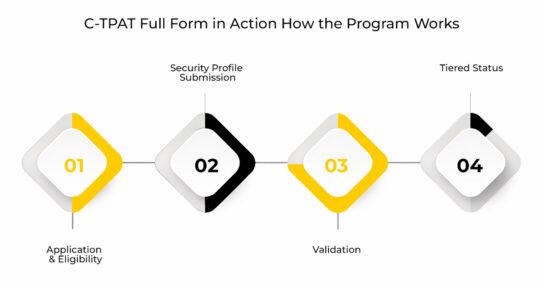
With some basic knowledge of the full form of C-TPAT and the C-TPAT definition, it is now time to discuss the functioning of the C-TPAT program.
Step 1: Application and Eligibility
Every company is not eligible for the C-TPAT certification. There is an eligibility criterion based on which only some companies are allowed to be a part of the C-TPAT program. These entity types include the following: US importers; US/Canada and US/Mexico highway carriers; rail and sea carriers; air carriers; licensed US customs brokers; US marine port authority and terminal operators; US freight consolidators; Mexican and Canadian manufacturers.
Step 2: Security Profile Submission
Once the company becomes eligible to join the C-TPAT program, it needs to submit its security profile. In this document, the company explains to the CBP the measures it takes to fulfill the requirements of CBP’s minimum security criteria in different areas such as physical security, personnel security, information technology security, conveyance security, and procedural security.
Step 3: Validation
Once the form has been submitted, CBP Supply Chain Security Specialists (SCSS) will validate the security profile by verifying that the business’s security practices match up with its profile in a face-to-face inspection. Validations are usually performed every three years at a minimum for current C-TPAT members.
Step 4: Tiered Status
C-TPAT compliance is categorized according to a three-tier system, which consists of Tiers 1, 2, and 3, which indicate basic C-TPAT certification, validated status once CBP verifies the company’s security practices, and tier 3, which is awarded to companies with excellent security practices and are named C-TPAT Partners of Excellence.
C-TPAT Certification: Benefits That Make It Worth Pursuing
-
Reduced Cargo Inspections
A business that receives C-TPAT certification will be recognized by CBP as a low-risk entity. Thus, its cargo will be subject to less physical inspections, which means that there will be no need to spend additional money on delayed cargo, storage fees, and the possible damage to cargo while it is being inspected.
-
Expedited Processing
Being a member of C-TPAT, a business may enjoy expedited processing through border crossings, especially if it has been granted Tier 2 or Tier 3 status.
-
Access to Free and Secure Trade (FAST) Lanes
With C-TPAT certification, it becomes possible for carriers and importers to use FAST lanes when crossing the borders from Canada and Mexico.
-
Improved Business Reputation
By getting a C-TPAT certification, a company is likely to increase its reputation in the market. Moreover, such certification is becoming an important criterion for vendor qualification.
-
Alignment with Global Standards
The C-TPAT program is internationally accepted and conforms to the WCO SAFE Framework of Standards. Businesses with a C-TPAT certificate generally experience an easier time meeting standards in other nations, including the European Union’s Authorised Economic Operator (AEO) Program.
C-TPAT Compliance: What You Need to Maintain Your Certification
C-TPAT certification is only the first step. C-TPAT compliance is an ongoing process that entails continued dedication and hard work. The following is what is expected of certified organizations:
- Reviewing and modifying the organization’s security profile according to changes in its supply chain operations
- Verifying the security practices of newly acquired business partners and suppliers to ensure compliance with C-TPAT requirements
- Educating workers about the necessary procedures for supply chain security and reporting suspicious activities
- Working closely with CBP officials when they conduct validation assessments
Failing to comply with C-TPAT requirements will lead to the suspension or termination of participation in the program, causing the company to forfeit all the advantages of C-TPAT membership.
C-TPAT vs. Other Trade Security Programs
It may be useful to compare C-TPAT with other such programs to get a better idea of its place in the international trading world.
AEO (Authorised Economic Operator): Similar to C-TPAT but an initiative by the European Union.
PIP (Partners in Protection): A similar initiative by the Canadian government that works parallel to C-TPAT when conducting cross-border transactions between Canada and the United States.
STP (Secure Trade Partnership): Singapore’s initiative that meets the WCO SAFE Framework requirements just like C-TPAT.
Large multinational companies often go after many such certifications to facilitate their global business processes. C-TPAT certification usually acts as a good starting point for such endeavors.
>Helpful Guide:- C-TPAT vs AEO: Key Differences & Which One Indian Exporters Need
Key Takeaways
- Customs-Trade Partnership Against Terrorism is the full form of C-TPAT.
- C-TPAT certification provides numerous advantages, such as reduced number of cargo checks, expedited border clearance procedures, and eligibility for FAST lane use.
- The C-TPAT program functions through tiers, with Tier 3 being the highest point for achieving supply chain security proficiency.
- C-TPAT adherence is a continuous process that involves keeping updated with security profiles, staff education, and managing partners.
- Although not compulsory, C-TPAT certification is becoming progressively mandatory for U.S. importers and may influence supplier choices.