

If you manufacture or export any products in Europe, you must have seen the CE mark before. But what does the term mean, and why is it so significant for international trade? To gain insight into the significance of this term, let’s delve into the definition of the CE mark full form.
This CE mark guide covers the complete details of the CE mark requirements, comparison to other certification systems, among others, thus helping you understand the entire process of complying with EU standards.
What Is the CE Mark Full Form
The full form of the CE mark is Conformité Européenne, which means European Conformity in English. The CE mark is a required conformity symbol for any product available for sale in the European Economic Area (EEA). The EEA consists of all 27 EU member states along with Iceland, Norway, and Liechtenstein.
CE mark full form for exporters to Europe can be explained as follows: when a manufacturer places the CE mark on a product, they are asserting that it complies with all the relevant EU directives and regulations. The CE mark does not serve as a quality label awarded by any government authority. Instead, the CE mark is simply an assertion by the manufacturer, often confirmed by an independent Notified Body, regarding the compliance of the product to all EU safety requirements.
The CE marking originated during the 1990s in connection with the EU New Approach legislation. It was designed to facilitate trade among EU member states by ensuring that all products conform to consistent safety requirements throughout the EEA. At present, the CE mark covers more than twenty types of products.
CE Mark and What It Means for Products
CE mark meaning requires more than just the definition of what it means. The CE mark has legal significance. A product displaying the CE mark shows that it has complied with the required assessment procedures and conforms to all the safety requirements set by the EU regarding CE marking.
The CE marking system does not provide any guarantee of quality in the business environment. Rather, the CE marking assures that the goods fulfill all the basic safety, health, and environmental requirements set out in the specific EU directive. In this regard, for instance:
- A power tool with CE marking indicates that it fulfills the standards of the Machinery Directive and the Low Voltage Directive.
- A device for use in medicine with CE marking adheres to the EU MDR regarding clinical evaluation and post-market surveillance.
- A children’s toy with CE marking has passed all the tests for safety under the Toy Safety Directive, including mechanical, physical, chemical, and electrical safety.
The lack of the CE mark where required disqualifies such products from being legally sold in the EEA market. Each EU country has its authorities that constantly check for adherence to these standards and have the right to order recalls, ban sales, and impose penalties on non-compliant manufacturers or importers.
CE Mark Full Form: Meaning, Importance & Certification Guide (2026)
Unlock seamless access to European markets with trusted CE compliance & certification guidance.
CE Mark in Medical Devices Compliance
Amongst all the other types of products, CE mark full form in medical device compliance is most significant from a regulatory standpoint. EU Medical Devices Regulation (MDR 2017/745) and In Vitro Diagnostic Regulation (IVDR 2017/746) set the standards for the certification of medical products used within the European region.
Medical devices are divided into several risk classes starting from low-risk Class I (for instance, dressings), medium-risk Class IIa (such as dental x-ray machines), moderate-risk Class IIb (ultrasonic scanning systems) and high-risk Class III (implantable cardiac devices) etcetera. As far as higher risks go, the greater involvement of Notified Body in assessing their compliance is required.
Notified Body is the name of an independent institution authorized by a country in the EU to certify compliance. Those companies which manufacture medical products but sell them out of the European region such as India, USA or China are required to apply CE mark for their product as per requirements of MDR that includes clinical evidence, technical documentation, quality management system ISO 13485 etc.
Thus, CE mark full form in medical device compliance is far more than just the marking on the package.
CE Mark Full Form and Global Trade Requirements
The full form of CE mark is increasingly being linked to the requirements of global trading because of the growing importance of standards in international trade. For manufacturers from nations such as India, China, Brazil, and South Korea, among others, the CE mark is the first international certification mark sought for European markets.
Internationally, the CE mark is synonymous with credibility in terms of conformity. In several countries, import regulations require the use of CE marks or at least accept CE marks as a good indication that the items comply with safety standards. In the UK, there is a UKCA mark, which is the equivalent of the CE mark following Brexit. However, the CE mark is still accepted on most products until other transition periods expire.
In India, knowledge about the CE mark is important for exporting firms. This is because although the country has a BIS certification process and product-based requirements, they are not automatically recognized in Europe. For manufacturers that seek to export electronics, machinery, toys, personal protective equipment, and medical devices into the European Union, the only way out is to undergo the CE mark process.
Apart from CE mark full form, other global trade needs include retaining technical files for at least 10 years following the end of market life of the products, appointing an Authorized Representative within the European Economic Area if the manufacturer is from outside Europe, and registering some products in European Union databases like EUDAMED for medical devices.
CE Mark Requirements: What You Need to Know
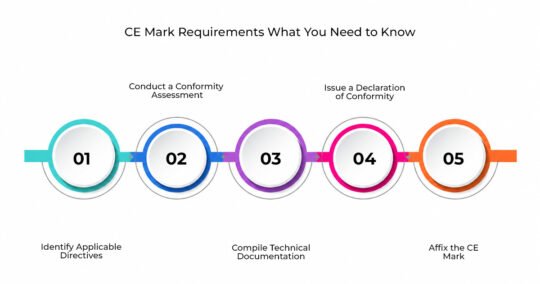
The requirements for CE marks vary according to the nature of the goods and the relevant EU directive or regulation. Nevertheless, the following are generally the processes necessary to gain a CE mark:
Step 1: Identify Applicable Directives
The first process involves identifying the relevant EU directive for the type of goods that have been produced. A single product may have to conform to several directives at the same time. For instance, wireless medical equipment would be governed by both the Medical Device Regulation and the Radio Equipment Directive.
Step 2: Conduct a Conformity Assessment
A manufacturer will either carry out the conformity assessment independently (where he is allowed) or have it done by a Notified Body. It involves checking the conformity of the product against the set standards.
Step 3: Compile Technical Documentation
Technical documentation needs to be compiled and should include product descriptions, designs, instructions for usage, risk assessments, among other aspects.
Step 4: Issue a Declaration of Conformity
When conformities are proven, the manufacturer makes a EU Declaration of Conformity, which states that the product is fully compliant with all relevant standards. The Declaration should be saved and submitted to authorities if requested.
Step 5: Affix the CE Mark
At this point, the CE marking is applied to the product, package, and/or instructions. There are certain specifications regarding the appearance of the mark, such as a minimum height of 5 mm.
CE Mark vs ISO Certification: Understanding the Difference
The topic of CE mark vs ISO certification has confused many manufacturers and exporters for years. Even though both CE marking and ISO certifications have something in common, they play totally different roles.
CE marking is a mandatory requirement for any product exported to the European Economic Area. It refers to specific products according to EU directives. CE mark vs ISO certification becomes an interesting point of view as only having CE marking will enable you to sell a product in Europe.
ISO certifications are internationally recognised standards that have been developed by the International Organisation for Standardisation. They are non-mandatory and cover a variety of areas such as quality management system ISO 9001, environmental management ISO 14001, and medical device quality management ISO 13485.
What is more, having ISO certification may help you get through CE marking easier. For example, if your company manufactures medical devices and has ISO 13485 certification, it means that your quality management system complies with the requirements of the EU MDR, although it does not mean your product will be marked with CE symbol.
>Helpful Guide:- ISO 9001 Certification Process (Step-by-Step)
CE Mark Safety Standards: The Technical Backbone
CE marking safety standards are the technical criteria that need to be satisfied by a product before the CE mark can be applied to it. They are called harmonized standards, and they are listed in the Official Journal of the European Union. If a product is produced in accordance with appropriate harmonized standards, it is considered to comply with the essential requirements of the corresponding directive.
Some of the most common CE marking safety standards include EN 60335, which applies to household appliances; EN 62368, which applies to audio/video and IT equipment; EN ISO 10993, which applies to biocompatibility of medical devices; and EN 1888, which applies to child care articles.
Harmonized standards are not compulsory for manufacturers. In fact, they can develop other technical solutions to prove compliance. Nonetheless, this is the easiest route to take, and it will significantly minimize the likelihood of non-compliance.
How Long Does CE Mark Certification Take
One of the most commonly asked questions by those companies which are preparing themselves to introduce their product into the European market is related to how long the process would take. The duration depends on various circumstances:
- Product category and hazard level: low-risk devices which do not require a third-party assessment are likely to be certified in only 4 to 8 weeks provided tests are completed quickly.
- Use of Notified Bodies: for those products which cannot be CE-marked without an independent Notified Body’s opinion, the certification process may take anywhere from 6 months to 2 years, especially when it comes to medical equipment or machinery.
- Technical file preparation and documentation: companies which have prepared their technical documents and test results will go through the procedure much faster than others.
- Backlog at testing laboratories and Notified Bodies: laboratories and Notified Bodies might have some backlog in testing products in certain categories of goods.
For consumer goods and electronics, the certification process would generally take 3 to 6 months to complete. For medical devices of Class III, the process would usually take from 18 to 24 months.
Key Takeaways
- The complete meaning of the CE marking is Conformité Européene. In French, it translates to “European Conformity.” The CE marking is mandatory for certain product groups to be sold within the European Economic Area (EEA).
- The CE mark ensures compliance with all relevant EU directives concerning health, safety, and environmental protection of products before being launched into the market.
- The relevance of the CE mark in India is growing because Indian exporters who wish to sell their products in the European Union countries must obtain the CE mark.
- The CE marking criteria vary based on the product category, and it involves testing, documentation, Declaration of Conformity, and sometimes third-party certification.
- The CE mark and ISO certification are often confused, but their distinction lies in the fact that the former is mandatory while the latter is voluntary.
Frequently Asked Questions
What is CE mark full form?
The full form of CE mark is Conformité Européenne, which means European Conformity in English.
CE mark full form explained for exporters to Europe, what does this mean practically?
It means that the exporter has applied a CE mark to his/her product as the product conforms with the EU regulations and is suitable for sale throughout the European Economic Area.
Why is CE mark important for products?
It is absolutely necessary for their commercialization in the European Union. Without the CE mark, it becomes illegal to sell, import, or distribute any controlled category product in the European Union.
What is the difference between CE mark and ISO?
CE marks are legally required by product regulations before entering the EU market, but ISO certifications are internationally recognized voluntary quality and management system standards.
How long does CE mark certification take?
The duration of CE mark certification typically ranges between 4 weeks for simple or low-risk products requiring a declaration of conformity up to 18–24 months for complex or high-risk products such as Class III medical devices.
What is CE mark full form in medical devices compliance?
The full form of CE mark for medical device compliance is Conformité Européenne, and its acquisition via EU MDR entails a clinical assessment, involvement of the Notified Body, and a quality management system conforming to ISO 13485.
How does CE mark full form and global trade requirements connect for Indian manufacturers?
The relationship between CE mark full form and global trading requirements is that CE marking is mandatory for exports of regulated products to the EU irrespective of any domestic Indian certification.