India’s food licensing regulations have undergone a major change. On March 10, 2026, the Ministry of Health and Family Welfare issued a Gazette Notification No. RCD-01002/1/2021-Regulatory-FSSAI-Part(1), completely revamping the FSSAI licensing system, which applies to all food businesses in the country.
The revised regulations will come into effect from April 1, 2026. If you are planning to open a restaurant, cloud kitchen, or a home-based bakery, or any other food-related business, the information you may have been reading online regarding the fees and other details are now outdated. This article provides you with the updated information.
Changes Made in 2026
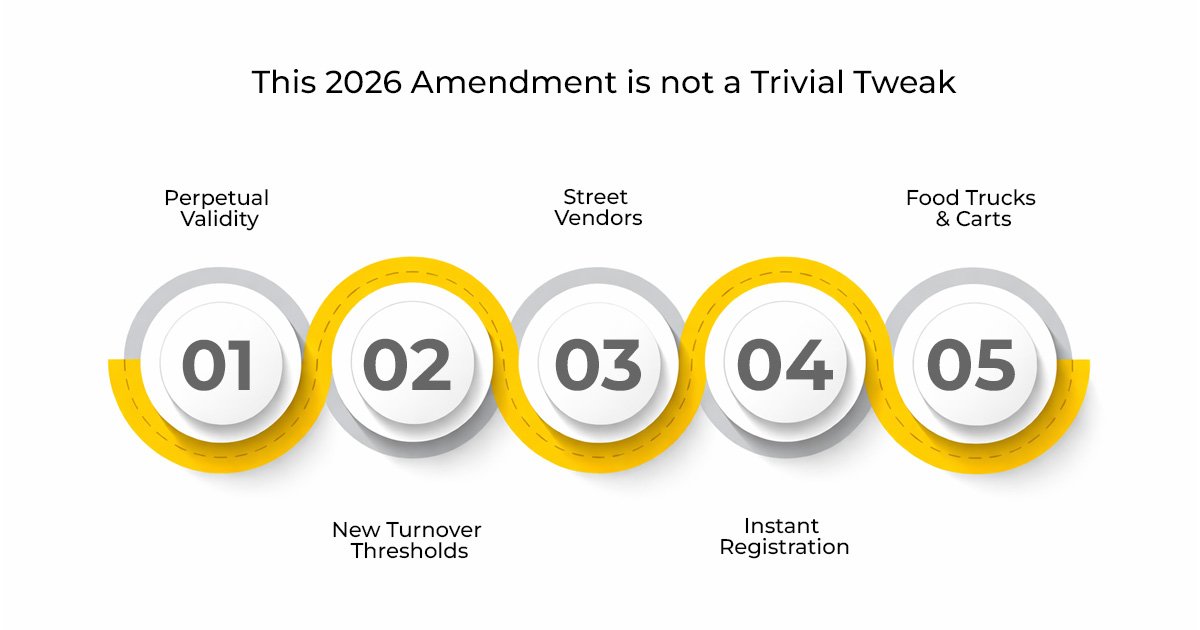
This 2026 amendment is not a trivial tweak, as it brings in six significant structural changes, which affect the way in which food businesses register, comply, and are inspected. Here’s a brief overview:
| What Changed | Old Rules | New Rules (From Apr 1, 2026) |
|---|---|---|
| Basic Registration Limit | ₹12 Lakh turnover | ₹1.5 Crore turnover |
| State License Limit | Up to ₹20 Crore | Up to ₹50 Crore |
| Central License Limit | Above ₹20 Crore | Above ₹50 Crore |
| License Validity | 1–5 years (renewal required) | Perpetual (annual fee only) |
| Street Vendors | Separate FSSAI registration needed | Deemed registered under Street Vendors Act |
| Instant Registration | Not available | Now available for petty FBOs |
| Food Trucks / Carts | Ambiguous category | Explicitly included under Petty FBO |
| Inspections | Fixed schedule | Dynamic risk-based framework |
- Perpetual Validity
FSSAI licenses are now valid forever. The earlier practice of issuing a license for 1 to 5 years period and the renewal cycle have been completely discontinued. Your license will be valid indefinitely provided you pay the prescribed fees every year and submit your Food Safety Compliance Report (FSCR) annually. If you fail in either of the two, your license will be suspended.
- New Turnover Thresholds
The Basic Registration limit has been raised from 12 lakh to 1. 5 crore. The limit for State License has been increased from 20 crore to 50 crore. As a result, thousands of food businesses will be eligible for a smaller license type, which also happens to be less expensive.
- Street Vendors
Vendors on the street who are already registered in accordance with the Street Vendors (Protection of Livelihood and Regulation of Street Vending) Act, 2014 will be hereafter considered registered under the FSSAI. No separate registration will be needed, though, they are still required to meet the hygiene standards as per Schedule 4.
- Instant Registration
Now small and petty food business operators can get registration certificates instantly after making a payment of a fee of 100 through the FoSCoS portal. There is no waiting time in the process which makes it significantly faster to get started legally.
- Food Trucks & Carts
Food trucks, food carts, and other mobile food units were considered as a grey area under the current FSSAI guidelines at times causing confusion as to which license they should apply for. However, the 2026 amendment has explicitly declared food trucks and food carts as Petty FBOs for licensing purposes, thus giving food truck operators a clear license for the first time.
- Risk-Based Inspections
The current system of carrying out inspections every fixed period is being replaced by risk-based ones. Now, there will be more regular inspections of high-risk food businesses and fewer ones in low-risk food businesses. This change will ensure that food businesses that follow the rules will get interrupted less and enforcement will be concentrated on areas where offenders exist.
>Helpful Guide:- FSSAI License Documents Required (Complete Checklist 2026)
FSSAI License Fees 2026
FSSAI licenses are issued in three categories depending on your annual turnover. All figures below are effective April 1, 2026, as per official Gazette Notification.
| Category | Old Threshold | New Threshold (From Apr 1, 2026) | Govt Fee/Year |
|---|---|---|---|
| Basic Registration | Up to ₹12 Lakh | Up to ₹1.5 Crore | ₹100 |
| State License | ₹12 Lakh to ₹20 Crore | ₹1.5 Crore to ₹50 Crore | ₹2,000 to ₹5,000 |
| Central License | Above ₹20 Crore | Above ₹50 Crore | ₹7,500 |
Basic Registration
Basic Registration is a category which is most suitable for small and petty Food Business Operators (FBOs). As per the new regulations, any food business operator whose turnover is up to ₹1.5 crore in a year can apply, which is a great jump from the earlier ₹12 lakh. The government fee is only ₹100 per annum. A lot of businesses that were required to have a State License will now be eligible for the simpler Basic Registration category. It is likely that you will be a Basic Registration candidate if you are a home bakery owner, a tiffin service owner, or a street food stall owner.
State License
State Licenses mainly cover mid-sized food businesses located within one state only. The annual fee can be anywhere from ₹2,000 to ₹5,000 depending on the category of the food business, production capacity, etc. Increasing the threshold limit to ₹50 Crore comes as a breath of fresh air to growing food businesses. Previously, if a food business generated revenue of ₹25 Crore, it would be required to obtain a Central License. Now, a food business can continue with a State License up to ₹50 Crore.
Note: If you are a seller on online food delivery apps, at least a State License is a must, regardless of your revenue as they need state-wise product tracking for their own regulations.
Central License
Central licenses are granted to large food enterprises, importers, and businesses working in several states. The government levies a license fee of ₹7,500 yearly. If your business has a turnover of over ₹50 crore annually, you will need a Central License. This also applies to food delivery services crossing multiple states and restaurants having outlets in different states.
What does Perpetual Validity mean?
This is a major change in the 2026 amendment. The previous FSSAI license system had a validity period of 1 to 5 years, and license renewal before the expiry date was a mandatory activity. But from 10 March 2026 it would be the case that the validity of FSSAI licenses is perpetual. This is to say that as long as you follow the rules your license will never expire. You do not have to renew, keep checking it, or have any concerns about it expiring. Yet it is of course recognized that a lifetime license still isn’t for free.
There are two annual requirements which are unavoidable:
Annual fee payment: It is mandatory for you to pay the annual fee to the government.
FSCR: Food Safety Compliance Report has to be submitted every year.
If you fail in either one, your license will be suspended automatically, and will only be reinstated after you have paid all the dues plus any penalties that may apply. The suggestion of locking in 5 years has no basis now since multi-year terms are no longer valid in the new system.
>Helpful Guide:- How to Download FSSAI License Certificate Online (Step-by-Step)
FSSAI Fees for Manufacturers
For food manufacturers, the State License Fee is dependent on your turnover as well as your installed production capacity. The following is the fee structure depending on capacity per shift:
| Production Capacity (Per Shift) | License Category | Govt Fee/Year |
|---|---|---|
| Up to 100 kg / 100 litres | Basic Registration (if turnover qualifies) | ₹100 |
| 100 kg – 1 MT / 100 – 500 litres | State License | ₹2,000 |
| 1 MT – 2 MT / 500 – 2,000 litres | State License (higher capacity) | ₹3,000 – ₹5,000 |
| Above 2 MT / above 2,000 litres | Central License (if turnover also qualifies) | ₹7,500 |
The criterion that is higher between the two, turnover or capacity, is the criterion used in the determination of the type of license. If you qualify under Basic Registration in terms of turnover but your capacity is more than 1 MT per shift, you will need a State License.
Total Cost of Getting an FSSAI License
While obtaining an FSSAI license, one should note that the cost of obtaining an FSSAI license is not just the government fee. The actual cost of obtaining an FSSAI license varies depending on the category of your license, the complexity of your business, and whether you are obtaining the license yourself or through a professional. Here’s a complete breakdown of the cost of obtaining an FSSAI license to help you plan your budget.
Government Fee (Mandatory for All Applicants)
This is the statutory fee paid to FSSAI through the FoSCoS portal. It is non-negotiable and does not vary by location or service provider.
| License Type | Annual Government Fee |
|---|---|
| Basic Registration | ₹100 |
| State License | ₹2,000 – ₹5,000 |
| Central License | ₹7,500 |
For State Licenses, the amount within the bracket of ₹2,000 to ₹5,000 will vary depending on the food business activity (manufacturer, trader, storage, transport, etc.) and your installed production capacity.
Consultant Charges
The majority of applicants, especially new entrants, seek the assistance of a compliance consultant or a legal service to help them prepare their documents and fill in their forms correctly to avoid rejection. Charges differ depending on the complexity of the application.
| License Type | Typical Professional Charges |
|---|---|
| Basic Registration | ₹500 – ₹2,000 |
| State License | ₹3,000 – ₹8,000 |
| Central License | ₹5,000 – ₹15,000 |
>Helpful Guide:- FSSAI License For Cloud Kitchen: Fees, Documents & Apply Online
Document Preparation Costs
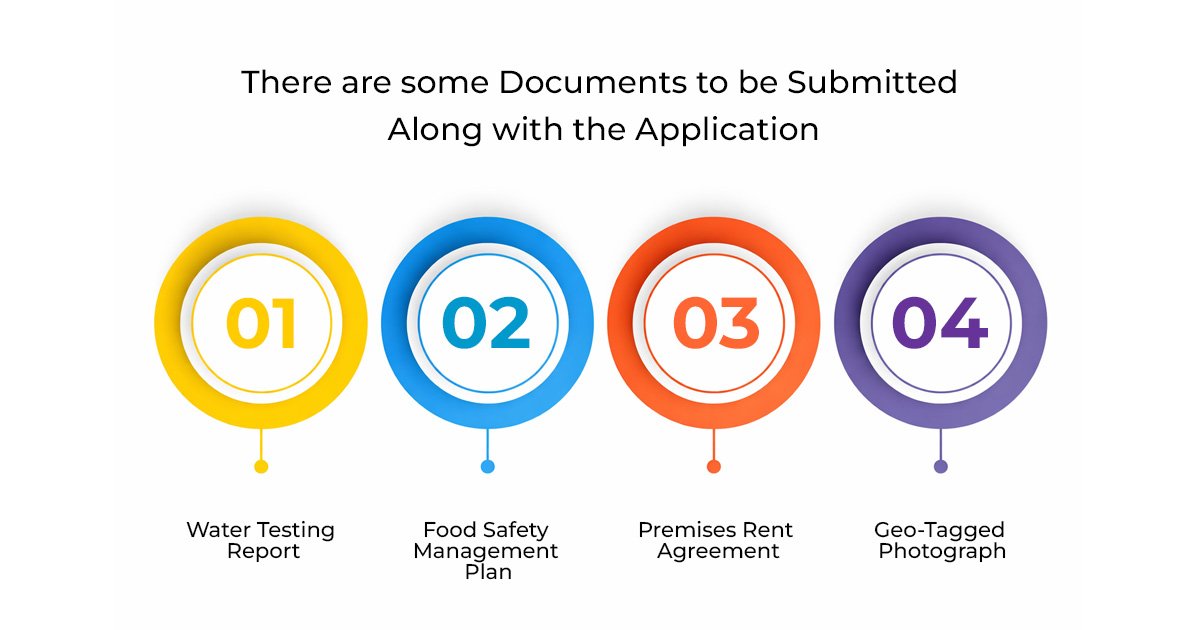
There are some documents to be submitted along with the application, which have a cost attached to them, especially for food manufacturers and food processing companies.
Water Testing Report: This document is required for food manufacturers and food processing companies. The cost of a water testing report, which involves a certified laboratory test for water, varies from ₹500 to ₹1,500 depending upon the laboratory.
Food Safety Management Plan (FSMP): This document is a must for food manufacturers who are seeking a State or Central License. The cost of hiring a food safety consultant to prepare this document varies from ₹2,000 to ₹5,000, which is a one-time cost for this document only.
Premises Rent Agreement / NOC: If your business premises are rented, you need to get a registered rent agreement or a NOC from the owner of the premises. The cost of a rent agreement varies from ₹200 to ₹1,000.
Geo-Tagged Photograph: According to the new rules of 2026, a geo-tagged photograph of your premises is a must, which involves a photograph taken from your smartphone with location services enabled. There are some consultants who charge a small amount if they need to go to your premises to take the photograph.
Total Cost Estimate (All-In)
Here is a realistic estimate of the cost of a new application in a straightforward scenario, combining government fees, professional charges, and basic document preparation:
| License Type | Govt Fee | Professional Charges | Document Costs | Approx. Total |
|---|---|---|---|---|
| Basic Registration | ₹100 | ₹500 – ₹2,000 | Minimal | ₹600 – ₹2,500 |
| State License (Trader/Retailer) | ₹2,000 | ₹3,000 – ₹5,000 | ₹500 – ₹1,000 | ₹5,500 – ₹8,000 |
| State License (Manufacturer) | ₹3,000 – ₹5,000 | ₹5,000 – ₹8,000 | ₹2,000 – ₹6,500 | ₹10,000 – ₹19,500 |
| Central License | ₹7,500 | ₹8,000 – ₹15,000 | ₹3,000 – ₹7,000 | ₹18,500 – ₹29,500 |
>Helpful Guide:- FSSAI License Renewal Online: Fees, Penalty & Last Date
How to Apply for an FSSAI License Online
- Step 1: Create your Account
-
-
- Visit the website foscos.fssai.gov.in.
- Click on Sign Up and enter your name, mobile number, and email address.
- Create your FBO account by entering the OTP sent on your registered phone number and create a password.
-
- Step 2: Check Eligibility
-
-
- After creating your account, login by entering your email address and password.
- Click on Apply for New License/Registration.
- Choose the State in which your business is located.
- Answer a series of questions on the Nature of Your Business (e.g., Manufacturing, Retail, Food Services).
- The website will automatically determine whether you need a Basic Registration License or a State/Central License based on your business turnover and capacity.
-
- Step 3: Fill the Application
-
- If you are applying for a Basic Registration License, fill out the details in Form A.
- If you are applying for a State or Central License, fill out the details in Form B.
- Enter your business details, the food categories that your business deals in, and the number of years for which you want a license (1-5 years).
- Step 4: Uploading the Documents
The 2026 portal strictly requires flatbed scans.
| Type of License | Key Documents Required |
|---|---|
| All Categories | Photo of applicant, ID Proof, and Address Proof of premises. |
| State/Central License | Blueprint of the layout, List of machinery/equipment, Water analysis report, and FSMS Plan. |
| Manufacturing | Manufacturing process flow chart and list of food categories. |
| 2026 Special | Geotagged photos of the premises showing longitude and latitude. |
- Step 5: Fee Payment & Submission
-
- The fees need to be paid online via UPI, Net Banking, or Credit/Debit card.
- After the fees payment, a 17-digit Application Reference Number will be sent.
Note: The status can be checked by entering the Application Reference Number in the Track Application section on the homepage.
- Step 6: Inspection and Approval
-
- Basic: The license is usually issued in 7-10 days without a physical inspection.
- State/Central: An inspection may be scheduled under the new risk-based inspection framework before the license is issued. Processing time for State and Central Licenses is usually between 30 to 60 days, depending on the licensing authority and inspection requirements.
Conclusion
The amendments by the FSSAI coming into effect from April 1, 2026 would be the biggest changes to the food license system in India in recent times. By raising the thresholds, many small businesses will be able to avail the simpler licensing process. A license will be valid forever, so there will be no more license renewal hassles. Besides that, new rules for street vendors and food trucks will bring a good number of informal food businesses into the formal compliance system.
In case you have an FSSAI license at present, you must check if the category in which you were licensed fulfills the turnover criteria of the new thresholds. If based on your earnings, it turns out that now you fall below the Basic Registration level of 1.5 crore, you can opt for the lower category licensing and also reduce your yearly fee drastically.
Those who are new applicants need to figure out the right category according to the new thresholds before they make an application on the FoSCoS portal.
>Top trending Guide:- BRC Full Form, Meaning, Certification Process & Cost in India (2026 Guide)
Frequently Asked Questions
How much is the FSSAI license fee in India 2026?
Government fees for Basic License is ₹100, for State License it is ₹2,000–₹5,000 and for Central License it is ₹7,500. These costs don’t include professional charges.
Do I need to renew my FSSAI license after March 2026?
No, the renewal process has been removed from March 10, 2026, with perpetual validity being applicable to all licenses.
What is the new FSSAI Basic License threshold?
The threshold limit has been increased from ₹12 lakh to ₹1.5 crore annual turnover, applicable from April 1, 2026.
What is the fee for FSSAI license in India in the year 2026?
Government fee for Basic License is ₹100, for State License it ranges from ₹2,000 – ₹5,000 and for Central License it is ₹7,500. These prices do not cover professional service charges.
Am I supposed to renew my FSSAI license after March 2026?
No, the renewal procedure has been abolished from March 10, 2026 as all licenses will be granted perpetual validity.
What is the updated FSSAI Basic License threshold?
The limit for threshold has been raised from ₹12 lakh to ₹1.5 crore in terms of annual turnover. This will take effect from April 1, 2026.
How has the turnover limit for FSSAI State License been changed?
The limit has gone up from ₹20 crore to ₹50 crore, which means that companies with an annual turnover of ₹20 crore to ₹50 crore will not be required to get a Central License. A State License will be enough for them.
Which FSSAI license must I have if I sell through Swiggy and Zomato?
A State License is required for any kind of e-commerce platform listing, irrespective of your turnover, as platforms need state level tracking of the products.
What will happen if I don’t pay my FSSAI annual fee?
Non-payment of fees will result in the automatic suspension of your license under the 2026 rules, and you cannot legally operate your food business.
Are street food vendors now automatically registered with FSSAI?
Yes, street vendors registered under the Street Vendors Act, 2014 are automatically considered registered with FSSAI and do not require a separate application. However, they must comply with the hygiene standards of the FSSAI regulations.
How much is the total FSSAI license cost including consultant fees?
| License Type | Govt Fee | Professional Charges | Approx. Total |
|---|---|---|---|
| Basic Registration | ₹100 | ₹500 – ₹2,000 | ₹600 – ₹2,500 |
| State License | ₹2,000 – ₹5,000 | ₹5,000 – ₹8,000 | ₹7,000 – ₹13,000 |
| Central License | ₹7,500 | ₹8,000 – ₹15,000 | ₹16,000 – ₹22,500 |