
The majority of ISO 22000 audit failures in India do not arise because businesses in India have poor food safety practices. They arise because they never translated their food safety practices into a system that can be audited. ISO 22000 audit preparation is the bridge between what you do well in your business and what the standard requires you to do well. This blog will serve you as a complete iso audit guide and get a complete 30-day ISO audit checklist. It will also help you understand exactly what auditors want to see at each stage of the ISO audit process. You’ll also learn exactly what you’ll need to have in place before your certification date.
What Auditors Actually Look For During an ISO 22000 Audit
Before you construct your preparation strategy, you have to grasp the auditor’s view. An ISO 22000 auditor is not seeking perfection; they are seeking proof that a process is functioning. This means that they are seeking documented intent as well as records to support that intent. Three failure modes are responsible for most non-conformities in Indian food businesses:
| Failure Mode | What the Auditor Finds | Typical Result |
| Documentation without practice | SOPs on file that no one follows on the floor | Major non-conformity |
| Practice without documentation | Good procedures running, but nothing recorded | Minor non-conformity |
| Gaps in records | Incomplete monitoring logs, missing dates or signatures | Minor or major depending on scope |
ISO 22000 Audit Preparation – What Happens at Each Stage
A complete understanding of the ISO audit process can help you prepare specifically for all the phases rather than considering the audit process in general. This is what happens in the complete ISO audit process:
| Audit Stage | What Happens | Your Key Preparation Task |
| Stage 1 – Document Review | Auditor reviews FSMS documentation off-site or on-site. Check whether your documented system meets the standard. | Ensure all FSMS documents are complete, version-controlled, and cover all clauses of ISO 22000:2018. |
| Stage 2 – On-Site Audit | The auditor visits the facility, interviews staff, observes operations, and cross-checks records against documented procedures. | Brief all department heads. Ensure records are accessible and staff can articulate their food safety responsibilities. |
| Surveillance Audit (Year 1&2) | Subset of clauses re-audited to confirm continued compliance and corrective action closure. | Keep corrective action register live. Do not allow surveillance to catch you off-guard, treat it like a full audit. |
| Recertification Audit (Year 3) | Full reassessment of the FSMS. Equivalent to a new certification audit. | Begin recertification preparation 3 months before expiry. Run a full internal audit cycle first. |
A complete iso audit guide can help you prepare specifically for all the phases rather than considering the audit process in general.
Helpful Guide:- ISO 22000 Validity in India , How Long It Lasts, Renewal Process & What Happens If It Lapses
30-Day ISO 22000 Audit Preparation Checklist for India
The ISO audit checklist india-specific plan that this section offers will help to prepare your organization for an audit by breaking it down into four weeks of preparation. Each week will have a specific focus.
Week 1 (Days 1 to 7): Gap Assessment & Document Review
Begin by determining where you are, not where you would like to be. A gap analysis against the clauses in ISO 22000:2018 at this point in the journey eliminates any last-minute errors.
| Task | Owner | Deadline | Check |
| Run a full internal audit against all ISO 22000:2018 clauses | Internal Audit Team | Day 3 |
|
| Review and update the HACCP plan – CCPs, critical limits, monitoring | Food Safety Team Leader | Day 5 |
|
| Verify master document register is current and version-controlled | Document Controller | Day 5 |
|
| Confirm FSSAI licence is valid and scope matches certification scope | Quality Manager | Day 6 |
|
| List all outstanding corrective actions and assign closure deadlines | Food Safety Team Leader | Day 7 |
|
Week 2 (Days 8 to 14): Records, Training & Supplier Controls
Week 2 is all about the evidence layer, which refers to the evidence that demonstrates your system is actually operating and not merely documented. It is at this point that the majority of Indian food businesses face the most significant gaps.
| Task | Owner | Deadline | Check |
| Compile 12 months of CCP monitoring records and verify completeness | Production Supervisor | Day 9 |
|
| Update training register and run floor competency checks per role | HR / QA Team | Day 10 |
|
| Review approved supplier list – remove inactive, add evaluated ones | Procurement / QA | Day 11 |
|
| Verify CoAs retained for last 6 months of incoming materials | Stores / QA | Day 12 |
|
| Confirm all PRP monitoring logs are complete – pest control, hygiene | Facility Manager | Day 14 |
|
Week 3 (Days 15 to 21): Mock Audit & Non-Conformity Closure
This is the most operationally heavy week. The reason for doing a mock audit this week is to have time to close non-conformities before, not after, the audit.
| Task | Owner | Deadline | Check |
| Conduct a full mock audit walkthrough – all departments and shifts | Lead Internal Auditor | Day 16 |
|
| Close all major non-conformities from mock audit with root cause | Department Heads | Day 18 |
|
| Hold management review meeting – document outputs and action items | Top Management | Day 19 |
|
| Verify calibration records for all measuring equipment at CCPs | Maintenance / QA | Day 20 |
|
| Confirm validation evidence exist for each control measure | Food Safety Team | Day 21 |
|
Week 4 (Days 22 to 30): Team Briefing
The last week is to test how ready you are. So if you are still fixing major system gaps in Week 4, then you are in trouble. Week 4 is to confirm, brief, and organize everything.
| Task | Owner | Deadline | Check |
| Organise a document-ready room | Document Controller | Day 23 |
|
| Brief every department head on audit scope and what the auditor will check | Food Safety Team Leader | Day 24 |
|
| Confirm top management availability for opening and closing meetings | Quality Manager | Day 25 |
|
| Run operator level floor briefing – CCPs, hygiene, emergency response | Production Supervisor | Day 26 |
|
| Designate single auditor escort – confirm their role and schedule | Quality Manager | Day 28 |
|
| Final document check – version numbers, signatures, no blank fields | Document Controller | Day 30 |
|
>Helpful Guide:- ISO 22000 Certification Mistakes: 10 Common Causes of Certification Failure in India and How to Avoid Them
ISO 22000 Audit Preparation – Documents Required
Here’s a list of some of the most common documents requested in an ISO 22000 certification audit in India. The absence of any of these can result in a non-conformity.
| Document | ISO 22000:2018 Clause | Minimum Retention Period |
| Food Safety Policy and FSMS Scope | Clause 5.2 / 4.3 | Current version should be always accessible |
| HACCP Plan with hazard analysis documentation | Clause 8.5–8.8 | Retained for product shelf life + 1 year |
| CCP Monitoring Records | Clause 8.8.3 | Minimum 2 years or as FSSAI requires |
| Internal Audit Reports | Clause 9.2 | Minimum 3 years (full certification cycle) |
| Management Review Minutes | Clause 9.3 | Minimum 3 years |
| Corrective Action Records | Clause 10.1 | Minimum 3 years |
| Training and Competency Records | Clause 7.2 | Duration of employment + 2 years |
| Supplier Approved List & Evaluation Records | Clause 7.1.6 | Minimum 3 years |
| Certificates of Analysis | Clause 8.6 | Minimum 2 years or as per customer requirement |
| PRP Monitoring Logs | Clause 8.2 | Minimum 2 years |
| Calibration Records for CCP Equipment | Clause 8.7 | Minimum 3 years |
| Validation Evidence for Control Measures | Clause 8.5.3 | Retained for life of control measure |
What Auditors Look For During Their Visit
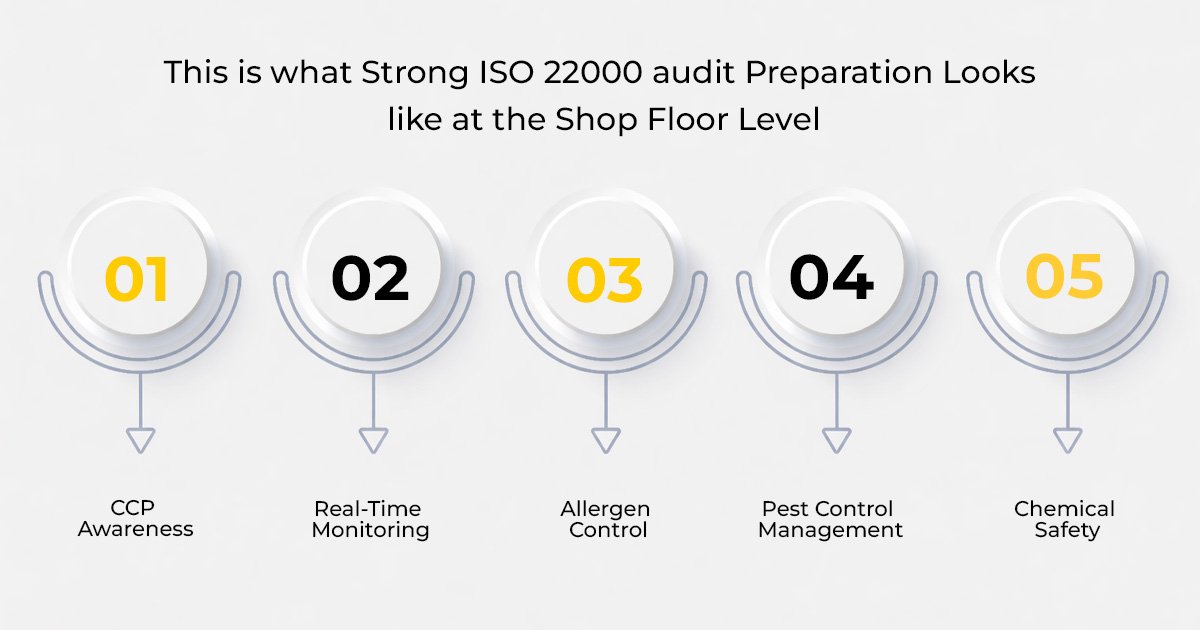
The on-site walkthrough is where an audit is won or lost. Good documentation will not save a facility if the people are not following procedures. This is what strong ISO 22000 audit preparation looks like at the shop floor level:
What Passes the Audit
- CCP Awareness: Operators clearly understand CCPs and know corrective actions when limits are exceeded.
- Real-Time Monitoring: Logs are completed instantly, properly signed, dated, and available at the point of use.
- Allergen Control: Allergen lines and production schedules are clearly documented and physically identified.
- Pest Control Management: Pest control maps accurately show bait station locations aligned with current service records.
- Chemical Safety: Chemicals are stored separately, properly labeled, with an updated COSHH/SDS register in place.
>Helpful Guide:- ISO 22000 Certification Cost In India – Expert Cost Breakdown
Key Takeaways
- An audit does not start when you walk into the auditor’s office. It starts when you start your gap audit team. Use a structured iso audit checklist from Day 1 to set the pace for everything that will follow.
- Do not update your documents a week before you start. Your SOPs change within 7 days. Your operators will not know them. Your records will not be up to date. The auditor will know. Stop updating your documents on Day 25.
- A document-ready room is not optional. Get your documents ready. This shows that you have a system that is maintained, not assembled for this audit. Refer to your iso audit guide when organizing documents so nothing critical is missed.
- A clean audit is not by accident. It is 12 months of internal audits, closing out corrections, management involvement, and 30 days of concentrated preparation.
>Top Trending Guide:- BRC Full Form, Meaning, Certification Process & Cost in India (2026 Guide)
Frequently Asked Questions
What all should be present in ISO 22000 audit preparation checklist india?
It should mainly contain gap assessment of ISO 22000 clauses, document version control, 12 months’ records, and closing mock audit findings.
How to pass ISO certification audit successfully?
Your written procedures should align with actual floor practices. Your operators should be able to explain what they are doing. Close all internal non-conformities with evidence.
ISO audit preparation guide food industry.
Prioritize HACCP accuracy, PRP documentation, supplier controls, and CCP monitoring because these are high-risk areas. Your success is dependent upon shop floor practices reflecting your Food Safety Management System (FSMS).
Which better ISO or haccp?
ISO 22000 is a robust management system that actually includes HACCP as part of its structure. HACCP is a tool for controlling hazards in an organization. ISO 22000 is a more global approach to improving your business.
ISO vs HACCP difference?
While HACCP is a tactical approach to address specific hazards in the process, ISO 22000 is a strategic solution covering commitment and improvement.
For how long is ISO food certification valid?
The ISO 22000 certificate is a 3-year validity certificate with yearly audits by NABCB bodies.
How far in advance should I start preparing for an ISO 22000 audit?
Start at least 30 days prior to certification, but if your internal audits have been behind, it may take 60 to 90 days.