
India ranks among the top organic produce suppliers across the globe, with organic farming in India being done on several million acres of land. However, with increased demand for organic products worldwide, there comes a point where India-based farmers and exporters have to make their minds as to which certification would be most appropriate. These include NPOP, NOP, and EU Organic certification. It is crucial to learn about the differences between NPOP and NOP as well as the EU organic and Indian organic certification schemes.
This guide breaks down all three standards in plain language so you can make the right choice for your export business.
What Is NPOP vs NOP Organic Certification: An Overview
A brief introduction about what NPOP and NOP stand for, along with their management organizations, will help us in our comparison.
NPOP – National Programme for Organic Production
India has its own national standard for organic products known as the National Programme for Organic Production (NPOP), which has been developed by APEDA – a statutory body under the ministry of commerce of India. This standard covers all stages of growing, manufacturing, labeling, and marketing of organic products both within India and also for export purposes.
NPOP certification enables the product to be exported to European Union and Switzerland countries through the bilateral agreement between the two parties.
NOP – National Organic Program (USA)
NOP is managed by USDA. This is the requirement for all exporters from India who want their products to be exported into the US as organic products. There is an MoU between India and USA that provides equivalence to Indian products certified under NPOP to NOP but only for unprocessed products from plants.
Processed organic products and livestock products need certification under NOP by a USDA-accredited certifying agent.
EU Organic Certification
The organic regulation of the European Union (EU 2018/848) serves as the benchmark for all the organic products marketed in the member countries of the European Union. India has bilateral equivalence with the European Union; that is, most of the products certified under NPOP are accepted, except that the certification agency needs to be accepted by the European Union.
>Helpful Guide:- Everything You Need to Know About Organic Certification
NPOP vs NOP Organic Certification: Key Differences at a Glance
This is a table for comparison to better understand the distinctions between the three different types of organic certification in India:
| Feature | NPOP | NOP | EU Organic |
|---|---|---|---|
| Governed by | APEDA / MoC, India | USDA, USA | EC, European Union |
| Primary Market | India & select exports | USA | EU countries |
| India Equivalence | Base standard | MOU with USDA (for some crops) | Bilateral recognition |
| Scope | Crops, livestock, processing | Crops, livestock, wild | Crops, livestock, aquaculture |
| Third-Party Audit | Required | Required | Required |
| Certificate Valid | 1 year | 1 year | 1 year |
| Cost (approx.) | Lower | Higher | Higher |
This table is a starting point – the nuances between certifications can significantly affect market access, labelling rights, and premium pricing.
NPOP vs NOP Organic Certification: Which Is Accepted in the USA and Europe From India
NPOP and the USA
One of the concerns that exporters from India have asked is: Is NPOP certificate valid in the USA? The answer is partially yes. As per the MoU on India-USA NPOP vs NOP equivalence, goods exported from India bearing NPOP certification can be labeled as organic products when entering into the United States as long as the export is one of the raw agricultural commodities like spices, pulses, cereals, etc.
However, in case of exports of processed organic food products, organic cosmetic products, and other livestock products, a full NOP certification would still be required.
NPOP and the EU
The NPOP scheme in India enjoys complete equivalency with the EU regarding most of the agricultural products. In other words, it means that if you have a NPOP organic certificate from any certified certifier, then you can easily ship your products in Europe as ‘organic’. The certifier must be listed as one of the approved control bodies of the EU.
If you are exporting and looking to know about which organic certification needs to be taken for shipment of goods to Europe, then you need to know that direct EU certification is necessary for aquaculture, wine, and certain processed products.
NPOP vs NOP Organic Certification: The Fine Print
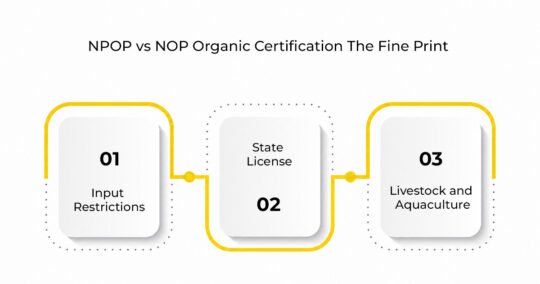
Though NPOP and EU organic products are perceived to be similar in many ways, there are a few distinctions that should be understood when considering EU organic versus Indian organic products.
Input Restrictions
The EU Organic Regulation (EU 2018/848) has put in place more stringent regulations regarding permitted substances from 2022 onwards. Certain inputs that are permissible under NPOP might not meet the requirements of EU regulations, specifically those inputs that are permitted synthetically in trace quantities.
Labelling Requirements
Those products that have the EU organic logo need to fulfil certain labelling requirements such as the use of the EU leaf logo, certifying body code, and origin of production. Those certified by NPOP that are sold in the EU need to follow certain labelling requirements despite the validity of the certification.
Livestock and Aquaculture
Aquaculture and organic livestock fall under the purview of EU organic certification and involve strict requirements concerning feed rations, outdoor exercise, etc. NPOP certification, on the other hand, does not cover these issues extensively, making parallel certification from the EU necessary in these cases.
NPOP vs NOP Organic Certification: Which Is Best for Indian Exporters
The choice between NPOP certification versus NOP certification or EU organic standards will be determined completely by your target destination and the type of products you intend to export.
Export to the USA
In case your destination is America, and you are exporting unprocessed plant-based produce, then NPOP certification (certified by an authorized agency) should work through the MoU agreement. In case you are exporting processed produce or animal-based products, then you must have NOP certification.
Export to Europe
In case of exports to the European market, NPOP is still the most viable way out in terms of bilateral agreement. This means saving money and time because you do not need EU certification separately.
Multi-Market Strategy
If your target markets include the US and Europe, you may want to go for the NPOP certification first (EU market coverage) followed by NOP certification by an accredited USDA agency for the US market. Most Indian exporters who have been around in the trade for a while now usually have both certifications under their belts.
NOP certification, however, is considerably more expensive than NPOP certification, including international auditing expenses. EU Direct Certification for organic produce is also a high-cost certification scheme.
>Read Also:- How to Transition to Organic Farming and Get Organic Certification
NPOP vs NOP Organic Certification: How to Choose the Right Organic Export Certification in India
Below is an outline that can be used as a decision-making tool when choosing between NPOP vs NOP organic certification and EU organic certification:
- Identify the target market: USA requires NOP certification, EU accepts equivalency of NPOP for most products.
- Verify whether the product category is covered by the MoU equivalency: not all products are covered by MoU equivalency.
- Consider the certifying organization: make sure that the NPOP-accredited organization is also approved in the EU third countries list.
- Determine the extent of the processing: raw products are usually covered by equivalency; processing products will require market specific certification.
- Prepare the budget: NPOP is the least expensive option; NOP and direct EU certification are more expensive but offer a larger premium market.
Key Takeaways
- NPOP is the Indian National Standard and the most cost-efficient way to initiate organic export certification in India, having bilateral equivalency with EU standards and partial equivalence to the US standards through the MOU.
- NOP Certification by USDA is compulsory if one plans to export their processed organic food and animal products to the USA, irrespective of whether they have received the NPOP Certification.
- NPOP-EU Organic equivalence applies to the majority of agricultural produce except for wine and aquaculture products.
- The distinction between NPOP and NOP certification is the difference in governing agency, scope, and cost since the former is governed by the Indian government and costs less than the latter.
- The combination of NPOP and NOP Certification is therefore the best way to target the US as well as EU markets simultaneously.
Frequently Asked Questions
What is the difference between NPOP and NOP certification?
NPOP is the Indian organic certification standard regulated by APEDA, while NOP is the US organic standard regulated by USDA. The main differences are jurisdiction, target market, certifier approval, and compliance requirements.
Is NPOP certification accepted in the USA?
Yes, NPOP-certified unprocessed plant products are accepted in the USA under a bilateral agreement. However, processed foods and animal-based products generally require USDA NOP certification.
Which organic certification is required to export to Europe?
For most product categories, NPOP certification is accepted for exports to Europe, provided the certifying body holds EU-recognized equivalence status.
NPOP vs NOP vs EU Organic: which is best for Indian exporters?
The best certification depends on the export destination. NPOP is commonly used for Europe, NOP is required for the USA, and many exporters choose dual certification to access multiple international markets.
What is the difference between NPOP, NOP, and EU organic certification in India?
NPOP is regulated by APEDA in India, NOP by USDA in the United States, and EU Organic by the European Commission. Each certification follows different regulations, markets, and compliance standards.
Which organic certification is accepted in the USA and Europe from India?
NPOP certification is widely accepted in Europe, while exports to the USA for unprocessed plant products may also qualify under the NPOP-USDA equivalence agreement.
How does EU organic vs Indian organic certification differ for processed foods?
EU organic certification has stricter rules regarding additives and processing aids for processed foods. NPOP equivalence may not apply to all processed food categories exported to Europe.