
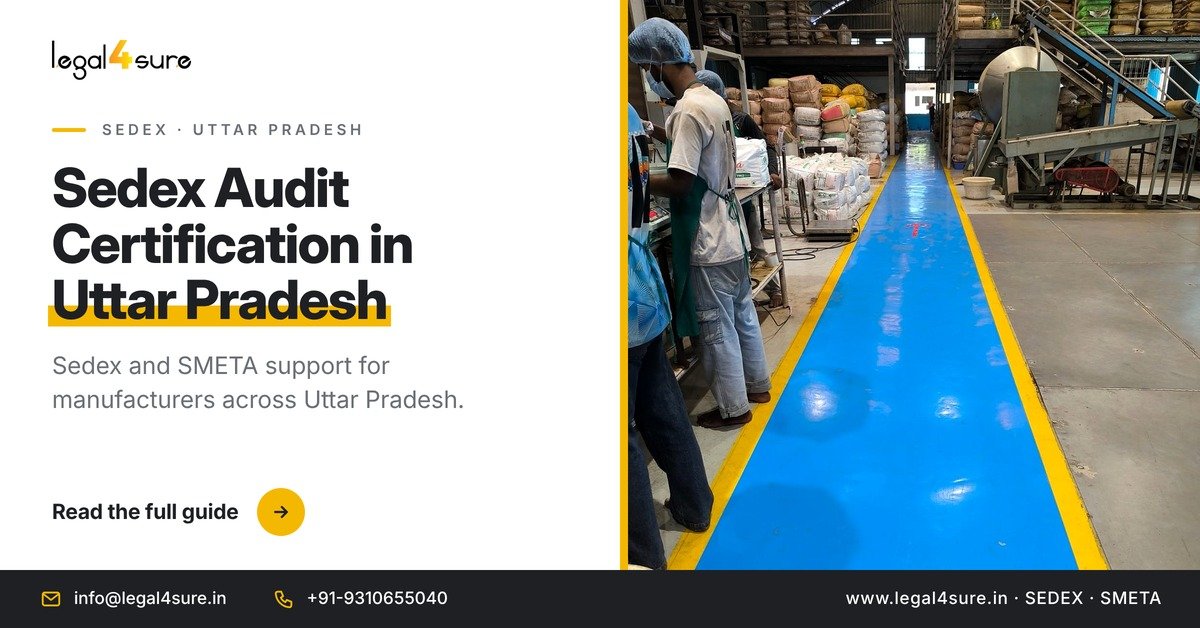
“Can you provide me with your Sedex audit report before I confirm the order?” Exporters from Noida, Kanpur and Agra receive this question regularly. Sedex certification in Uttar Pradesh, which actually means membership of Sedex along with an SMETA audit report, proves to your international partners how you treat your employees and how safe you conduct your business. Its main advantage is that it makes you a more desirable and less risky exporter.
Sedex is a global tool that facilitates managing and improving the ethical practices of your company, while the SMETA audit evaluates a site according to the standards of Sedex. This guide will introduce you to the concept of Sedex, tell you about its importance and benefits, explain its requirements, show mistakes that exporters in Uttar Pradesh do in their attempt to get certified and when it is worth your efforts.
It’s mostly informative, with comparisons and key points to help you decide whether it’s worth it for your business.
What Is Sedex Audit Certification, Exactly?
The Sedex program and the SMETA audit tool are operated by Sedex, which is applicable to any business, whether UP producers or exporters, whose purchasers need proof of ethical behavior.
Short Answer: “Sedex certification” is the general term used for being a member of Sedex and uploading the SMETA audit report onto the platform; in truth, Sedex does not certify anything but publishes your audit results.
A few things worth knowing upfront:
- Any business organization can become a member of Sedex by registering itself through the internet and paying an annual membership fee according to its size and nature.
- Indian organizations like other supplying organizations in any part of the world have to register themselves and fill the SAQ questionnaire and go through a SMETA audit.
- SMETA audit takes place in two versions: 2-pillars (health and safety & labor practices) and 4-pillars (adding environment & business ethics).
- SMETA audit is usually asked for by the international clients of UP exporters in leather, textiles, handicrafts and electronics sectors.
Why Global Buyers Prefer Sedex Audit-Ready Suppliers
Global buyers prefer suppliers whose ethical practices have been independently assessed and are visible on Sedex.
1. It Minimizes Risks for the Buyer
The buyer’s reputation is associated with each product it sources. The SMETA audit will reveal how workers are treated and whether the facility is safe; hence, the buyer will not have to trust the supplier’s assurances only when signing the contract. This becomes especially important when the buyer has not visited your factory yet.
2. It Helps Satisfy the Buyer’s Ethical Commitments
Many major global brands have their own commitments in the sphere of ethical sourcing. Submitting your Sedex audit report will provide the required proof, in a format they understand, without having to chase you for pieces of documentation.
3. It Ensures Timely Delivery
If the factory is properly documented, has established roles and responsibilities, and works in a safe environment, there will be no unexpected troubles that could delay the process. A well-conducted audit by a buyer will give him assurance that his order will be delivered on time.
4. It Will Show Your Professional Approach
Gap analysis, documentation and SMETA audit itself demonstrate the importance of compliance for you. When buyers compare several UP suppliers on price and quality, this is often what makes them choose one.
The Core Benefits of Sedex Audit Certification in Uttar Pradesh
Here’s where the benefits actually show up, in practical terms.
More Efficient Onboarding with New Buyers
After uploading your audit report to Sedex, you can provide it to new buyers using the system without having to answer similar questionnaires. This makes your first exchange process shorter and allows your team to concentrate on samples, costs and manufacturing.
Less of a Surprise at the Time of Audit
Your audit process will involve performing a gap assessment and an internal audit before SMETA audit, which helps you solve any potential problems prior to audit and reduces the amount of them mentioned during the auditing process.
Better Position Among the Buyers During Supplier Evaluation
As the buyers trim their supplier lists, those who have proven ethical compliance in a transparent way will be in a better position to remain on the list than others. Your Sedex account will help you maintain rather than earn such a position even in tough competitive conditions.
SMETA Audit Suitable for Major UP Industries
The leather and textile industry in Kanpur, the handicraft industry in Agra, and electronics manufacturing companies in Noida all deal with customers who demand ethics in sourcing. The rising industrial sector in Lucknow and traditional industries in Varanasi have the same problem. An audit from Uttar Pradesh suppliers would help them meet their customer requirements.
Greater Buyer Trust and Customer Loyalty
Practicing good labor conditions, taking care of health and safety standards, and behaving in an ethical way will earn buyers’ trust and create loyalty in them, which will be beyond a single transaction. Buyers prefer working with suppliers whom they do not have to worry about and place more orders from them.
Reduced Costs Related to Problems in the Future
Preparation and training employees in advance cost less than dealing with problems after receiving buyer complaints. Also, planned actions always work out to be less expensive than unplanned ones.
An Edge in Vendor Audits and RFPs
When a buyer runs a vendor assessment, a completed Sedex audit in Uttar Pradesh answers many questions before they’re asked. It sets you apart from suppliers who are only starting the process and can’t yet show an audit history.
Sedex Audit Benefits: Quick Comparison
Here’s how a supplier without a Sedex audit compares with one that has completed it.
| Benefit | Non-Audited Supplier | Sedex Audit-Ready Supplier |
|---|---|---|
| Buyer onboarding | Repeated questionnaires | Report shared on Sedex |
| Ethical proof | Self-declared | Independently assessed |
| Documentation | Often incomplete | Prepared per legal requirements |
| Audit outcome | More gaps found | Gaps closed beforehand |
| Global market appeal | Limited | More attractive to global partners |
| Scope options | Not defined | 2-Pillar or 4-Pillar |
What Does It Take to Meet Sedex Audit Requirements?
Meeting Sedex requirements means registering, preparing your documentation and completing a SMETA audit.
- Registration – Registration is done online from Sedex site, select membership type and connect your buyer via Sedex reference code
- Self-Assessment Questionnaire – Fill the self-assessment questionnaire (SAQ) prior to documentation work
- Gap analysis – Look for gaps in existing documentation and procedures
- Leadership and responsibility – Allocate a responsible person who will be responsible for the entire Sedex Certification process and define their rights and responsibilities
- Document and Internal Audit – Prepare documents according to statutes and check for compliance and fill all the gaps

- Budget – Cost of Sedex Certification in Uttar Pradesh is approximately Rs. 1,50,000 to 3,00,000 total
Common Mistakes UP Exporters Make When Pursuing Sedex Audit Certification
- Anticipating the awarding of a certificate. Sedex tracks and discloses your SMETA audit findings; what the buyers see are your report and how you have responded to findings.
- Booking an SMETA audit before a gap analysis. First identify your gaps and close them before letting the auditor identify the gaps.
- Selecting 2-Pillar when the buyer needs 4-Pillar. Clarify the scope required by your buyer through a written agreement prior to applying for SMETA audit so as to avoid paying twice.
- Failing to complete the SAQ. Complete it properly in the Sedex system since it determines how buyers view your facility.
- Neglecting the internal cost aspect. Your time and effort put in as part of preparations, training and changes add up to the cost you incur in addition to fees of membership, audit and consultants.
When Sedex Audit Certification Makes the Most Sense
- A buyer or partner from abroad has requested your Sedex audit report.
- You sell leather, textiles, handicrafts or electronic products from Kanpur, Agra, Noida or other UP cities.
- You wish to attract new global partners/markets who require you to show proof of ethical compliance before any deal can be made.
- Your documents, labor practices and safety procedures have never been checked against Sedex norms.
- Your buyer requires a wider 4-pillar report including environment and business ethics.
- You need to recover from a tough audit and build up a good compliance track record.
It matters less for businesses that sell mainly to local buyers who don’t ask for ethical data, but good preparation still helps when a larger customer comes along.
Key Takeaways
- “Sedex Certification” actually implies Sedex membership, followed by an audit report in SMETA format sent to the buyer.
- SMETA audits are available in two types: 2-Pillar and 4-Pillar, thus make sure which one is required by your buyer.
- Sedex certification process starts with registration and SAQ filling up, to gap analysis and documentation to internal audit and final audit.
- Total cost for Sedex certification in Uttar Pradesh is approximately ₹1,50,000 to ₹3,00,000 depending on market prices.
- Exporters from UP like Noida, Kanpur, Agra, Lucknow and Varanasi carry out Sedex audits to impress their international clients.
- Preparation before the audit plays a major role in its success.
Conclusion
Uttar Pradesh Sedex audit certification makes it easier for exporters to get their buyers on board, experience fewer audits surprises, and appear more appealing to international partners. Requests for proof of ethics are increasing by buyers, and an audit report has become an essential requirement rather than just a nice to have.To start your Sedex journey, talk to Legal4sure.
UTTAR PRADESH
Win Global Buyer Trust with Expert SEDEX Audit Preparation and Compliance Support
Get complete support for SEDEX membership, SAQ completion, gap assessments, documentation and SMETA 2-Pillar or 4-Pillar audit preparation. Legal4Sure helps UP manufacturers and exporters strengthen ethical compliance and meet international buyer requirements.
Frequently Asked Questions
What are the main benefits of Sedex audit certification in Uttar Pradesh?
It allows you to submit the verified ethical information to the buyers around the globe and make a difference among suppliers that do not have any audit.
How does a Sedex audit help UP exporters in leather, textiles and handicrafts?
The buyers of Kanpur leather or Agra handicrafts usually seek for some confirmation of ethical labor conditions and safety, and the SMETA audit is what they are looking for.
Why do global buyers prefer suppliers with a Sedex audit?
It minimizes the risk for them and meets their own commitments of compliance, since the audit independently evaluates the practices of the organization.
Is Sedex audit certification mandatory?
No law makes it compulsory, however, the buyers often request such an audit before placing and renewing orders.
Can my company get Sedex membership directly, or do I need a Sedex consultant in Uttar Pradesh?
You may register independently; many companies make use of the services that Sedex certification services Uttar Pradesh consultants provide.
How is a Sedex 2-Pillar audit different from a 4-Pillar audit?
2-Pillar covers labour standards and health and safety; 4-Pillar adds environment and business ethics for a broader view.
What is the Sedex certification cost in Uttar Pradesh, and how to get Sedex certification in Uttar Pradesh affordably?
Market rates: membership ₹14,500–₹15,500 a year, audit ₹1,20,000–₹2,00,000 per site, consulting ₹80,000–₹1,00,000. Preparing well avoids repeat costs.