
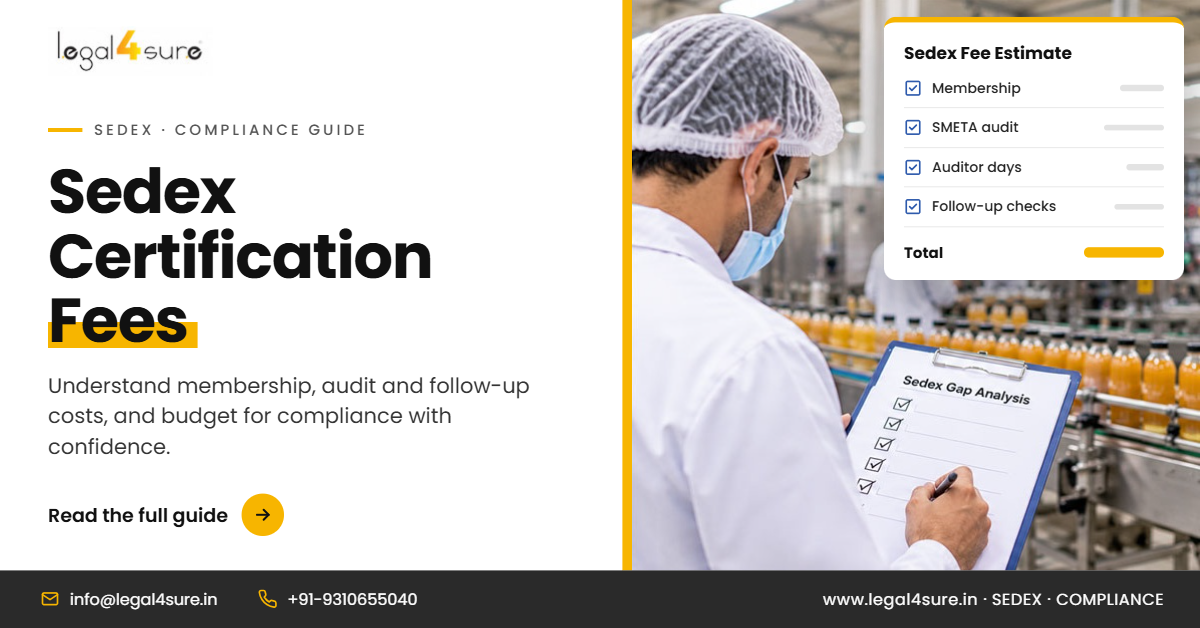
For Indian manufacturers, exporters, and suppliers that have dealings with overseas retailers, food companies, clothing producers, or any other international buyer, it will be helpful to understand the costs associated with Sedex membership.
Yet, there are many more costs to consider than just the membership cost alone. There is an audit cost, travel expenses for the auditor, consulting, correction, and further evaluation. The overall price is dependent on the factory size, audit scope, number of employees, condition of the factory, and buyer requirements.
There is one important thing to remember while budgeting: Sedex is not a certification program. It is a tool for exchanging responsible sourcing information, and SMETA is an audit methodology applied to evaluate workplace. Neither Sedex membership nor SMETA audit lead to any traditional certification pass or fail result. It is explained in Sedex What We Do page.
The guide provides information about the published membership fees, the factors influencing the cost quotations in India, the expenses that you should pay attention to in addition to the above, and the way to estimate your budget without using unreliable prices.
What are Sedex membership fees?
The fees for membership in Sedex represent the yearly payments companies have to make to be able to work within the Sedex platform and use its responsible sourcing and information sharing tools. For suppliers, the membership fee enables the management of the company’s information, self-assessment data, and audit reports that can be shared with authorized buyers.
According to the Sedex Official Website (Supplier Membership page), the published annual fees include £224 per site for Standard membership and £374 per site for Supplier Plus. The above prices are those charged by Sedex for the membership, as seen on their official website checked on 29 October 2026. There might be regional taxes applicable, and therefore Indian companies have to ensure that they know the final payment amount.
It is imperative to note the difference between the fees for platform subscription and the cost of the audit. The membership fee entitles a company to use the Sedex tools; however, it does not cater for the auditing service provided by an independent auditor who visits your factory.
Indian companies searching for Sedex certification are normally looking for a combination of membership, audit, and help in improving the workplace conditions.
Why do Indian suppliers join Sedex?
Indian manufacturers may consider joining when:
- An international buyer requests a Sedex account or a SMETA audit.
- A retailer or importer wants information about labour practices and workplace safety.
- The company wants to share audit information with several customers.
- The business needs a structured way to manage responsible sourcing information.
- The company wants to reduce repeated questionnaires and duplicated social audits where buyers accept a shared report.
Sedex states that a single SMETA audit can be shared with multiple buyers, helping suppliers reduce duplication. However, buyers can still have different requirements, so confirm acceptance before assuming that one audit will meet every customer’s needs.
Sedex membership plans and platform charges
The most straightforward starting point when calculating Sedex membership fees is to identify the membership plan required for your business and the number of sites you need to register.
| Membership plan | Published annual fee | Main purpose |
| Standard | £224 per site | Platform access, supplier directory listing, assessments and audit sharing |
| Supplier Plus | £374 per site | Standard features plus priority directory placement and additional visibility tools |
Source: Official Sedex Supplier Membership pricing. Prices are subject to confirmation and applicable regional taxes.
Standard membership
Standard membership is intended for suppliers that need access to the platform and its core features. It supports the completion of self-assessments, management of site information, sharing of audit reports and access to supplier learning resources.
For a single-site Indian factory whose main objective is to meet a buyer’s supplier onboarding requirement, this is a sensible option to evaluate first.
Supplier Plus membership
Supplier Plus includes the Standard membership features and additional visibility benefits. These include priority placement in the supplier directory, visible contact details for potential customers and a Supplier Plus badge and certificate that can be used to communicate the company’s ESG commitment.
The higher membership price does not replace the need for an audit when a buyer requires one. It also does not mean that a factory has received a SMETA certification.
Are platform charges and membership fees the same?
For a supplier, the annual membership payment covers access to the Sedex platform. It should not be confused with fees charged by the independent audit company or a consultant.
The platform and audit expenses serve different purposes:
- Membership: Access to the platform and tools for managing and sharing information.
- Audit: Independent assessment of workplace conditions and business practices.
- Consultancy: Optional help with preparation, documentation, training and corrective actions.
This distinction is central to understanding the overall Sedex certification cost in India. Always ask providers to separate these components in their quotations.
3. How much does a SMETA audit cost in India?
There is no single official India-wide price for a SMETA audit. The final quotation depends on the factory’s workforce, the audit scope, the number of audit days, travel requirements and the audit company’s commercial rates.
For budgeting, businesses can use published provider estimates as an initial reference, but these should not be treated as fixed market prices or official Sedex tariffs.
For example, Legal4Sure’s published SMETA audit cost guide lists indicative ranges of ₹35,000–₹70,000 for a 2-pillar audit and ₹55,000–₹1,20,000 for a 4-pillar audit. These are provider-published estimates, not prices guaranteed by Sedex or every approved audit company. Actual quotations may differ by site and scope.
A practical way to understand the costs is to separate the audit quotation from the membership and preparation expenses.
| Cost component | How to budget for it |
| Annual membership | Confirm the current fee for the required plan and number of sites |
| SMETA audit | Request a quotation from a Sedex-approved Affiliate Audit Company |
| Auditor travel and accommodation | Check whether these are included or billed separately |
| Preparation support | Obtain a separate quote if you need consultancy |
| Corrective actions | Estimate the cost of fixing any gaps identified at the factory |
| Follow-up assessment | Confirm whether a desktop review or another site visit may be needed |
The table is a budgeting framework rather than a fixed price list. It helps prevent a low initial quotation from hiding additional expenses.
What about the Sedex fee charged per audit?
There is also a platform-related audit fee that needs careful interpretation.
Sedex’s Affiliate Auditor information page states that, effective 1 July 2026, the fee for a SMETA audit is £199 per audit for Sedex members. Sedex says this fixed charge is billed directly to the audit company. It is not the same as the total commercial quotation that the factory receives for the auditor’s work.
The audit company may incorporate applicable costs into its quotation. Therefore, Indian businesses should ask whether the quoted amount includes the relevant platform fee, travel, report-related charges and taxes rather than adding or subtracting the same fee twice.
2-pillar versus 4-pillar audits
The scope of the assessment can affect the cost.
2-pillar SMETA audit
Covers labour standards and health and safety. It may suit a supplier whose buyer specifically requests these two areas.
4-pillar SMETA audit
Covers labour standards and health and safety, with additional assessment of environmental management and business ethics.
Sedex describes these four areas in its SMETA audit overview. The correct scope should be confirmed with the buyer before booking; choosing a narrower audit simply to reduce costs may leave the supplier unable to meet the customer’s requirements.
What affects SMETA audit fees?
The cost of SMETA audit for factory assessments depends on more than the type of audit selected. An auditor must understand the site’s workforce, working arrangements, facilities and records before determining the time and resources required.
These are the main factors Indian businesses should consider when requesting quotations.
1. Number of workers
A factory with a larger workforce may require more time to review employment records, wage documentation, working hours and worker interviews. The number of workers is one factor used to determine the audit’s duration and scope.
2. Factory size and complexity
A site with multiple buildings, warehouses, production areas or separate operational units may require additional assessment time. The number of departments and the complexity of operations can also influence the audit plan.
3. Audit scope
A 4-pillar assessment covers environmental management and business ethics in addition to labour and health and safety. This broader scope may affect the time and resources needed for the assessment.
4. Location and travel
A factory in a location that requires substantial travel may incur additional expenses. Ask whether transportation, accommodation and other travel-related costs are included in the quotation.
5. Existing compliance records
A factory with organised employment records, wage registers, working-hour records, safety procedures and relevant statutory documents may be better prepared for the assessment.
Missing records or gaps in workplace practices can increase preparation time and lead to additional corrective work. Good documentation does not replace actual compliance, but it helps the auditor assess the site accurately.
6. Follow-up requirements
If the assessment identifies issues that need correction, the factory may need additional support and verification. The nature of the findings determines whether further evidence, a desktop review or another site visit is required.
For these reasons, businesses should not compare quotations based on price alone. Ask each provider to explain the audit scope, planned duration, deliverables and possible additional charges.
Understanding audit man-days and audit body charges

The term audit man-day refers to one person’s working day allocated to audit activities. It helps explain how audit duration influences the final quotation.
For example, if an audit requires two auditors working for two days, that represents four auditor-days of effort. This is an illustration of the calculation, not a statement that every SMETA audit requires four man-days.
The number of audit man-days depends on factors such as workforce size, site layout, the number of facilities and the audit scope. Eurofins explains in its SMETA audit booking FAQs that fees are calculated using man-day rates and that audit duration varies according to site-specific factors.
Eurofins
How are audit charges calculated?
A simplified budgeting formula is:
Auditfee=Auditor-dayrateRequiredauditor-days
The actual quotation may also include travel, report preparation, platform-related charges and other agreed services.
For example, consider a hypothetical factory that receives a quote based on four auditor-days at ₹20,000 per auditor-day.
| Item | Illustrative amount |
| Auditor-day rate | ₹20,000 |
| Required auditor-days | 4 |
| Calculated audit fee | ₹80,000 |
This is a mathematical example, not a verified SMETA market rate or a quotation from an audit company. Taxes, travel and other charges are excluded.
When assessing Sedex membership fees alongside audit body charges, request an itemised quotation. Confirm whether the number of auditor-days includes on-site work only or also covers preparation and reporting.
Why can two factories receive different quotations?
Two factories in the same industry may have different workforce sizes, building layouts, operating arrangements and audit scopes. One may have complete records and established safety systems, while the other needs substantial preparation.
Consequently, the same headline audit price should not be assumed to apply to both sites. An accurate estimate requires information about the actual factory and the buyer’s requirements.
Sedex consultant fees in India
Consultants can help factories understand audit expectations, identify gaps and prepare the systems needed to demonstrate responsible workplace practices. However, consultancy is a separate service, not a mandatory payment to Sedex.
Sedex consultant fees India can vary according to the scope of support, the factory’s existing compliance systems and the amount of work needed before the audit.
Services may include:
- Initial gap assessment of the factory.
- Review of employment records, wage registers and working hours.
- Support with policies, procedures and statutory documentation.
- Management and worker awareness training.
- Mock audits and preparation planning.
- Assistance with corrective action plans after the audit.
Some factories may need only a limited review, while others require more extensive support across several departments. The quotation should reflect the work involved rather than simply promise a particular audit outcome.
What should you check before hiring a consultant?
Before choosing a provider of Sedex certification services, ask for the following:
- A written scope of work covering the services included.
- A clear distinction between consultancy charges and audit company charges.
- An explanation of any additional charges for training, travel or follow-up work.
- Relevant experience with your industry and factory operations.
- A realistic schedule for preparation and corrective actions.
A consultant can help you prepare, but cannot guarantee that an audit will have no findings. SMETA is an assessment methodology, and its purpose includes identifying areas where workplace practices need improvement.
Legal4Sure offers support for businesses navigating ethical trade and social compliance requirements. If you are comparing a SMETA audit consultant with an independent audit provider, make sure you understand which services are advisory and which must be performed by a Sedex-approved auditor.
Additional expenses and remediation costs
The initial quotation is only part of the budget. Businesses should also consider the costs of correcting issues identified during the assessment.
What is remediation?
Remediation means taking action to address an identified problem. Depending on the finding, this could involve improving a safety arrangement, correcting employment records, updating a policy or addressing a workplace practice.
The cost depends on the issue itself. Correcting an incomplete record may require staff time, while improving a physical safety condition could involve equipment, installation or facility work.
| Expense | Example | How to plan |
| Documentation | Updating employment or working-hour records | Assign internal responsibility and review time |
| Training | Worker or management awareness sessions | Confirm the training scope and provider charges |
| Workplace improvements | Safety equipment or facility changes | Obtain actual vendor quotations |
| Consultancy | Help with corrective action planning | Agree on a separate written scope |
| Follow-up verification | Evidence review or additional audit visit | Confirm the method and fee with the audit company |
There is no reliable universal amount for remediation because findings differ from one site to another. A factory should not assume that all corrective actions will be inexpensive or that every audit will require a re-audit.
Is there a re-audit charge?
A follow-up assessment can involve additional fees, but the amount depends on the type of verification required and the audit company’s quotation.
Some findings may be addressed through documentary evidence or a desktop review, where accepted. Others may require an on-site follow-up. Ask the auditor which method applies and whether travel, auditor-days and reporting are charged separately.
Sedex provides guidance on addressing non-compliances through its SMETA audit resources. The appropriate corrective action should follow the finding and the buyer’s requirements rather than a fixed-cost assumption.
Budgeting for annual renewals
Membership is an annual expense, whereas audit timing depends on the applicable requirements and the buyer’s expectations.
Do not automatically assume that membership renewal and a new audit are due on the same date. Maintain a separate schedule for membership renewal, audit planning and corrective action follow-up.
This approach helps Indian exporters plan their compliance budget without paying for an unnecessary assessment or missing a buyer’s deadline.
How to estimate your total budget
To estimate the total Sedex certification cost for an Indian factory, list the expenses separately instead of relying on a single package price.
The total depends on your site and the services you actually require. The following example demonstrates how to build a budget using illustrative figures.
| Cost component | Illustrative budget |
| Membership and platform access | Use the current official fee |
| Independent audit | Obtain an itemised quotation |
| Preparation and consultancy | Based on the agreed scope |
| Corrective actions | Based on identified gaps |
| Follow-up assessment | Include only if required |
| Total | Calculate after receiving quotations |
The most reliable way to determine Sedex membership fees and the complete assessment budget is to confirm the current membership price directly with Sedex and obtain a written quotation from an approved audit company.
A practical budgeting checklist
Before committing to an expenditure, confirm:
- The buyer’s exact audit requirements.
- The number of sites that need registration.
- The appropriate membership plan.
- Whether a 2-pillar or 4-pillar SMETA audit is required.
- The proposed audit man-days and auditor-day rates.
- Whether travel, taxes and platform-related charges are included.
- Whether preparation consultancy is necessary.
- How corrective actions and follow-up verification will be priced.
This process gives you a clearer view of the expected expenditure and makes quotations easier to compare.
How to reduce avoidable compliance expenses
Reducing costs should begin with proper planning, not by choosing the cheapest provider without checking its credentials.
Here are five practical steps.
- Confirm buyer requirements first. Establish the required audit scope before booking. An assessment that does not meet the buyer’s expectations may lead to additional expenses.
- Organise records in advance. Review employment contracts, wage records, working hours, safety documentation and relevant statutory requirements before the auditor arrives.
- Address known workplace gaps early. An internal review can help identify issues that may require time, training or physical improvements to resolve.
- Compare itemised quotations. Ask providers to specify auditor-days, travel, reporting, platform-related fees and follow-up charges. A lower headline price may not represent a lower total cost.
- Share audit information where accepted. Sedex allows suppliers to share a SMETA audit with multiple buyers. Check whether your customers accept the same report before paying for separate assessments.
These measures can make the process more predictable. They do not guarantee a particular audit result, but they help companies plan their spending and avoid unnecessary duplication.
How Legal4Sure can help
For Indian businesses, preparing for a social compliance audit can involve several teams, including HR, factory operations, administration and safety. Coordinating their work before the audit can make the process easier to manage.
Legal4Sure supports businesses seeking guidance on ethical trade and compliance requirements. Its services can help companies understand the preparation work involved and plan the steps needed to address identified gaps.
Businesses considering Sedex certification services should first establish which tasks require a consultant and which must be handled by an independent, Sedex-approved audit company.
Legal4Sure can be approached for guidance on:
- Compliance gap assessment: Identifying areas that need attention before the assessment.
- Documentation support: Reviewing the records and procedures relevant to the audit.
- Audit preparation: Helping teams understand the assessment process and organise their responsibilities.
- Corrective action planning: Supporting the preparation and tracking of actions arising from audit findings.
If you are comparing providers, ask for a written scope, clear pricing and a distinction between consultancy and independent auditing. No consultant can legitimately guarantee a clean audit result or issue an official Sedex certification.
Planning a SMETA audit for your factory? Contact Legal4Sure to discuss your requirements, understand the preparation involved and request a quotation for the support you need.
Final takeaway
For Indian manufacturers and exporters, understanding Sedex membership fees is the starting point for planning responsible sourcing compliance. The overall budget also depends on the independent audit, preparation requirements, possible workplace improvements and any follow-up verification.
The most important step is to distinguish official membership charges from audit body charges and consultancy fees. Confirm the buyer’s requirements, verify current prices with Sedex and obtain an itemised quotation from an approved audit company before committing to a budget.
Legal4Sure can help businesses understand their preparation needs and explore suitable compliance support without confusing consultancy services with the independent audit itself.
Understand Your Sedex Costs and Plan Your SMETA Audit with Confidence
Planning Sedex membership or a SMETA audit for your factory? Legal4Sure can help you understand compliance requirements, assess documentation gaps, prepare for audits, and plan corrective actions. Get guidance on the support your business needs and request a clear quotation for your compliance preparation.
Frequently asked questions
1. How much does Sedex certification cost in India?
Sedex does not issue certifications, so the total cost generally refers to annual membership, an independent SMETA audit and any preparation or corrective action expenses. Sedex’s published supplier membership prices are £224 per site per year for Standard and £374 for Supplier Plus. Audit and consultancy charges must be confirmed separately.
2. What affects SMETA audit fees?
SMETA audit fees depend on workforce size, site complexity, audit scope, required auditor-days, travel and the audit company’s commercial rates. Corrective action or follow-up verification may add expenses where required.
3. Are there Sedex membership fees?
Yes. Sedex publishes annual supplier membership fees of £224 per site for Standard membership and £374 per site for Supplier Plus. Confirm the applicable price, taxes and payment terms directly with Sedex before registering.
4. What is the Sedex audit cost per man-day?
There is no single official Sedex audit cost per man-day for all Indian factories. Audit companies determine their commercial rates based on the work involved. Request the auditor-day rate, required number of days and any additional expenses in writing.
5. What are Sedex consultant fees India?
Sedex consultant fees India vary with the scope of work, existing compliance arrangements and the level of support needed. A quotation may cover a gap assessment, documentation review, training or corrective action support. Consultancy is separate from membership and independent audit charges.
6. What is the cost of SMETA audit for factory assessments?
The cost of SMETA audit for factory assessments depends on the number of workers, site layout, audit scope and auditor-day requirements. Published Indian provider estimates can help with initial budgeting, but a site-specific quotation is needed for an accurate figure.
7. Is there a re-audit charge?
A follow-up assessment may involve an additional charge. Depending on the findings and applicable requirements, verification may be conducted through a desktop review or an on-site visit. Confirm the method and cost with your audit company.
8. Does Sedex provide a certificate after the audit?
No. Sedex membership and SMETA audits are not certification schemes, and there is no conventional pass-or-fail certificate issued through the SMETA methodology. The audit produces findings and supports corrective action and continuous improvement.
9. Can one SMETA audit be shared with multiple buyers?
Yes. Sedex allows suppliers to share a SMETA audit with multiple buyers through its platform. However, individual buyers may have additional requirements, so confirm that the report and audit scope meet their expectations before relying on one assessment.
10. How do I choose a Sedex consultant in India?
Choose a provider with relevant industry experience, a clear scope of work and transparent pricing. Check whether its services cover preparation, documentation, training and corrective action support. The actual SMETA audit must be conducted by an authorised Sedex Affiliate Audit Company.