In the modern global market, ethical supply chains are not a choice; they are a necessity in international trade. SEDEX represents the gold standard in corporate social responsibility for exporters to prove their ethical business standards.
Implementation of SEDEX standards through a SMETA audit enables businesses to not only reduce audit fatigue but also gain a competitive advantage in the market with key retailers. This guide highlights the key benefits, the process, and the requirements to achieve SEDEX compliance.
What Is SEDEX Certification for Exporters
SEDEX (Supplier Ethical Data Exchange), is a worldwide not-for-profit membership organization that enables businesses to exchange information on ethical and responsible business practices in supply chains. For exporters, especially those supplying to international buyers, becoming SEDEX certified ensures you are able to prove to buyers that your business practices meet the very stringent requirements for ethical trading.
SEDEX export certification doesn’t work like any other quality certification, like ISO. Exporters simply sign up to SEDEX as a supplier, complete a self-assessment questionnaire, and in most cases, also complete a SMETA audit by a qualified independent auditor. The results are stored on the SEDEX platform, making them available to all your buyers who are also SEDEX members.
The importance of SEDEX certification for exporters in India has risen significantly in recent times. With brands increasingly scrutinizing their supply chains, especially in light of the UK Modern Slavery Act or the EU Corporate Sustainability Due Diligence Directive, SEDEX certification for exporters in India is now becoming the new normal rather than the exception.
Benefits of SEDEX Certification for Exporters
| Benefits | Description |
| Global Market Access | Buyers from the UK, EU and US are increasingly asking for SEDEX membership as a prerequisite to the purchase. Certification opens doors to highly profitable contracts that one may not get without it. |
| Competitive Edge | Certified exporters are at a disadvantage when it comes to tenders and auctions. Buyers of SEDEX audit exporters’ products consider them as low risk who are worth long term investing. |
| Reduced Audit Fatigue | One SMETA audit report is shared with many buyers on the platform. It reduces the suppliers’ need of going through multiple audits. |
| Improved Workplace Practices | Through the SEDEX manufacturing process, companies keep on improving in the worker welfare, safety and environmental sustainability areas. |
| Risk Mitigation | Certification is a sign of responsible management and it implies a relatively small likelihood of supply chain problems, buyer de-listing, or damage to reputation. |
| Regulatory Readiness | Export requirements of SEDEX comply with the latest changes in international ESG and due diligence laws. This makes sure that exporters are never behind in legislation. |
Requirements Of SEDEX Certification for Exporters
Following are some of the the major SEDEX export requirements:
| Pillar | What It Covers | Key Focus Areas |
| Labour Standards | Workers’ rights and fair employment | Working hours, wages, no child labour, freedom of association |
| Health & Safety | Safe working environment | Fire safety, machinery safety, PPE, emergency procedures |
| Environment | Environmental impact of operations | Waste management, energy use, emissions, water usage |
| Business Ethics | Governance and anti-corruption | Anti-bribery policies, data protection, supplier code of conduct |
It is important that exporters are prepared to prove their policies, internal records, and operational evidence for all four pillars. The SEDEX manufacturing process is audited in detail. This includes walkthroughs of the production floor and interviews with employees.
>Helpful Guide:- Urgent Buyer Requirement: Sedex / SMETA Audit Needed Immediately—What’s the Solution?
Process Of Applying For SEDEX Certification for Exporters
Step 1: Register on the SEDEX Platform
The first step in the SMETA audit certification process is to register your facility on the SEDEX platform at www.sedex.com. Membership to SEDEX is a prerequisite for SMETA audit certification. SEDEX offers two types of membership to its suppliers:
AB Member – Suppliers who buy and sell to other SEDEX members
B Member – Suppliers who sell to SEDEX-registered buyers only
Membership fees for Indian suppliers to SEDEX range from $150 to $300 per annum based on membership levels.
Step 2: Complete the Self-Assessment Questionnaire (SAQ)
Before scheduling the SMETA audit, you will be required to complete a Self-Assessment Questionnaire on the SEDEX platform. The Self-Assessment Questionnaire covers labor practices, health and safety, environment, and business ethics.
Step 3: Link With Your Buyer on SEDEX
Your buyer is required to initiate a link request on SEDEX to link with you. Once linked, your buyer will be able to view your audit report and SAQ responses.
Step 4: Choose an Approved Audit Body
The SEDEX SMETA audit needs to be performed by an approved body. In India, there are various approved bodies functioning across key industrial areas such as Delhi NCR, Mumbai, Bengaluru, Tirupur, Surat, and Ludhiana. Some of these approved bodies include Bureau Veritas, SGS, Intertek, and ELEVATE.
Step 5: Pre-Audit Preparation
In this step, many suppliers face difficulties. Before the actual auditing process begins, you will be required to prepare and present various documents such as wage registers, attendance records, and contracts to your auditor. Other key areas to prepare for include health and safety risk assessments, fire drill records, environmental permits, and waste disposal records. An assessment is recommended before the actual auditing process.
Step 6: On-Site Audit
In this step, the approved body will visit your factory for one to two days to carry out the actual auditing process. The SMETA audit process will include a combination of document review, interviewing workers, interviewing management, and a facility walkthrough. The workers will be interviewed confidentially. This is a key step and cannot be tampered with.
Step 7: Corrective Action Plan (CAPR)
The auditor prepares a CAPR after the audit. This contains all the non-conformities identified during the audit. Non-conformities are classified as Critical, Major, and Minor. If there are any instances of child labour or forced labour, the audit fails. Non-conformities must be addressed within a set timeframe.
Step 8: Report Shared on SEDEX
Once all the issues are resolved, the final SMETA report is shared on the SEDEX platform with your associated buyers.
>Helpful Guide:- Top Mistakes to Avoid in Sedex SMETA Audits | Social Audit
SEDEX Requirements for Export Companies in India
India is one of the biggest centers for required SEDEX manufacturers across the world, including garments, textile, pharmaceuticals, engineering goods, food processing, etc. Knowledge of the SEDEX requirement for export companies in India involves understanding the SEDEX requirement both globally and in the Indian context.
Documentation Exporters Must Prepare
The documentation required by Indian export companies in the context of the SEDEX audit requirement typically includes the following:
- Factory registration certificate and license
- Wage register and pay slips for all categories of workers
- Working hour register and overtime register
- ESI and PF registration and payment proof
- Fire safety certificate, electrical safety certificate, and structural safety certificate
- Written policies on anti-harassment and anti-discrimination policies
- Environmental compliance certificates (GPCB/SPCB clearance certificates, etc.)
- Contracts for all contract workers and migrant workers
- Child labor and forced labor policy declarations
- Business ethics policy and anti-bribery policy
>Helpful Guide:- Cost Of SEDEX Certification 2025: Full Pricing Breakdown
Common Challenges Faced by SEDEX Audit Exporters
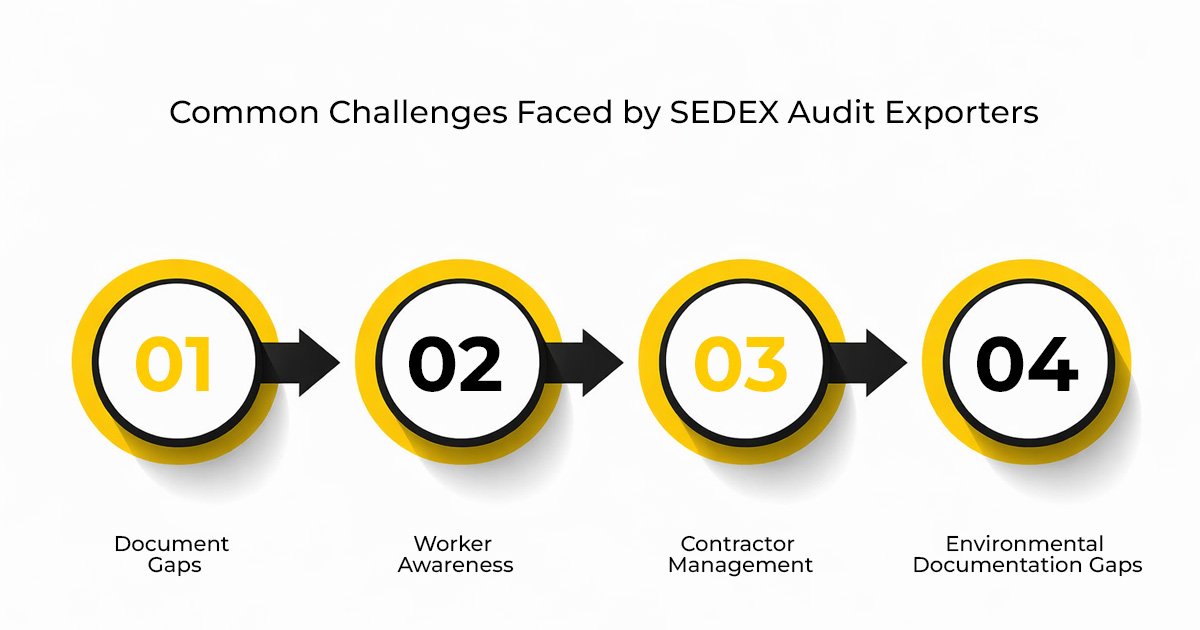
Despite the obvious advantages, SEDEX audit exporters in India experience the following challenges in the certification journey:
- Document Gaps
Small and medium exporters usually do not maintain formal documents. Formal and traceable documents are a prerequisite for the audit, which has to be addressed in the pre-audit phase of the SEDEX manufacturing process audit.
- Worker Awareness
Worker interviews are a crucial component of the SMETA audit process. Workers unaware of their rights or the organizational policies may result in major non-conformances, even if the conditions in the organization are acceptable.
- Contractor Management
Ethical compliance of the contractors down the supply chain, especially in the case of labor contractors, is a challenge that SEDEX required manufacturers in India to experience in the certification journey.
- Environmental Documentation Gaps
Environmental compliance documents, especially in the case of textile, pharmaceutical, or food processing industries, may be inadequate, resulting in non-conformances in the Environment pillar of the SEDEX audit.
Key Takeaways
- Secures High-Value Contracts: As a member of SEDEX, you immediately gain access to top retailers in the UK, EU, and US who require ethical transparency in their supply chain.
- Eliminates Audit Fatigue: A single SMETA audit report enables you to share your compliance information with multiple global buyers at once.
- Verifies Operational Ethics: The certification process assesses your performance across the four essential pillars: labor, health & safety, environment, and business ethics.
- Demands Precise Record Keeping: Successful export businesses keep formal, traceable records, such as wage records and safety certificates, to meet the auditors’ needs.
Ensures Regulatory Readiness: Anticipatory SEDEX compliance ensures your business is ready for the evolving world of ESG legislation.
>Top Trending Guide:- BRC Full Form, Meaning, Certification Process & Cost in India (2026 Guide)
Frequently Asked Questions
What is the SEDEX certification process for exporters in India?
The steps include registration on the SEDEX platform, completion of the SAQ, compliance with the labour, health and safety, environment, and ethics regulations, and completion of the SMETA audit by a third-party certification body.
What are the SEDEX requirements for export companies India?
The requirements mainly include compliance with the labour, health and safety, environment, and ethics regulations, and completion of the SMETA audit by a third-party certification body.
How exporters get SEDEX certification India?
The steps include a buyer mandate in which the export company registers on the SEDEX platform as a supplier, establishes a relationship with the buyer, completes the SAQ, and finally schedules the SMETA audit with a certification body.
Who are SEDEX required manufacturers?
The SEDEX required export companies in India include those that export products to international retailers or brands that have set a commitment to fair business practices and ethics.
What does the SEDEX manufacturing process audit involve?
The audit involves an on-site facility inspection, document review, and confidential worker interviews by a third-party auditor to verify compliance across labour, health & safety, environment, and business ethics standards.
How long is SEDEX audit India valid?
A SMETA audit for SEDEX audit India is generally valid for 1-2 years. Exporters must undergo re-auditing within this period to maintain an active, valid compliance status on the SEDEX platform.
Is SEDEX export certification mandatory for all exporters?
SEDEX export certification is not legally mandatory but is practically required by most major international buyers. Exporters supplying to UK, EU, or US brands will typically find it a non-negotiable part of supplier onboarding.