
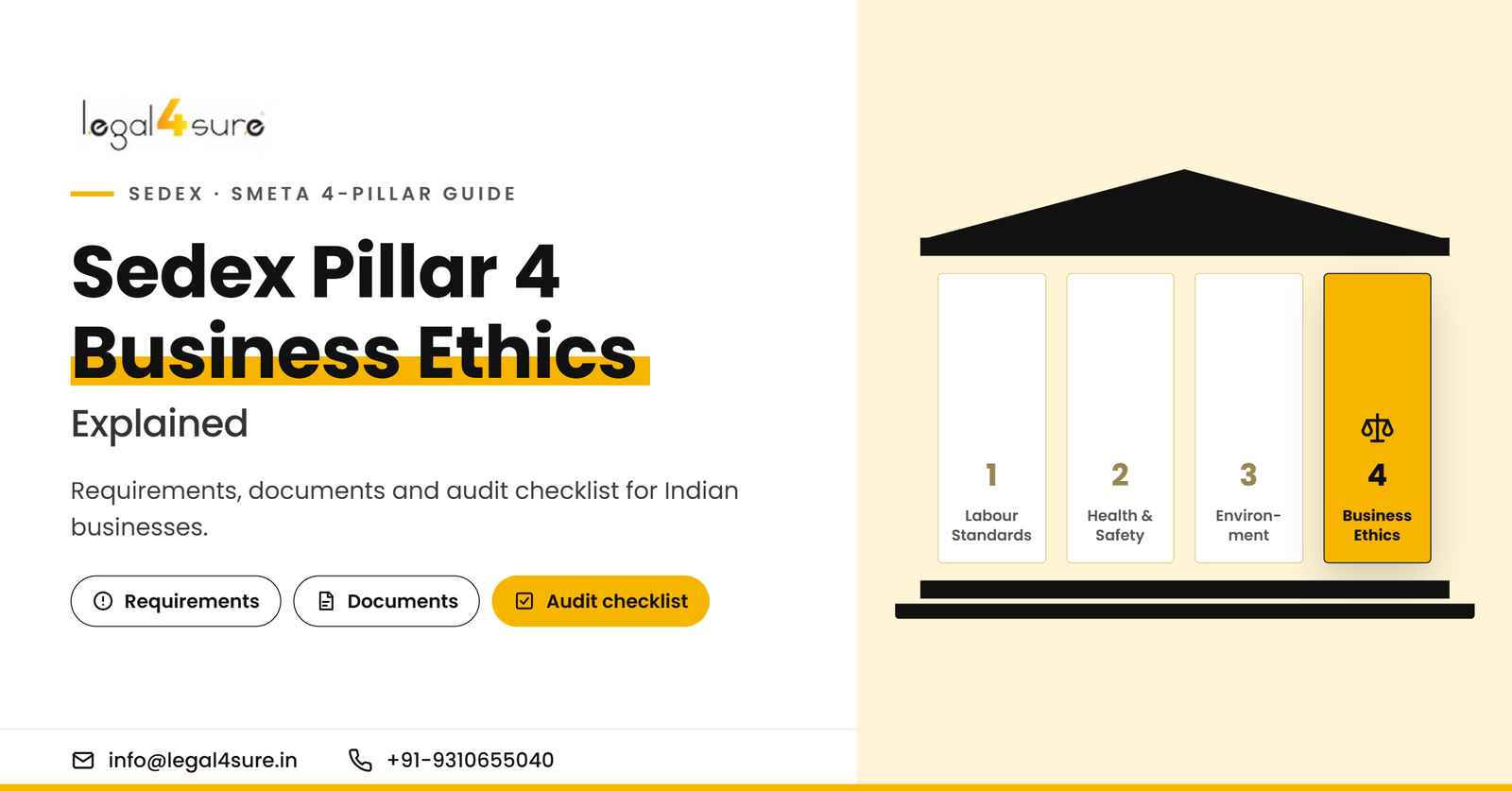
In relation to Indian manufacturers serving global retailers, food brands, garment industry, and other international clients, ethical practices become an important criterion for the evaluation of suppliers. It is no longer enough to assess how the product is produced; the buyer wishes to see whether the supplier works ethically, complies with the law, and has measures to prevent bribery, corruption, and fraud.
Here the fourth pillar of the Sedex – the one related to Business Ethics within a four-pillar SMETA audit – comes into play. It evaluates how the company assesses its risks in terms of ethics, how it communicates its policy, processes the complaints, and prevents unethical behavior of employees.
For instance, an Indian manufacturer of garments, working with foreign buyers, should show how it deals with suppliers, prevents illegal payments, handles confidential complaints, and keeps business records transparently.
According to the official description by Sedex, SMETA evaluates Labour Standards, Health and Safety, Environment, and Business Ethics. In addition, according to the Sedex website, neither membership nor SMETA audit provides certification, and there is no pass/fail rating in the methodology.
This distinction matters when a business starts preparing for Sedex certification or receives an audit request from an international buyer. The practical objective is to demonstrate responsible business practices through documented policies, working systems and evidence.
This guide explains the business ethics pillar, applicable requirements, audit documents, common preparation gaps and the steps Indian businesses can take before an assessment.
What Is Sedex Pillar 4?
Sedex pillar 4 is the Business Ethics component of a SMETA four-pillar audit. It seeks to establish the adequacy of policies, controls and practices for risk assessment and management relating to bribery, corruption, fraud, and other unethical business practices.
According to the SMETA 7.0 methodology, Business Ethics is one of the workplace requirements, number 10C. The workplace requirements of the SMETA 7.0 include knowledge of relevant legislations, identification of ethical risks, prevention measures and compliance with relevant fiscal requirements.
From a practical perspective, an auditor might wish to know:
- Does the organization have a policy on business ethics or anti-bribery?
- Is there knowledge of the kind of behavior that is expected of the employees?
- Are there ways of reporting issues anonymously?
- Does management investigate the issues raised and take any necessary action?
- Are transactions and third party interactions conducted in a transparent way?
- Is compliance demonstrated with relevant laws and client requirements?
The specific evidence required will depend on the workplace, activities carried out, relevant laws, the risk identified and the auditing methodology.
What Does Business Ethics Mean in a SMETA Audit?
Business ethics are related to carrying out one’s business with integrity and responsibility in compliance with all legal and ethical norms.
For a manufacturer or exporter from India, this may include avoiding illegal payments, keeping accounting records accurate, handling conflicts of interests, verifying third parties and putting in place procedures for reporting misbehaviors.
It is not only important to check whether the policy was put in place. It is also necessary to verify whether the management has implemented the policy and whether there is sufficient evidence to prove their statements.
For instance, it is not enough for an organization to have its anti-bribery policy if there is no evidence of informing employees about it, of ignoring complaints or investigating cases of misconduct.
This is why Sedex pillar 4 should be approached as a management and risk-control exercise rather than a document-collection exercise.
What Are the Four Pillars of a SMETA Audit?
A SMETA audit can cover either two or four pillars, depending on the assessment selected and the buyer’s requirements. A four-pillar assessment includes all four areas below.
| Audit pillar | What it examines | Examples of supporting evidence |
| Labour Standards | Employment practices, working hours, wages, recruitment, discrimination and worker treatment | Employment contracts, wage records, attendance registers and HR policies |
| Health and Safety | Workplace hazards, safe working conditions, hygiene and emergency preparedness | Risk assessments, safety training records, inspection reports and emergency plans |
| Environment | Environmental management, waste, resource use, emissions and relevant permits | Environmental policies, waste records, permits and resource-consumption data |
| Business Ethics | Bribery, corruption, fraud risks, ethical policies and reporting systems | Ethics policies, risk assessments, training records, complaint registers and investigation records |
A two-pillar audit covers Labour Standards and Health and Safety, including a basic environmental assessment. The four-pillar option expands the environmental assessment and includes the Business Ethics pillar.
For suppliers preparing for Sedex certification, it is important to confirm whether their buyer requires a two-pillar or four-pillar assessment. Preparing for the wrong scope can lead to unnecessary work or missing evidence.
Why Is Sedex Pillar 4 Important for Indian Businesses?
Many Indian companies deal with many parties such as suppliers of raw materials, logistics companies, recruitment firms, contractors, distribution companies, and even customers outside India. Each of these partnerships presents unique risks of ethical issues.
For instance, there may be a benefit received by an employee in charge of procurement without disclosure. There could also be a promise of a bribe made by a sales representative in order to secure a deal.
There could also be an internal concern regarding financial wrongdoing, but there is no procedure for making such a disclosure.
1. It supports responsible supplier relationships
International buyers want visibility into how suppliers manage business conduct. Documented controls can help a company demonstrate that purchasing, sales and supplier-management decisions follow consistent rules.
2. It helps identify ethical risks before they become serious
A risk assessment can help management identify activities where bribery, fraud, conflicts of interest or other misconduct may occur. The company can then introduce controls proportionate to those risks.
3. It strengthens accountability
Clear responsibilities make it easier to establish who approves payments, reviews third parties, investigates complaints and monitors compliance.
4. It can help meet buyer expectations
A buyer may request a SMETA audit as part of its supplier-assurance programme. Completing the requested assessment and addressing findings can support the supplier relationship, although it does not guarantee a contract or continued business.
5. It connects ethical policies with Indian legal obligations
Indian businesses must understand the laws applicable to their activities. For example, India’s Prevention of Corruption Act, 1988 includes provisions addressing bribery of public servants and bribery by commercial organisations. The relevant legal obligations depend on the facts and circumstances of a case.
A business ethics programme should therefore reflect both the audit’s expectations and the company’s actual legal obligations.
Key Business Ethics Requirements Under SMETA 7.0
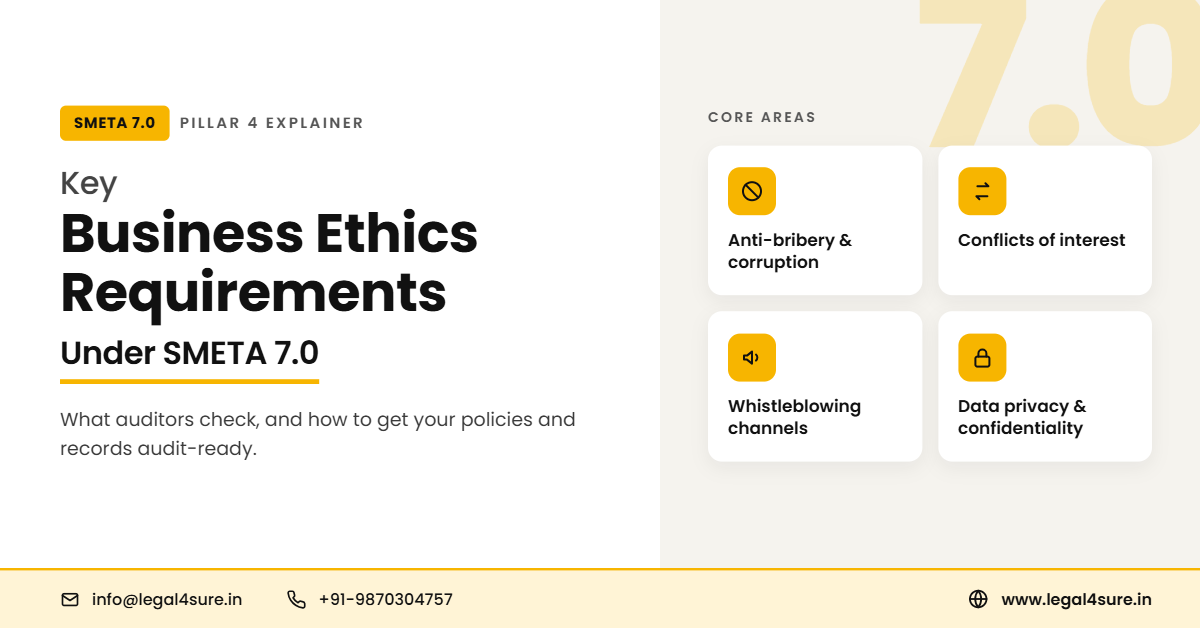
Understanding the requirements is the first step towards preparing for a four-pillar audit. Under SMETA 7.0, Business Ethics requirements are grouped under workplace requirement area 10C.
Sedex’s official Introduction to SMETA guide identifies specific expectations covering legal awareness, risk assessment, financial compliance, policy communication, staff training, confidential reporting and personal data protection.
1. Anti-bribery and anti-corruption controls
The company should understand the laws relevant to bribery, corruption and fraudulent business practices. It should assess where these risks could arise and introduce suitable preventive measures.
Examples include:
- Rules prohibiting bribes, kickbacks and improper payments.
- Controls over gifts, hospitality and conflicts of interest.
- Approval procedures for sensitive payments and business expenses.
- Due diligence for agents, contractors and other high-risk third parties.
- A process for reviewing suspected misconduct.
For Indian businesses, the Prevention of Corruption Act, 1988 is an important legal reference where its provisions apply. The company’s controls should reflect its actual operations, legal exposure and buyer expectations.
2. A documented business ethics policy
A written policy should explain the conduct expected from employees, managers and relevant business partners. It should address the ethical risks identified by the organisation.
A practical policy may cover:
- Bribery and corruption.
- Fraud and falsification of records.
- Conflicts of interest.
- Gifts and hospitality.
- Reporting suspected misconduct.
- Investigation and disciplinary procedures.
- Protection of confidential information.
The policy should be communicated to relevant parties, including suppliers identified as high-risk. Simply keeping a signed policy in an office file may not demonstrate effective implementation.
3. Risk assessment and preventive measures
The company should identify where unethical conduct could occur and determine how those risks will be controlled.
For example, procurement and logistics teams may face different risks from production staff. A business that frequently uses customs agents, brokers or external sales representatives may need additional checks on third-party relationships.
A useful risk register records the risk, its potential impact, the existing controls, the person responsible and the planned improvement measures.
4. Business ethics training
Employees in roles with greater exposure to ethical risks should receive appropriate training. SMETA 7.0 specifically identifies roles such as sales, purchasing and logistics as examples of positions that may need this attention.
Training evidence can include attendance sheets, training material, assessment results and refresher-training records.
5. Confidential reporting and complaint handling
Employees and other relevant stakeholders should have an accessible way to report suspected unethical practices. The mechanism should support confidential and anonymous reporting, effective investigation and protection against retaliation, as required by the applicable workplace requirements.
A company may use a dedicated email address, a reporting hotline, a designated officer or another suitable channel. It should also establish how complaints are recorded, investigated, escalated and closed.
6. Financial compliance and accurate records
Where applicable, the business should demonstrate awareness of and compliance with relevant fiscal requirements. Depending on the circumstances, evidence may include statutory filings, financial statements, tax records and independent financial audit reports.
Financial documents should be accurate, traceable and consistent with the company’s actual transactions.
7. Personal data protection
SMETA 7.0 also addresses how businesses obtain and store personal information. Companies should identify applicable data-protection obligations and establish suitable consent, access and security controls.
For example, access to employee identity documents, payroll data, complaint records and supplier information should be restricted to authorised personnel.
These requirements form a practical foundation for Sedex pillar 4 preparation, but the audit should be assessed against the applicable SMETA methodology and official workplace requirements rather than an informal checklist alone.
SMETA Documents Required for Business Ethics
The documents required depend on the organisation’s size, business model, risk profile, applicable laws and audit scope. There is no single universal document bundle that guarantees compliance.
For Indian suppliers, the following table provides a practical starting point for preparing a Sedex audit documents list India.
| Document category | Documents and records to prepare | Why they matter |
| Business ethics policy | Approved ethics, anti-bribery and anti-corruption policy | Shows the company’s expectations for ethical conduct |
| Risk management | Business ethics risk assessment and risk register | Demonstrates how ethical risks are identified and controlled |
| Employee communication | Policy acknowledgements, communication records and relevant training material | Shows that employees have been informed about expectations |
| Training | Training calendar, attendance sheets and assessment records | Provides evidence of ethics training |
| Reporting mechanism | Whistleblowing procedure, reporting-channel details and complaint register | Shows how concerns can be reported and managed |
| Investigations | Investigation procedures, case records and corrective-action evidence, where applicable | Demonstrates how reported issues are handled |
| Third-party management | Supplier code of conduct, due-diligence records and relevant contractual clauses | Supports controls over suppliers and intermediaries |
| Financial compliance | Applicable tax records, statutory filings, financial statements and independent audit reports, where relevant | Helps demonstrate fiscal compliance |
| Conflicts of interest | Declaration forms, registers and approval records, where applicable | Supports transparency in business decisions |
| Data protection | Privacy policy, data-handling procedures, access controls and relevant consent records | Supports responsible handling of personal information |
| Management oversight | Meeting minutes, review records and corrective-action trackers | Demonstrates management involvement and follow-up |
This SMETA documents preparation list focuses on Business Ethics. It does not replace the wider document requirements for Labour Standards, Health and Safety or Environment.
Which documents are essential and which depend on risk?
A business should begin with the requirements applicable to its site and activities. A documented ethics policy, a risk-based approach, appropriate training and an accessible reporting process are central to preparing for this assessment.
Other records depend on the circumstances. For instance, a company that uses third-party agents may need stronger evidence of due diligence than a company that does not use such intermediaries. Financial audit reports may be relevant where required by the applicable fiscal framework or assessment circumstances.
The objective is to produce genuine, relevant evidence rather than create paperwork solely for an auditor.
SMETA 4-Pillar Audit Checklist for Indian Manufacturers
Before an audit, businesses should review all four pillars rather than preparing for Business Ethics in isolation. The following SMETA 4-pillar audit checklist is a practical internal preparation tool, not an official substitute for the SMETA auditor requirements.
Pre-audit readiness checklist
0/20 reviewed
Tick each item once your team has reviewed the relevant records and practices. A tick indicates internal review, not verified compliance.
Business Ethics
Approved business ethics and anti-bribery policy is available
Ethical risks are documented with suitable controls
Relevant employees have received ethics training
Confidential reporting and investigation procedures are established
Applicable financial and data-protection records are available
Labour Standards
Employment contracts and personnel files are maintained
Wage records and payslips are consistent with payments
Attendance, working hours and overtime records are available
Recruitment, age-verification and employment practices are documented
Grievance and disciplinary procedures are available
Health and Safety
Workplace risk assessments and safety procedures are current
Fire safety and emergency arrangements are documented
Safety training and incident records are maintained
Required inspections and equipment maintenance are recorded
Relevant medical, first-aid and safety arrangements are in place
Environment
Environmental policies and relevant permits are available
Waste handling and disposal records are maintained
Water and energy consumption are tracked where relevant
Hazardous substances are identified and managed appropriately
Environmental risks and improvement actions are documented
Copy checklistReset
What HR documents are checked during a SMETA audit?
HR documents for SMETA mainly support the Labour Standards assessment, although some records may also provide context for Business Ethics.
Common examples include:
- Employee master records and personnel files.
- Appointment letters and employment contracts.
- Identity and age-verification records, handled appropriately.
- Attendance registers, shift schedules and overtime records.
- Wage registers, payslips and supporting payment records.
- Leave records and applicable statutory benefit records.
- Recruitment and employment-agency documentation, where relevant.
- Worker grievance records and disciplinary records.
- Training attendance and policy acknowledgement records.
Auditors may compare documents with payroll data, employee interviews and actual workplace practices. Records should be genuine, complete and consistent. Businesses should not create backdated or misleading documents to make their files appear compliant.
How to Prepare for Sedex Pillar 4 in India
Preparing for a SMETA assessment is easier when responsibilities are assigned before the audit date.
Step 1: Confirm the buyer’s audit requirements
Check whether the buyer expects a two-pillar or four-pillar assessment, which methodology applies, and whether there are additional customer-specific requirements.
Step 2: Review the existing ethics programme
Examine current policies, risk assessments, complaint channels, training and financial controls. Identify gaps between written procedures and actual practice.
Step 3: Assign responsibilities
Management, HR, finance, procurement and operations may all need to contribute. Assign an owner to each requirement so that documents and actions are not left incomplete.
Step 4: Check records against actual practice
Review whether staff understand the policies, complaints can be raised safely and financial approvals work as documented. Where a gap exists, record it and implement a suitable corrective action.
Step 5: Organise supporting evidence
Maintain a clear, controlled record system. Keep current policies separate from older versions and ensure authorised staff can retrieve relevant evidence without unnecessary delay.
Step 6: Conduct an internal review
Use a risk-based review to identify unresolved issues. Correct genuine gaps and retain evidence of actions taken. Do not hide problems or fabricate records.
Step 7: Coordinate with the approved audit company
SMETA audits are conducted by auditors from Sedex-approved Affiliate Audit Companies, not by Sedex itself. Confirm the audit scope, site details, timing and evidence requirements directly with the appointed audit company.
A Sedex consultant in India may help organise documentation, assess gaps, explain requirements and coordinate preparation. However, businesses should distinguish consultancy or preparation support from the independent audit itself.
Sedex Requirements: Membership, Audit and Compliance
Businesses sometimes use the phrase Sedex certification when referring to supplier registration, a SMETA audit or buyer-required compliance. These are related, but they are not interchangeable.
Sedex membership provides access to its platform for managing and sharing supplier information. A SMETA audit is an independent assessment of workplace conditions and management systems. Neither membership nor completion of the audit constitutes a formal Sedex certification.
For a supplier, the usual process is:
- Register for the appropriate Sedex membership.
- Complete the company profile and relevant Self-Assessment Questionnaire.
- Connect with the buyer or buyers who need access to the information.
- Arrange the required SMETA assessment through an approved Affiliate Audit Company.
- Review the findings and implement appropriate corrective actions.
- Share the relevant audit information with connected customers through the platform.
A business seeking Sedex certification services should first confirm what the buyer actually requires. It may need platform membership, a SMETA audit, support with corrective actions or a combination of these activities.
What Is the Sedex Audit Cost in India?
The total cost depends on the supplier’s membership choice, the audit scope, site size, workforce, location, audit duration and the appointed audit company’s fees.
These are published membership prices, not an all-inclusive audit quotation. Regional taxes may apply. Check the official supplier membership page for current pricing and package details.
Grow Beyond Compliance
The Sedex audit cost is separate from membership. Sedex states that the audit company determines the price of the assessment, with costs varying by factors such as site size, workforce, location and audit scope.
Your Comprehensive Guide
Before requesting a quotation, Indian businesses should confirm:
- Whether a two-pillar or four-pillar audit is required.
- The number of sites and buildings included.
- Workforce size and relevant operational details.
- Whether travel, follow-up visits or additional services are included.
- Whether consultancy, training and corrective-action support are charged separately.
For an accurate estimate, request a written quotation from an approved audit company and confirm the current membership fee directly with Sedex.
How Legal4Sure Can Help With SMETA Preparation
For Indian manufacturers and exporters, the difficult part of an ethical trade assessment is often connecting the written requirements with actual business practices and supporting records.
Legal4Sure can support businesses with preparation activities such as:
- Reviewing existing policies and identifying documentation gaps.
- Organising the records relevant to the selected audit scope.
- Helping teams understand applicable compliance requirements.
- Preparing an internal checklist and corrective-action tracker.
- Supporting staff awareness and audit-readiness planning.
Businesses looking for a SMETA audit consultant or compliance preparation support should confirm the provider’s scope, experience and deliverables before engaging them.
Legal4Sure can also help businesses understand the preparation steps involved in Sedex certification services, while the formal SMETA assessment must be arranged through an appropriately approved Affiliate Audit Company.
The aim is to make preparation more organised, reduce avoidable documentation gaps and help management address genuine compliance issues before the assessment.
Common Mistakes to Avoid During Business Ethics Preparation

Even businesses with documented procedures can struggle if the evidence does not match their actual practices.
Treating membership as certification: Registration on the platform does not mean that a business has received a formal Sedex certification.
Copying policies without implementation: A policy should reflect the company’s actual activities, risks and responsibilities.
Ignoring employee awareness: Staff in higher-risk roles should understand the rules relevant to their work.
Keeping no record of complaints: A reporting mechanism needs an appropriate process for documenting and handling concerns, while protecting confidentiality.
Overlooking third parties: Suppliers, agents and contractors may create risks that require proportionate checks and controls.
Preparing only the documents requested by the buyer: The audit scope may cover wider workplace conditions and management systems, so businesses should confirm the full requirements.
Failing to follow up on findings: Identifying a gap is only the first step. Management should assign corrective actions, establish realistic deadlines and retain evidence of completion.
A structured approach to Sedex pillar 4 helps businesses focus on the quality of their systems rather than the number of documents in a folder.
Conclusion
Business Ethics is an important part of the SMETA four-pillar methodology because it examines how a company identifies and manages risks related to bribery, corruption, fraud and other unethical practices.
For Indian suppliers, preparation starts with understanding the applicable requirements, maintaining genuine records, training relevant employees and ensuring that reporting and investigation processes work in practice.
Sedex pillar 4 should not be treated as a standalone certificate or a paperwork exercise. It is part of a wider assessment of how responsibly a business operates and how effectively it manages risks.
If your company is preparing for a buyer-requested assessment, Legal4Sure can help you understand the documentation, review preparation gaps and plan the next steps. Confirm your audit scope with the buyer and arrange the formal assessment through a Sedex-approved Affiliate Audit Company.
Prepare Your Business for SMETA 4-Pillar Audit Requirements
Strengthen your business ethics compliance with expert support for SMETA 7.0 preparation, anti-bribery policies, ethical risk assessments, documentation reviews, employee training, and corrective action planning. Legal4Sure helps Indian manufacturers and exporters identify preparation gaps and organise the evidence needed for buyer-requested audits.
Frequently Asked Questions
1. What are the Sedex requirements?
The requirements depend on the selected membership, buyer expectations and audit scope. For a SMETA four-pillar assessment, the workplace is assessed across Labour Standards, Health and Safety, Environment and Business Ethics. The business should maintain relevant records, implement suitable management controls and address identified gaps.
2. What documents are needed for a SMETA audit?
Documents may include employment contracts, wage records, attendance registers, safety assessments, environmental permits, waste records, business ethics policies, risk assessments, training records and complaint-handling procedures. The exact list depends on the site, activities, applicable laws and audit scope.
3. What does a 4-pillar audit cover?
A four-pillar SMETA audit covers Labour Standards, Health and Safety, Environment and Business Ethics. It examines workplace practices, relevant records and management systems to identify risks and opportunities for improvement.
4. What HR records are checked?
Auditors may review personnel files, employment contracts, age-verification records, attendance, overtime, wage records, leave, recruitment records, worker grievances and training evidence. These records may be compared with employee interviews and actual workplace conditions.
5. Is Sedex certification mandatory for Indian exporters?
There is no universal requirement for every Indian exporter to join Sedex. A buyer may require membership and a SMETA audit as a condition of its supplier-assurance process. Businesses should confirm the requirements directly with their customers.
6. Can a business complete a SMETA audit without Sedex membership?
Sedex states that businesses must be members to have a SMETA audit conducted by an Affiliate Audit Company and to upload and share the report through the platform. Confirm the current process with Sedex before arranging the assessment.
7. How long does a four-pillar SMETA audit take?
Sedex’s published guide gives approximately three days as an illustrative duration for a four-pillar audit, compared with approximately two days for a two-pillar audit. Actual duration depends on the site’s characteristics and audit scope.
Sedex
8. How can an Indian company prepare for a Sedex audit?
The company should confirm the buyer’s requirements, review applicable policies and records, assess ethical risks, train relevant staff, organise supporting evidence and address identified gaps. It should then coordinate the formal assessment with an approved audit company.
9. Where can I find a Sedex audit documents list India?
Start with the official SMETA 7.0 workplace requirements and the audit-preparation guidance available through Sedex. Build a site-specific document list covering the four pillars, then confirm any additional requirements with the buyer and appointed audit company.
10. Does hiring a consultant guarantee a successful SMETA audit?
No. A consultant can help organise documentation, identify gaps and prepare staff, but cannot guarantee an audit outcome. SMETA findings depend on the evidence, actual workplace practices and applicable requirements.
Editorial note: Before publication, verify the current SMETA methodology version and membership prices against the official Sedex pages linked above. Avoid presenting a consultant’s services or a completed SMETA audit as a formal Sedex certification.