
Sedex worker voice has moved from being a secondary concern to becoming a key part of supplier assessments. Buyers now want to understand what workers think about their working conditions, and Sedex-approved tools help them collect this feedback before an audit takes place. For factories, this means there are new expectations for how the grievance mechanism works.
A suggestion box and signature on the grievance policy may have got you by in the past. They mean much less when anonymous feedback, worker interviews and SMETA 7.0 all pose the question, “Do your workers trust this channel?”
This article outlines what Sedex worker voice tools are, how they impact your grievance system, and what needs fixing before your next audit. Legal4sure helps you plug this exact hole, so the recommendations below will address aspects that auditors typically explore on the shop floor.
What Is Worker Voice in Sedex?
Voice of workers in Sedex includes the process by which the workers express their opinions regarding compensation, safety, treatment, and management without fearing any form of retaliation and the process through which the companies gather and use such information. These include audit interviews, anonymous surveys, workers’ committees, and formal grievance procedures.
Since 2020, Sedex has allowed for direct reporting by the workers through its partnership with &Wider which provided survey platforms and mobile voice technologies that Sedex members can use independently or together with other types of assessments. Another pilot project was carried out with Ulula whereby worker surveys were done prior to onsite SMETA assessments. This pilot project involved 10 buyers, 32 suppliers, and 2,400+ workers in food, agriculture, and apparel sectors accessed using QR codes, web, and telephone-based Interactive Voice Response.
The bottom line is very clear. The information about worker opinions is not only gathered during the audit day.
Why Sedex Worker Voice Tools Matter for Your Factory
Three shifts make worker voice harder to treat as paperwork:
- The survey responses may reach the auditor even before the auditor does. As part of the Ulula pilot, the aim was to enable the auditor to identify recurring problems beforehand so that the interviews could not start from scratch.
- SMETA 7.0 goes further by providing more specificity. This audit tool separates out the ETI Base Code into more specific workplace conditions and incorporates “Collaborative Action Required” for Living Wages, Responsible Recruitment, Child Labour, and Discrimination.
- The buyers are demanding more proof. The need for due diligence requires the brands to demonstrate that they do not just have the policies but also listen to the workers’ concerns.
Whether a buyer asks you to run a survey or join a Sedex worker voice programme depends on that buyer. Confirm it with your linked customers instead of assuming.
How Sedex Worker Voice Tools Affect Factory Grievance Systems
Credibility will be affected the most. A great grievance procedure may fall apart when 20 workers are individually asked if they would use it. Worker voice instruments highlight this disparity earlier and more broadly.
Here’s how a worker-voice-ready system differs from a traditional one:
| Element | Traditional setup | Worker-voice-ready setup |
|---|---|---|
| Channel | One box near HR | Two or more channels, including one outside management control |
| Anonymity | Handwritten notes, often traceable | Confidential or anonymous option workers believe in |
| Language | Local policy in one language | Every workforce language and literacy level covered |
| Records | Informal or missing | Dated log with owner, action and closure date |
| Feedback loop | Worker never hears back | Worker told the outcome, with trends reviewed by management |
| Audit result | Policy exists, workers unaware | Interviews, survey data and records agree |
What changes in daily practice
- Training for the supervisor is necessary as the supervisor is the first person to whom complaints can be made.
- Wage complaints, complaints concerning overtime, and complaints regarding recruitment charges are classified as risk indicators and not individual problems.
- Grievances are discussed at meetings conducted on a regular basis.
Sedex Worker Voice Requirements for Grievance Mechanisms
However, Sedex does not suggest any specific tool for handling grievances. Actually, what an auditor does is test if the staff can report complaints in a safe manner, understands how to make such reporting and is satisfied with the outcome. Moreover, Sedex Self-Assessment Questionnaire covers issues regarding trade unions, etc.
Auditors usually look for four things:
- Access. The employee can access the channel without having to get permission from his line manager.
- Awareness. The employee can describe how to use the channel. A poster on its own does not show this, but an interview would.
- Safety. The absence of any form of retaliation policy is evident and nobody within the organization fears using it.
- Resolution. All the complaints have a tracking record, response, and closure date.
That’s the working definition of a Sedex grievance mechanism worth showing an auditor.
How Should Factories Manage Worker Grievances for a Sedex Audit?
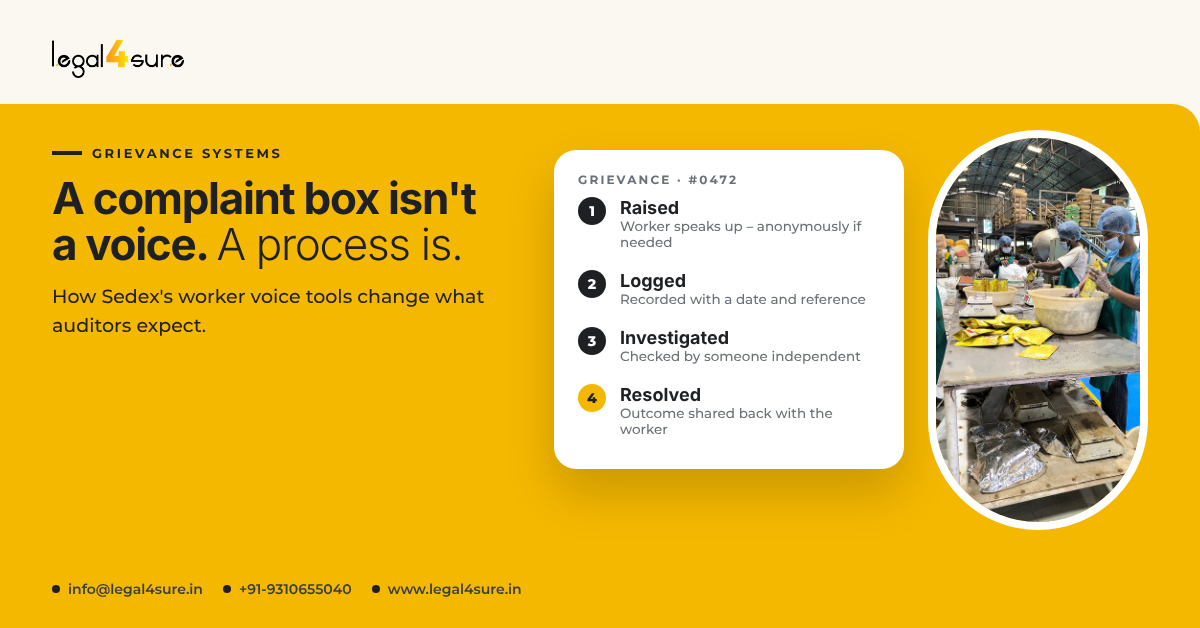
Establish a minimum of one private process in their native language(s), make everyone aware of it, document every complaint with a responsible person and date, solve it in a just manner, and inform the employee about the result. Analyze the trend.
A seven-step routine that holds up in an audit
- Prepare a simple grievance process in clear language, along with timelines for acknowledgment and resolution.
- Provide multiple channels, such as a worker committee representative, an HR desk, and an anonymous channel.
- Train workers on the same during induction and regularly thereafter, including contract and migrant workers.
- Train supervisors/ managers on non-retaliation and maintain attendance records thereof.
- Maintain a grievance log of the date, nature, owner, action, and closure of each grievance.
- Follow-up on the grievance by closing the loop with the worker in confidentiality and documenting the same.
- Conduct trend analysis on a monthly basis and escalate repeated or critical issues to senior management.
Choosing the right channel
| Channel | Works well when | Watch out for |
|---|---|---|
| Suggestion box | Workers can drop notes unobserved | Boxes near cameras or HR; no one opening them regularly |
| Hotline or IVR | Literacy levels vary | Cost, language coverage, workers doubting it’s anonymous |
| QR code or mobile survey | Most workers carry smartphones | Excluding workers without phones or data |
| Worker committee | Members are elected and trusted | Management picking the representatives |
| HR open door | As a backup route only | Workers fearing direct exposure |
Guidance on good practices provided by the Fair Labor Association emphasizes the importance of using anonymous surveys conducted in local languages and literacy levels. These considerations also hold true for internal company survey mechanisms.
What Auditors Cross-Check in Worker Feedback During a Sedex Audit
Worker feedback in a Sedex audit isn’t limited to the interview room. Auditors compare several sources and look for consistency:
- What workers report privately in interviews compared to what management reports about the same channel.
- Grievance registers versus the quantity and nature of complaints reported by workers.
- Committee meeting minutes versus changes implemented.
- The treatment of migrant, agency, and contract workers versus that of permanent employees.
- Survey information provided by the buyer or a Sedex-related supplier versus the site documentation.
When these don’t match, auditors dig deeper. When they do, the audit goes smoothly. Missing evidence tends to lead to findings that need a corrective action plan, so it’s worth knowing how that process works before you need it.
Sedex Worker Engagement and SMETA 7.0 Gender Data
Worker engagement within Sedex is about more than just handling grievances. It encompasses how you consult, communicate, and engage the workforce in decision-making processes that affect them.
The new gender data in SMETA 7.0 allows for sites to report their workforce with more subtlety than simply reporting a breakdown of males and females. We have written an explanation of SMETA 7.0 gender data that breaks down all the reporting implications.
In terms of grievance systems, the application of such data becomes rather self-explanatory. If your register of grievances has no grievances registered from women or migrant workers, this does not indicate a joyful workforce. Instead, this could be indicative of the existence of a channel through which the respective group cannot or will not approach. This is what gendered data on grievances can reveal.
Common Mistakes Factories Make
- Taking the suggestion box as the entire system.
- Allowing HR or line management to vet any complaints before others.
- Conducting a training only once during the induction period.
- Documenting complaints but not noting the result.
- Using one language to print posters in a workplace that is multilingual.
- Interpreting a small number of complaints as something positive.
- Implementing a new digital application without informing employees about who will see their response.
When Digital Worker Voice Tools Help, and When They Don’t
While technology can play a role, it is not a solution. As per the findings of research conducted by a team of scientists led by Brown University on “technology-enabled worker voice” projects, there have been cases where the use of certain technologies has been a burden for workers without providing any adequate benefits or protections for them. The guidelines provided by Shift regarding the method highlight the same.
| Where it helps | Where it falls short | |
|---|---|---|
| Pros | Reaches many workers quickly, anonymous, works across languages, produces trend data | Needs workers to trust it and know how to use it |
| Cons | Gives auditors a pre-visit picture | Doesn’t fix a poor management response by itself |
| Use it when | Large or multilingual workforce, buyer asks for it, repeat issues | Small workforce with low phone access and strong committee |
| Skip it when | You can’t act on what it reveals | You’d use it only to tick a box |
The honest rule is this: don’t collect feedback you aren’t prepared to act on. Workers notice quickly, and survey fatigue sets in fast.
Getting Help With Your Grievance System
In many cases, factories do not know how prepared for an audit they are until the auditor does the audit on them. A mock audit of the process of your grievance procedures, register, and worker awareness will provide an indication of any issues that might exist. A Sedex Registration Consultant will assist you in ensuring consistency among your Sedex profile, SAQ, and on-site information.
Legal4sure begins its assessments with verifying whether what you have written is consistent with what management says and what workers say.
Key Takeaways
- Worker voice within Sedex includes interviews, surveys, committees, and complaints mechanisms, and not just a complaint box.
- Sedex-related surveys can help auditors get feedback from workers prior to the audit visit.
- Auditors assess access, awareness, safety, and resolution at every complaints mechanism.
- SMETA 7.0 Gender data helps you identify underutilized mechanisms.
- No complaints don’t establish trust; documentation and interviews do.
Conclusion
Sedex worker voice methods have not replaced the audit process; however, they have set the bar higher in terms of evidence of worker voice and response mechanisms. Factories that see grievance handling as a process, with effective channels of communication, good record-keeping, and follow-up actions will see an easy audit process.
Begin with a very simple test. Ask ten workers in private what steps they would take to voice out a complaint. This will indicate where to begin in addressing the issue. If a second opinion before the auditor’s visit is needed, Legal4sure will be glad to assist.
Prepare Your Factory’s Grievance System for Sedex and SMETA Audits
Not sure whether your workers trust your grievance channels? Legal4Sure can help review your grievance procedure, worker awareness, complaint records, and follow-up actions so your factory is better prepared for a Sedex or SMETA audit.
Frequently Asked Questions
What is worker voice in Sedex?
It means how workers provide their feedback about working conditions without fear, and how the company handles that feedback.
How do Sedex worker voice tools affect factory grievance systems?
They highlight weaknesses in the system sooner, thus the importance of documentation, awareness, and follow-up.
What are the Sedex worker voice requirements for grievance mechanisms?
Workers must have access to them, awareness about them, confidence to use them and visible resolution, supported by dated documentation.
How should factories manage worker grievances for a Sedex audit?
Provide a confidential mechanism, document all grievances with a responsible person, handle the grievance and inform the worker about that.
Does worker feedback count in a Sedex audit?
Yes, auditors will check the consistency between interviews, grievance documentation, and survey data.
Is Sedex worker engagement mandatory for suppliers?
It depends on buyer’s requirements, thus clarifying them with linked customers.
Can a Sedex Registration Consultant help with grievance systems?
Yes, they can check the procedure, your register, and platform data before the audit.