
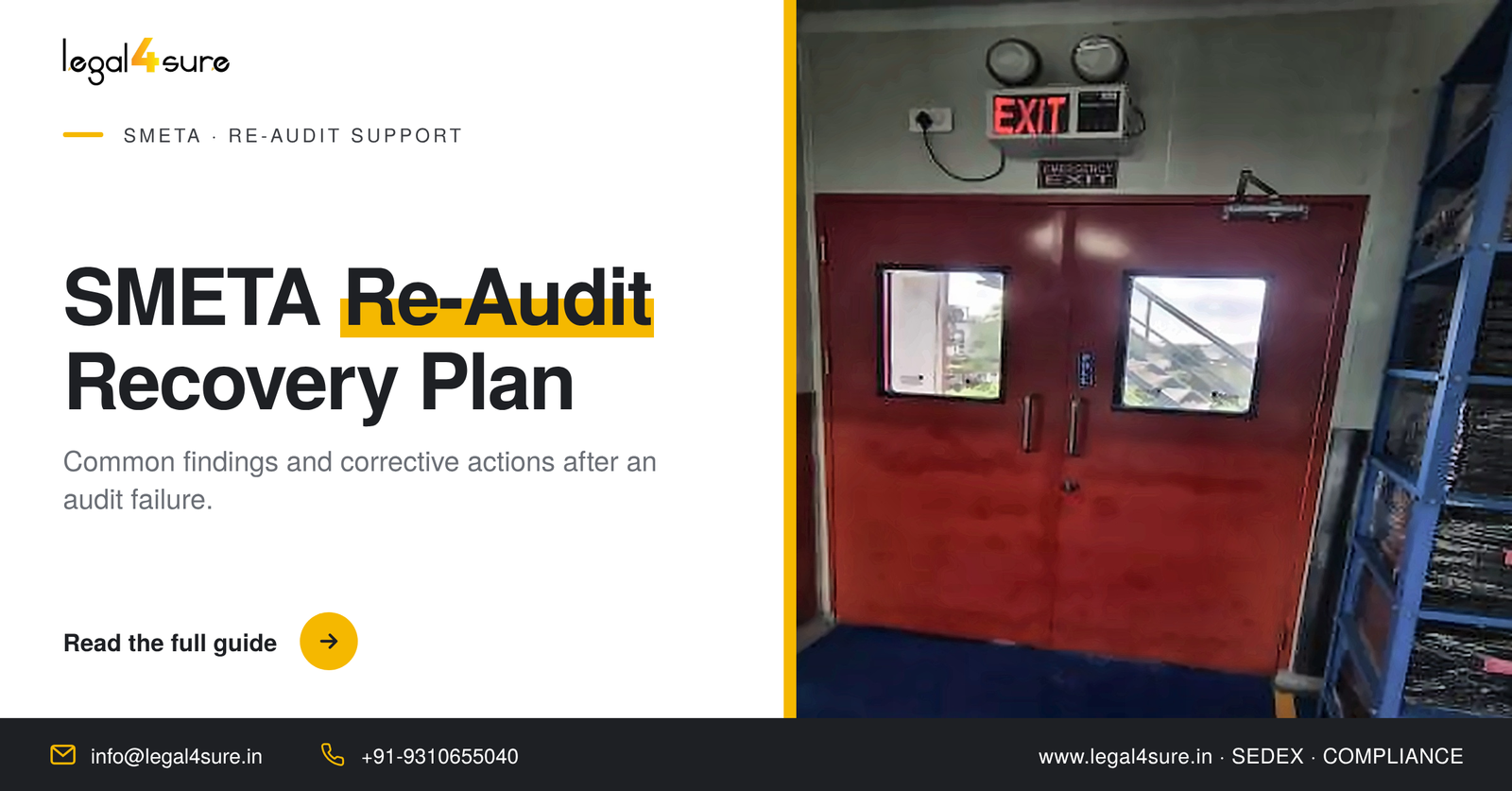
SMETA re-audit refers to the second audit or visit which aims at determining whether your location has addressed the issues identified during the previous SMETA audit.
First, it is important to understand that SMETA does not have a pass-or-fail result in the traditional sense. However, a report highlighting serious issues can put your orders at risk. This is why the term “SMETA audit failure” is so commonly used by suppliers.
In this guide, we will discuss what follows after the failed audit, the most common findings, and the recovery strategy that can be implemented right away. Legal4sure helps suppliers recover from SMETA audit failure, and that’s why the guidance provided below is based on real-life experience.
What Is a SMETA Re-Audit?
A re-audit under SMETA means a second visit to check on whether the site has addressed nonconformities identified in the previous SMETA audit. It can be a partial re-audit of open items only or a comprehensive one that audits all pillars again, based on CAPR and buyer needs.
The phrase is somewhat ambiguous since some buyers mean a brief visit, while others refer to the comprehensive audit process again. Find out which type your buyer wants before proceeding.
An audit firm notes the route in CAPR for each issue. This is your first indicator of what kind of re-audit you are about to experience.
What Happens If a SMETA Audit Fails?
There is nothing automatic since there is no fail or pass in SMETA. Your nonconformities are documented in the report, and your CAPR contains deadlines for fixing the nonconformities. How things will proceed after that will depend on the gravity of the issues and on your buyer, who might require more urgent action or another audit.
Auditors rate findings by severity, commonly as critical, major or minor. Roughly, here’s how that plays out:
- Important findings require prompt attention and generally lead to escalation by the purchaser.
- Important findings require a definite deadline and generally require verified information.
- Less important findings are followed up and resolved within extended periods of time.
Common SMETA Non-Conformities Auditors Raise
Most SMETA non-conformities fall into a handful of repeat categories. If you recognise yours below, you’re in good company.
| Finding | Typical root cause | Evidence auditors expect |
|---|---|---|
| Excessive hours or overtime | Order peaks with no overtime cap or tracking | Revised roster, attendance data, monthly review records |
| Wage or deduction errors | Manual payroll and unclear deduction rules | Corrected payslips, back-pay proof, written deduction policy |
| Incomplete age or contract files | Records kept by different people | Complete personnel files, age verification, signed contracts |
| Fire and emergency gaps | Blocked exits, expired extinguishers, no drills | Dated photos, inspection logs, drill records |
| Chemical storage and PPE | No storage rules or training | Labelled storage, safety data sheets, PPE issue logs |
| Weak grievance system | No channel workers trust | Written procedure, complaint log, worker communication proof |
Notice the pattern. Most findings trace back to a missing system, not a single mistake. That’s why quick patches rarely survive a second visit.
SMETA Re-Audit Fast Recovery Plan
This framework isn’t a Sedex rule. It’s a practical sequence for working within your CAPR deadlines.
Days 1-3: Triage
- Read the report in full together with the CAPR.
- Categorize the issues according to urgency and deadlines.
- Designate one person for every single issue.
- Verify the timeline and process of verification with the audit firm.
Week 1-2: Risk and Critical Issues
Start with anything that is a threat to safety or could escalate because of it, and anything that could be escalated by the buyers. Block the exits, store chemicals appropriately and cease whatever activities are against the law. Remember to take photos with dates.
Weeks 3-6: System
This is the time to address the underlying cause of the problem. Modify the policies, solve any payroll problems, train the supervisors and make a system of follow-up. This would require remembering, and it is bound to fail eventually.
Final Leg: Evidence and Verification
Create one folder of evidence for each issue, perform an internal mock audit, and hand in the evidence with the date of the verification. Do not wait until the deadline week.
A Realistic Example
Consider a unit within the garment factory that has an important finding of overtime along with a less significant finding of missing training logs.
The important finding of overtime receives an HR owner, a weekly overtime cap and monthly reviews while the less important finding of missing training logs receives a training matrix and a retraining week.
After two months have passed, the auditor reviews the attendance records of the whole time period. The correction for overtime issues requires a site visit because the hours record needs to be verified from the shop floor activity.
How Urgent Is Your Situation?
Use this quick decision framework to set your pace:
- An important one that is open is to act fast and notify your customer what you’re doing.
- Important ones with deadlines falling within 90 days: conduct a weekly tracking process and review them with management.
- Minor ones only: do monthly reviews and close them together with other improvements.
How to Close SMETA Non-Conformities and Corrective Actions
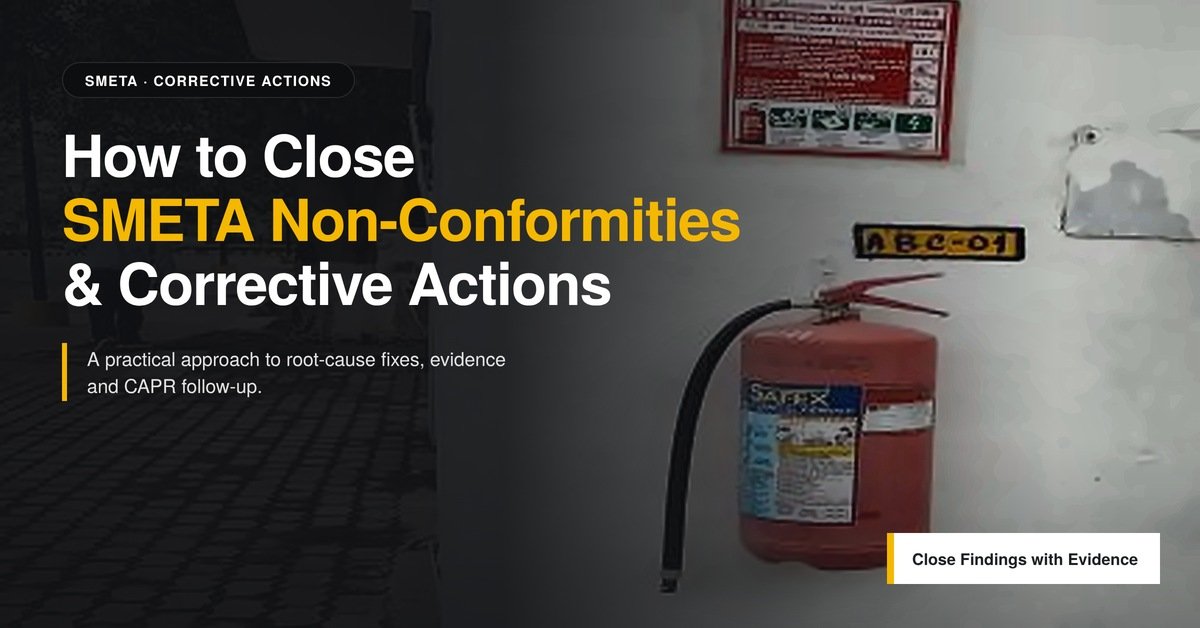
To resolve a nonconformity, you correct the underlying problem, demonstrate the correction with evidence and sustain the correction. The finding is resolved by an auditor only when the evidence is relevant to the initial finding.
Work each finding through three questions:
- Why is this so? Keep questioning until a procedural or policy failure is reached.
- How has this changed so that it can’t happen again?
- What evidence is an external observer going to accept?
Good evidence is dated, specific and independent of your own claims. Think signed policies, training attendance sheets, payroll samples across several months, and meeting minutes.
SMETA CAPR Closure: What It Means
The SMETA CAPR closure refers to the time at which an auditor acknowledges your evidence and declares the corrective action taken as completed. The closure of each CAPR occurs independently, either through a desktop review or a follow-up visit.
Partial closure often happens. You may find yourself closing ten CAPRs while leaving two unclosed due to the fact that a change in policy takes more time to produce its effects. Update your closure information accordingly and set a new date.
Desktop Review, Follow-Up Audit or Full Re-Audit?
Three verification routes exist, and they differ in scope and cost. Your CAPR and your buyer decide which applies.
| Factor | Desktop review | Follow-up audit | Full re-audit |
|---|---|---|---|
| Scope | Selected findings, remotely | Open findings, full or partial | All pillars in scope |
| Site visit | No | Yes | Yes |
| Best for | Policies, certificates, training records | Wages, hours, physical safety fixes | Repeat cycle or serious failures |
| Cost | Usually lowest | Day-rate, set by audit company | Comparable to a new audit |
Any changes to pay and work schedule usually require a field visit, as documentary evidence alone cannot sufficiently prove the validity of the change.
A guideline that can be applied is as follows: if the solution resides in documents, then do an office visit; otherwise, do a field visit.
How Do You Prepare for a SMETA Re-Audit?
Preparation comes down to proving that every fix still holds on the day. Work through this checklist:
- Each CAPR item has an owner, a status, and an evidence file.
- The physical corrections have been implemented, not just taken photos once.
- The payroll/attendance has the complete history since the first audit.
- The supervisors can describe the new procedure in their own words.
- There has been a walkthrough mock test conducted for the exit, storage, and notice board.
- The employees are aware of the grievance process.
Don’t coach workers on what to say in interviews. Auditors notice rehearsed answers, and consistent real practice protects you far better.
Documents to Keep in Your Re-Audit File
- Original report and signed CAPR
- Revised policy documents with dates of approval
- Payroll and attendance records including overtime records for entire period of review
- Training records and certificates
- Physical correction photos with dates
- Management review meeting minutes
Why a Mock Audit Pays Off
The mock audit, performed by an outsider to your compliance department, identifies problems before it is too late to fix them. Conduct the audit from the perspective of an auditor, interview a few supervisors, and look at the records over different months. Chances are that there will be a weakness found somewhere, and it will cost much less to do so.
How Buyers React After a Failed SMETA Audit
Buyers rarely judge you on one report alone. They look at how you respond. Procurement and compliance teams typically weigh four things:
- The seriousness of the results, particularly those that are critical
- If similar results have been found in previous audits
- How swiftly the corrective actions pass through the CAPR process
- How open you are in communicating during the process
This one is often overlooked. A short update of your progress to your buyer, along with the CAPR status on Sedex, will go down much better than staying silent and then submitting late. Quiet suppliers tend to get more difficult questions asked.
Good news is always good to give. If you’ve resolved the critical issues early, let the buyer know.
Common Mistakes After a Failed SMETA Audit
- Symptom solving, like blocking only one exit point, without system fixing
- Allowing investigation to occur just one week before submission
- Setting an unrealistic deadline for the team
- Date falsification, changing a trivial finding to a critical one
- Not taking care of the purchaser during correction activities
When to Bring in Outside Support
Many sites can handle minor findings in-house. Outside help earns its place when findings are critical, repeat from a previous audit, or span several pillars.
- Take care of internal issues: documentations not available, missing training logs, housekeeping glitches.
- Seek assistance with: wage system design, duplication of results, key issues, tight deadlines from buyers.
Our Legal4sure team goes through the report, prepares the CAPR and conducts a mock audit prior to validation.
SMETA is not a certification, so it does not have a fixed expiry date. However, understanding Sedex certification validity is important for suppliers working with international buyers. Sedex membership and SMETA audit reports are different, and buyers generally decide how frequently suppliers need to undergo another audit. This is usually once a year or once every two years, depending on buyer requirements and the supplier’s compliance history.
Legal4sure provides SMETA Audit services pan India, Contact us now to discuss your Sedex requirements and get assistance with your home furnishing factory’s audit preparation.
Key Takeaways
- SMETA re-audit ensures that the previous observations have been rectified, and it could be in the form of desktop audit, follow-up audit, or complete audit.
- There is no pass/fail grade for SMETA, but major observations might lead to buyer actions.
- Most of the non-conformances are due to absence of systems, and thus, solving root causes will last longer than solving temporary problems.
- Closure of CAPR relies upon time-specific observations corresponding to each observation.
- Begin with critical points; allocate owners; and prepare observations before the deadline.
Conclusion
A re-audit of SMETA is a second chance, not a sentencing process. Categorize by severity, address the source of the issue, and maintain a paper trail that could be followed by anyone else without your input.
Companies that consider the CAPR process as a project planning process generally resolve issues quickly and approach the next audit process confidently. If you need assistance with preparation, Legal4sure can be of service.
Recover from SMETA Audit Findings with the Right Corrective Action Plan
Get expert support to review your SMETA audit report, prepare CAPR documentation, address non-conformities, organise corrective action evidence, and conduct a mock audit before verification. Legal4Sure helps you prepare for your SMETA re-audit and regain buyer confidence.
Frequently Asked Questions
What happens if a SMETA audit fails?
There is no such thing as a failure. You’ll receive a CAPR with deadlines, and your buyer might ask you to solve it quicker or conduct a re-audit.
How do you prepare for a SMETA re-audit?
Distribute CAPR findings among owners, provide dated evidence, verify that any physical solutions are still effective, and conduct a mock walk-through.
Do you have tips on how to prepare for a SMETA re-audit after audit failure?
Tackle the critical and safety issues first, then recreate the processes that caused each finding. Provide dated evidence as soon as possible.
Can you explain how to close SMETA non-conformities and corrective actions?
Determine the root cause of the problem, solve it, and provide dated evidence. An auditor will close each CAPR line separately.
Is a SMETA re-audit mandatory?
It depends on how you want to verify your CAPR and your buyer’s requirements.
How long does SMETA CAPR closure take?
Each finding has its own deadline, from immediate action up to 365 days, depending on severity.
Who pays for a SMETA re-audit or follow-up visit?
The report owner usually pays the audit company. Confirm fees and the payer before booking.