
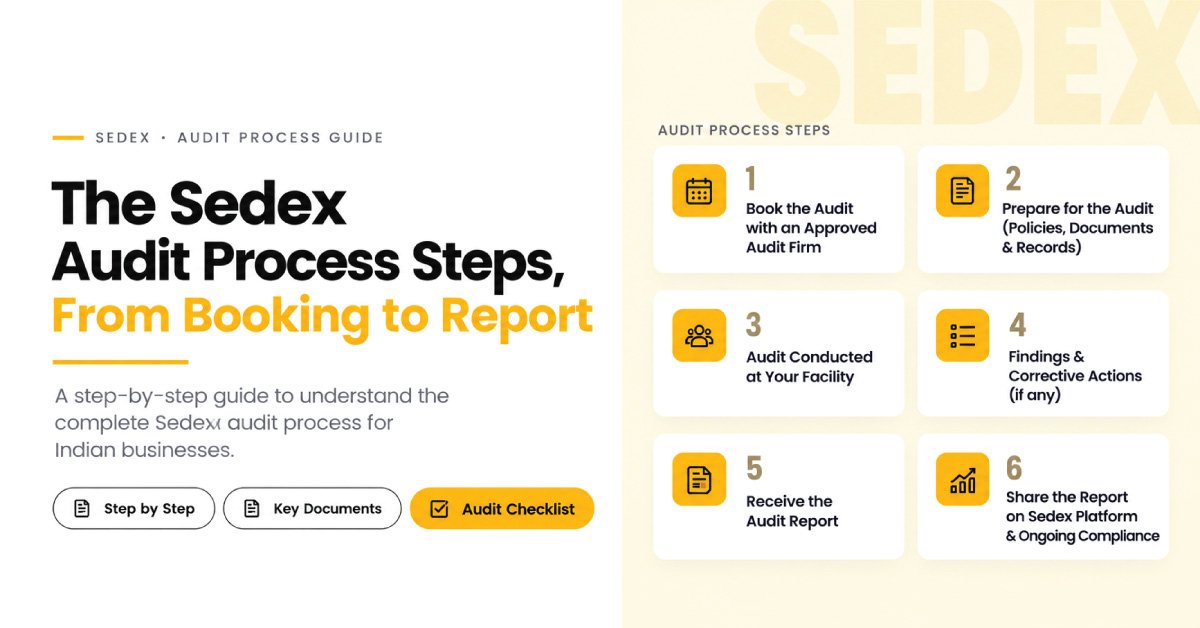
The first thing international buyers will want to know from their Indian sellers is whether their site has undergone a Sedex audit. In short, the buyer should be aware of seven stages from registration to submission of the SMETA report. Doing all those sequentially allows you to conduct a single audit and get multiple customers as a result. The whole knowledge about Sedex audit process steps will help you.
Sedex, which stands for Supplier Ethical Data Exchange, is a member-based organization that helps organizations run their business in a responsible manner. SMETA (Sedex Members Ethical Trade Audit) is the audit that is conducted on this platform. It provides detailed information about all the steps, related paperwork and facility check, and what takes place after the auditor has left.
It can be considered informative, containing a comparison table and useful checklists to estimate your readiness of the factory.
What Is the Sedex Audit Process, Exactly?
The Sedex audit process is the pathway a supplier will use for their site to be evaluated for ethics and social performance using SMETA, and sharing the results with their buyers through the Sedex platform. The Sedex platform is maintained by Sedex, while the audits are conducted by approved auditing firms.
Short answer: The Sedex audit process is a seven-stage process from joining Sedex to submitting a SMETA audit report.
A few things worth knowing upfront:
- Membership-based Sedex provides three types of members A, B, or AB, and Indian suppliers typically go for Type B.
- Your account in Sedex is connected to your buyer’s account, and you specify which sites should undergo the audit.
- The audit can involve two or four pillars, including Environmental or Business Ethics, to two Labor or Health & Safety.
- For Indian suppliers, the audit is the way into the buyer market in the UK, Europe, US, and elsewhere, with one audit covering many buyers.
The four pillars consist of Labour (working hours, wage, child labor, forced labor), Health & Safety (occupational health & safety, emergency planning, PPE), Environment (waste management, emission, resources consumption) and Business Ethics (anti-bribery, anti-corruption, business ethics). Only environment and business ethics are relevant for 4-Pillar audits.
Why Buyers Prefer Suppliers Who Follow the Sedex Audit Process
Consumers like to see that suppliers have completed their Sedex audit, as it eliminates any assumptions and provides an easily readable report.
In essence, this system allows you to turn your compliance into a document the buyer can review for himself. There are four good reasons for this.
1. It Provides Transparency to the Buyers of the Supply Chain
The buyers can access your audit report through your Sedex account itself. This transparency will ensure the buyer about the working conditions in your place without having an extra audit done by themselves.
2. It Proves That You Meet Global Ethical Standards
The SMETA audit proves that you meet the standards set globally from the ethical and social perspective. It becomes important for the buyer who answers back to his customers.
3. One Report Can Be Used for More Than One Buyer
There can be more than one buyer viewing the same audit report. Buyers don’t have to do the same task twice, and you will be saved from getting tired from auditing again and again for each and every customer.
4. It Keeps Your Profile Updated
Your Sedex profile can prove that you have a valid audit report. The validity period of a SMETA audit report is one to two years.
The Sedex Audit Process Steps, From Booking to Report
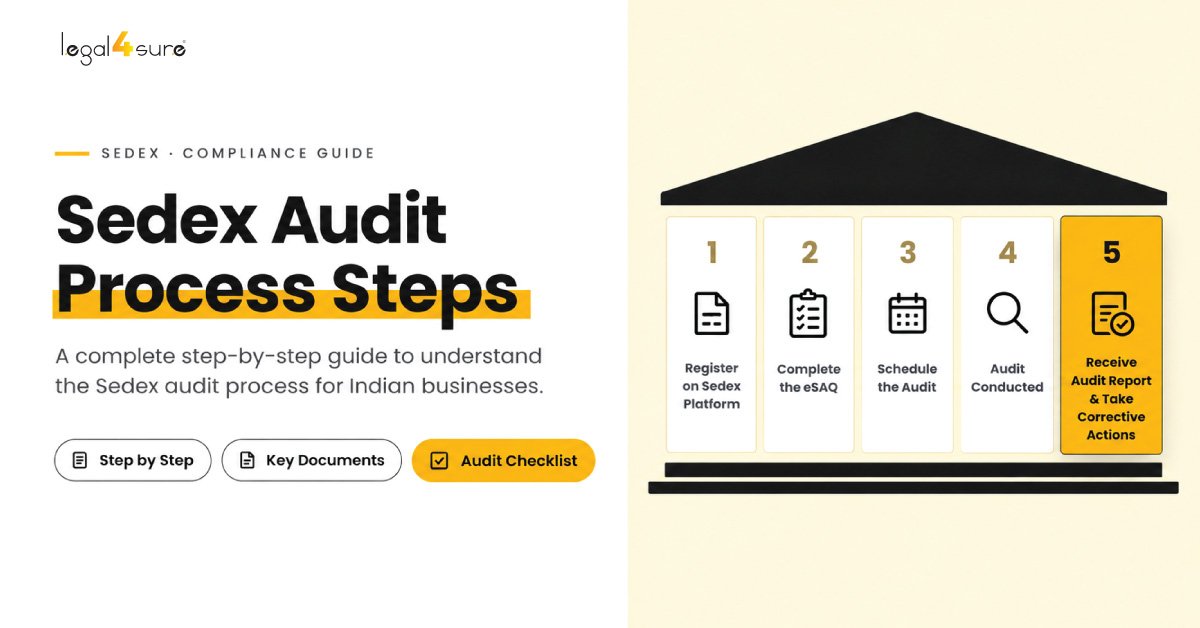
And here is the full process step-by-step. When you want to know how to get Sedex certification in India, then this is your way to go. Technically speaking, Sedex is the membership, while SMETA is the audit, hence the loose term of “certification”.
Step 1: Create an Account on Sedex
Sign up for a Sedex account via sedex.com, select your membership category as A, B or AB and then make payment for annual membership fees. After this, connect your account to your buyer’s Sedex account and decide on your scope, which is basically the site(s) to be audited.
Step 2: Fill Self-Assessment Questionnaire
The SAQ addresses the working conditions and remuneration, health and safety, freedom of association, child/forced labor and environment for conducting a 4-Pillars audit. The auditor will have gone through the questionnaire before visiting and thus any discrepancies in your responses and reality are counted as a non-conformance. It can be considered your first impression, because the auditor gets the first idea of your site through it.
Step 3: Pick an Approved Auditor Company
Pick a company that has been approved by Sedex and also has SAAS accreditation as well as Indian compliance like Factories Act and Minimum Wages Act. Common companies in India include SGS, Bureau Veritas, Intertek and TÜV Rheinland.
Step 4: Preparing Prior to the Audit
Assemble documents like staff records, appointment letters, fire safety certificates, drill record cards, statutory permits, and training certificates. Ensure fire exits, notices, first aid, and canteens are available.
Inform workers about their rights but don’t brief them about what to say.
In case of a 4-pillar audit, add environmental clearance among the documents to be gathered. Post statutory notices in the local language and ensure workers understand the grievance redressal process.
Step 5: Conducting the On-Site Audit
An on-site audit takes place over a period of one or two days and goes through five steps: an opening session, document review, facility inspection, confidential worker interviews and closing session where the auditor gives preliminary conclusions.
The worker interview sessions are done in confidence and include selected workers, thus providing first-hand experience for the auditor. The facility inspection includes production areas, storage rooms, canteens and toilets while document review focuses on payrolls and attendance among others.
Step 6: Get the Report and Submit the CAPR
The audit body provides you with the SMETA report categorizing findings as Zero Tolerance, Major Non-Conformance, Minor Non-Conformance and Observation or Good Practice. You are then required to submit the Corrective Action Plan Report (CAPR) containing the root cause, action, photo and record proof, and deadlines.
If an issue falls under Zero Tolerance, it should be fixed immediately. Urgent rectification should be made for Major non-conformances, while Minor non-conformances have a specific deadline. Observations and good practices are recommendations or acknowledgment, and they do not constitute failure.
Step 7: Uploading and Sharing of Report
The last step is uploading the SMETA report on the Sedex platform. The linked buyers will then be able to access it, while your account shows your current valid audit for one to two years. Since the report is uploaded on your account, the buyers can easily access it without your intervention.
In the timeline for the factory on Sedex, there are two important numbers; one to two days for on-site auditing and one to two years of report validity. Schedule everything else based on the buyers’ deadline and your CAPR deadline.
2-Pillar vs 4-Pillar: Quick Comparison
Most Indian vendors start with the 2-Pillar Audit. The 4-Pillar audit includes the Environment and Business Ethics pillars and is typically required by most major international retailers. It’s best to ask your buyer which one they need before booking the audit.
| Aspect | 2-Pillar Audit | 4-Pillar Audit |
|---|---|---|
| Pillars covered | Labour and Health & Safety | Labour, Health & Safety, Environment, Business Ethics |
| Labour focus | Hours, wages, child and forced labour | Same |
| Health & Safety focus | Workplace safety, emergency procedures, PPE | Same |
| Environment | Not covered | Waste, emissions, resource use |
| Business Ethics | Not covered | Anti-bribery, corruption, fair practices |
What Does It Take to Meet Sedex Audit Requirements?
Meeting the requirements comes down to records, facilities and people. Auditors check all three.
A quick self-test: if an auditor asked for any item below tomorrow, could you hand it over within minutes? If not, start there.
- Statutory licences – factory licence, PF, ESIC and other statutory clearances up to date
- Employee data – attendance, payroll and leave register, and letters of appointments to all
- Safety measures – fire exit routes, safety clearances, drills and training records
- Facilities at workplace – first aid kits, personal protective equipment, canteen, washroom and drinking water, with posters in the local language
- Environmental clearances and records – for 4-Pillar audit
- Worker’s awareness – workers who are aware of their rights and grievance procedure
Common Mistakes Indian Suppliers Make When Preparing for a Sedex Audit

Most problems come from small oversights, and each one has a simple fix.
- SAQ Completion, roughly. Make sure to answer accurately as any discrepancy is a non-conformance.
- Selecting an audit body without verification of its approval. Ensure that Sedex approves the auditing body, as well as that it is aware of all relevant Indian laws including the Factories Act and Minimum Wages Act to ensure compliance with proper standards.
- Providing worker answers script. Explain to workers their rights and ensure they know the process of grievances and let them answer in the interview freely.
- Considering the CAPR merely paperwork. Make sure to include the root cause, the corrective action, the proof and the deadline in the CAPR.
- Leaving facility inspection until the day of the audit. Make sure that fire exits are clear, signs in the local language are displayed and first aid kits and PPE are ready before the auditors arrive.
When the Sedex Audit Process Makes the Most Sense
It makes the most sense when a buyer, a target market or your own growth plans call for verified ethical compliance.
- The buyer is asking you to get listed on Sedex and conduct an SMETA audit.
- You are selling or are planning to sell in the UK, Europe or USA.
- You have many buyers but wish to conduct one audit for all.
- You have a global retailer who requires a 4-pillar audit.
- You are an exporter starting out with a good compliance track record.
It matters less if you sell only domestically and no buyer has asked for it. Even then, tidy records and safe facilities are worth having.
Key Takeaways
- Sedex audit involves seven phases, starting from the registering of the audit platform to uploading the report.
- SA 8000 SMETA audits look at Labor, Health & Safety, Environment, and Business Ethics, depending on whether it is two or four pillars.
- Correct SAQ responses and good record-keeping help maintain low non-conformities.
- CAPR should include the root cause, action taken, evidence, and time frame for all findings.
- One uploaded report can satisfy several buyers, and this reduces audits and costs.
- Audit reports remain valid for one to two years.
Conclusion
It becomes very easy to carry out a Sedex audit when you know the order to do things in: registration, self-assessment, appointing of a certified auditor, preparation, audit process, and uploading of the report/CAPR. You will have a single report that would earn the trust of multiple clients. What used to be optional is now mandatory for many exporters. You can always count on Legal4Sure for any assistance.
Simplify Your Sedex Audit Preparation from Booking to Report
Prepare your factory for buyer requirements with expert support for Sedex registration, SAQ completion, SMETA 2-Pillar or 4-Pillar audit preparation, documentation reviews, and Corrective Action Plan Report (CAPR) follow-up. Legal4Sure helps Indian manufacturers and exporters identify compliance gaps and organise their audit readiness with confidence.
Frequently Asked Questions
What are the Sedex audit process steps?
Registration with Sedex, completion of SAQ, selection of an approved audit body, preparation, on-site audit, CAPR and report submission.
How does the Sedex audit process help Indian suppliers?
Gives access to buyers from UK, Europe and USA and a single SMETA report can be used by several of them.
Why do buyers prefer suppliers who complete the Sedex audit?
They can see your report directly in Sedex without conducting an audit themselves.
Is the Sedex audit mandatory?
Depends on your buyer; buyers who have Sedex requirements will surely ask for it, so please clarify your buyer’s requirements in writing.
Can my factory register on Sedex directly?
Yes. Since Sedex is a membership-based platform, you can create your own Sedex account; you have to select whether you want to be type A, B or AB and link yourself with your buyer.
What is the difference between Sedex and SMETA?
Sedex is the membership platform and SMETA is the audit conducted through it whose report is then uploaded in your Sedex account.
Does the Sedex audit process reduce audit costs?
It can. Since several buyers can view one report, you avoid repeating audits for each customer.