
The U.S. market is a peak of potential for medical device companies around the world, famous for its highly developed healthcare system and substantial demand. But to tap into this market, it is not enough to have innovative products; it is necessary to comply with the strict regulatory requirements of the U.S. Food and Drug Administration (USFDA). For Indian companies and food business operators who have ambitions to expand their presence, understanding the fda device india scenario and completing the fda medical registration is not only beneficial but also necessary.
This blog post is intended to make the USFDA certification for medical devices process easier to understand, pointing out potential mistakes, explaining how to achieve compliance, and showing the enormous benefits of USFDA medical device certification for Indian companies who want to gain worldwide recognition.
Talk to Our Experts Today
Exporting medical devices to the US? USFDA Certification for Medical Devices is mandatory — avoid import refusal & FDA rejection! Get Legal4Sure’s expert assistance for 510(k), PMA approval & full compliance. Fast, 100% online. Apply Now!
Key Benefits of USFDA Certification for Medical Devices
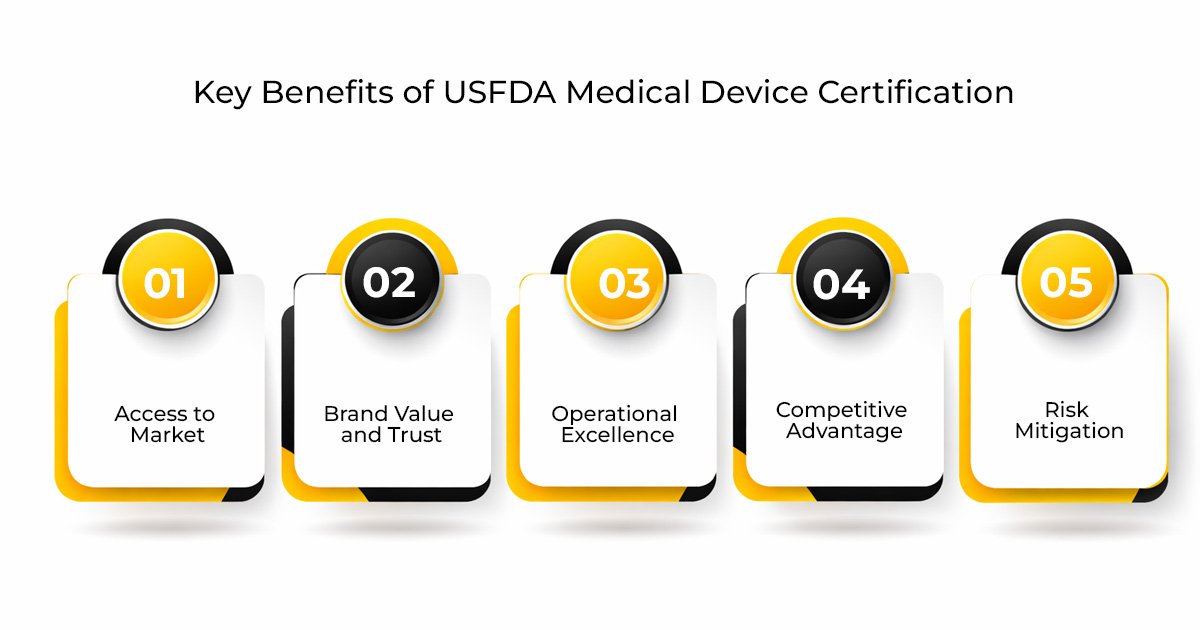
The hard work put into obtaining USFDA medical device certification brings immense returns to Indian companies:
- Access to Market: Directly gain access to the extremely lucrative United States pharmaceutical industry, thus expanding your customer base and revenue potential.
- Brand Value and Trust: Instantly enhance your brand’s credibility on a global scale. United States FDA Pharma Certification is a universally accepted badge of honor for quality and safety, which inspires trust amongst buyers, partners, and medical professionals across the globe.
- Operational Excellence: The process of cGMP compliance itself guarantees improved operational efficiencies, standardization, and high-quality production processes, thus reducing waste and errors.
- Competitive Advantage: Set your company apart from your peers and competitors by having this critical certification, which will make you a preferred partner for discerning buyers across the globe.
- Risk Mitigation: Avoid the risks of costly product recalls, legal actions, and import restrictions by complying with the highest standards.
>Helpful Guide:- What Is USFDA Certification? Meaning, Benefits & Complete Process Explained
Questions on USFDA Certification for Medical Devices
Indian entrepreneurs face certain concerns while thinking about USFDA medical device certification:
- Is USFDA medical device certification another red tape process that will suck our resources without any benefit to us?
- Will the fda medical registration process be too complicated and time-consuming, thereby stopping our current production process?
- Can we really satisfy the strict usfda approval process requirements of medical devices India without revamping our entire business?
- Is it possible to get usfda device approval for our innovative product, or is it only for bigger companies?
- What if we invest a lot and still are not able to get usfda device process compliance?
>Helpful Guide:- Everything You Need to Know About US FDA Certificate
Step by Step Process to get USFDA Certification for Medical Devices
The process of obtaining USFDA device approval for your medical device requires a systematic and meticulous approach. Below is a simplified explanation of the fda device India registration:
- Classification & Product Code Identification
Each of your device needs to be assigned an FDA Product Code and Regulation Number.
Identify Class: Decide which class your device falls under: Class I, Class II, or Class III.
| Device Class | Risk Level | Example | Pathway |
| Class I | Low Risk | Bandages, Handheld Scalpels | General Controls |
| Class II | Moderate Risk | Syringes, Powered Wheelchairs | 510(k) Premarket Notification |
| Class III | High Risk | Heart Valves, Pacemakers | Premarket Approval (PMA) |
Confirm Exemptions: Verify whether your device is 510(k) Exempt. Most Class I devices only need to be registered, not pre-market submissions.
- Appoint a US Agent
Since you’re exporting from India, you need to appoint a US Agent.
- They will act as your liaison to the FDA.
- They will help respond to their questions and facilitate potential facility inspections.
- Build a QMSR Compliant Quality System
Before you submit anything, your manufacturing process needs to be audit-ready.
- ISO 13485: Make sure your quality system complies with the new QMSR regulations.
- Document Controls: Keep your Design History File (DHF) and your Device Master Record (DMR) up to date. This area causes Gap issues for Indian firms.
- Pre-Submission (Q-Sub) Meeting
For novel or complex Class II devices, you have the option to request a Pre-Sub meeting with the FDA.
- This allows you to get feedback on your testing protocols prior to spending money on clinical trials or bench testing.
- Prepare & Submit the Pre-Market Application
For Class II or Class III devices, you must submit your technical dossier:
- 510(k) (Premarket Notification): Demonstrate Substantial Equivalence to a predicate device.
- PMA (Premarket Approval): Show clinical evidence for safety and efficacy (Class III).
- eSTAR Template: From 2026, the FDA will mandate the use of the eSTAR electronic template for these submissions to ensure they are complete.
- Pay the FDA User Fee & Register your Establishment
After you receive approval (or if you are exempt), you must pay the annual fee.
- The annual establishment registration fee is about ₹10 Lacs.
- FURLS Account: You will need to log into the FDA Unified Registration and Listing System to register your facility.
- Device Listing & UDI
The last administrative hurdle before you can ship your device:
- List the Device: You will need to associate your particular product models with your facility in the FDA system.
- UDI Implementation: You will need to assign a Unique Device Identifier to your packaging so that the product can be traced throughout the US supply chain.
>Helpful Guide:- USFDA Registration Process In India | Food, Pharma & Step by Step Guide
Why Manufacturers Struggle with USFDA Certification for Medical Devices
- Lack of Specialized Knowledge: Although product knowledge is strong, knowledge of USFDA approval processes for medical devices in India (e.g., device types, submission processes such as 510(k) or PMA, QSR) is weak. This is more than just general quality; it is about details of regulatory requirements.
- Lack of Proactive Approach: Companies attempt to bolt on compliance after product development rather than incorporating a Quality Management System (QMS) (such as ISO 13485) from the start of product design. This results in rework and lost time.
- Information Overload & Misinformation: The sheer volume of USFDA information can be overwhelming, making it difficult to discern what information is relevant to their particular device, or following outdated guidance.
- Underestimation of Documentation Requirements: The USFDA requires extremely detailed and thorough documentation of all processes, from design and manufacturing to testing and post-market surveillance. Many companies find their documentation to be inadequate.
>Helpful Guide:- Documents Required For USFDA Certification In India 2026 | Complete Checklist
Key Takeaways
- Apply the principles of QMS at the product design stage instead of waiting for the manufacturing stage.
- Consult with consultants who are experienced in handling USFDA medical device certification for Indian companies.
- Incorporate quality and compliance into the DNA of the company.
- Your meticulous and retrievable documents are your greatest strength at the USFDA device process.
- USFDA compliance is not just a destination but a continuous journey.
>Helpful Guide:- USFDA Certification Cost 2026 – Full Fee Breakdown & What You Must Know
Frequently Asked Questions
What is usfda certification for medical devices export usa india?
It is the mandatory process of obtaining approval by the USFDA that the Indian medical device manufacturers have to go through in order to legally export and sell their devices in the US.
What is the fda medical device registration process india for manufacturers?
The key requirements include the implementation of a QMS, preparation of a pre-market submission (510k, PMA), registration of the facility and listing of the device.
What are the usfda approval requirements medical devices india requirements?
Compliance with the Quality System Regulation (QSR), correct classification of the device, preparation of a pre-market application and facility inspections.
Can you explain the usfda device process in simple terms?
This includes assessing device risk, developing a quality system, validating the safety and effectiveness of the device by submitting (such as 510(k).
Is fssai enough export usa for medical devices?
No, FSSAI is responsible for regulating food products in India. Medical devices for the US market must comply with USFDA regulations, which are different and separate from FSSAI.
What is the difference between fda vs fssai india regarding medical devices?
FDA is responsible for regulating medical devices and food in the US market, while FSSAI is responsible for regulating food safety and standards in India.
Is usfda mandatory india for selling medical devices in the US?
Yes, USFDA approval is mandatory for any medical device to be legally sold in the United States, regardless of its country of origin.