
If you are in the food, packaging, or consumer products industry, especially if you supply to retail chains or export markets, you have almost certainly been asked about BRC certification at some point. But what is BRC certification, and why is it now one of the most sought-after quality management systems in the world, especially in the country of India? In this guide, you will find the answer to these, as well as many other related questions.
What is the full form of BRC, what does the term mean, what is the procedure for getting certified, what are the costs involved, which industries require the highest level of BRC certification, and many other related topics will be discussed in this ultimate guide on BRC certification India for the year 2026.
What is BRC Certification
To get a clear idea of what BRC certification means, it would be helpful to understand where it all started. BRC full form is British Retail Consortium. This organization, based in the UK, developed its first Global Standard for Food Safety way back in 1998. The idea behind it was very simple. A number of large-scale retailers in Britain needed a system by which they could be sure that all their suppliers in the chain were providing safe, legal, and high-quality products.
The meaning of BRC has changed a lot since then. What started off as a standard for food safety in the UK has now become a comprehensive range of international standards covering food safety, packaging materials, storage and distribution, consumer products, and agents and brokers. In 2019, the certification division of BRC changed its name to BRCGS, which now stands for Brand Reputation Compliance Global Standards.
Therefore, to answer what BRC certification means in today’s world, it would be safe to say that BRC certification now means a third-party verified management system standard by which an organization can get certified for meeting very stringent international standards for product safety, operational integrity, and legal compliance.
>Helpful Guide:- Emergency BRC Certification: How to Get Approved When Audit Is Due in 15–30 Days?
What Are The Benefits Of BRC Certification in India?
For Indian businesses, knowledge of what is BRC certification and its benefits in India is a logical place to begin, before investing time, money, and resources into the process. The advantages are diverse, wide-reaching, and commercially significant.
- Opening Doors to International Retail Markets
Global retailers such as Tesco, Walmart, Waitrose, Aldi, Lidl, Carrefour, and several others require their approved suppliers to have a valid BRC certificate. For Indian exporters, BRC certification India is their entry pass. Without BRC, they would not be approved as a vendor, irrespective of product quality.
- Fewer Shipment Rejections and Faster Customs Clearance
BRC certification demands high standards for HACCP-based food safety management systems, traceability, and corrective action. These ensure a high degree of protection against shipment rejections at entry points, which would otherwise cause costly delays for exporters.
- Stronger Brand Credibility and Buyer Confidence
A BRCGS certificate is a widely accepted stamp of approval, proving that your facility has been audited against high standards. It is a guarantee of quality, instilling long-term trust among buyers, consumers, and retailers, which is a significant advantage for exporters in competitive product segments such as spices, food, seafood, or snack food.
- Operational Improvements and Cost Savings
The journey to attaining BRC certification is a catalyst for businesses to formalize their processes, eliminate operational gaps, and create internal audit systems. The end result is a leaner, more efficient operation, which has a direct impact on reducing product wastages, rework, and quality-related costs.
- Winning More Tenders and Long-Term Contracts
In today’s tendering environment, both local FMCG tenders and international procurement tenders require BRC certification. By attaining BRC certification, businesses are at a structural advantage when tendering for contracts, competing on an equal footing with well-established global suppliers.
Why is BRC Certification Required for Food Export?
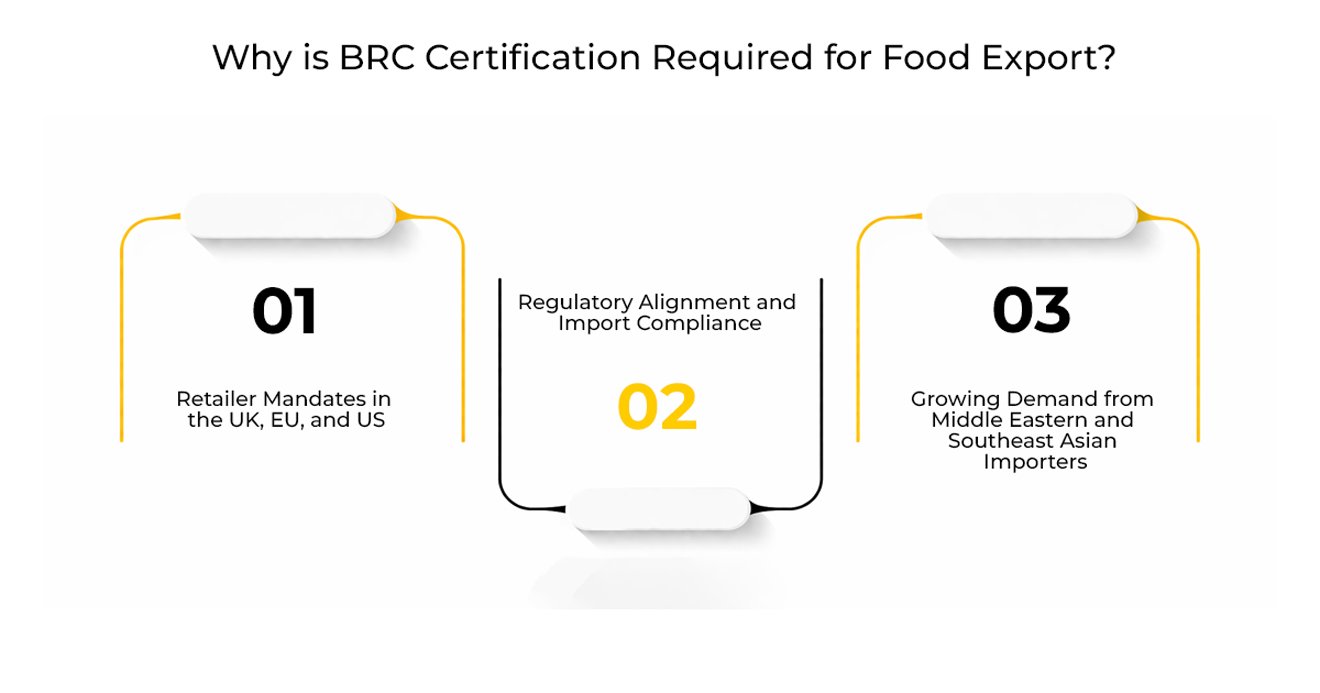
A very practical question that is commonly asked by Indian exporters is that why is BRC certification necessary for food exports? Is it a legal requirement or a buyer requirement, or is it possibly both? The answer to this question is based on retailer policy, international regulation, and supply chain risk management.
- Retailer Mandates in the UK, EU, and US
In the UK and EU, leading retail groups have incorporated BRC certification into their supplier approval schemes as a non-negotiable requirement for their suppliers. If an Indian food manufacturer wants to supply a retailer in the UK with their products in a private label or branded format, then BRC certification is one of the qualifications that is specified in their supplier qualification scheme, with no exceptions whatsoever. This is one of the most important reasons why BRC certification required for food exports cannot possibly remain a discretionary option for food manufacturers in this region.
- Regulatory Alignment and Import Compliance
The UK Food Standards Agency, as well as the European Food Safety Authority (EFSA), require food importers to comply with rigorous safety standards. A valid certificate from the BRCGS demonstrates to regulatory authorities that the food safety processes implemented by the overseas food supplier have been audited to comply with international food safety benchmarks.
- Growing Demand from Middle Eastern and Southeast Asian Importers
Apart from the UK and EU markets, the demand for the BRC certificate is growing among food importers in the UAE, Saudi Arabia, Singapore, and other high-value markets. In the case of Indian food exporters, the demand for products like rice, spices, ready-to-eat food products, confectionery, etc., the demand for the BRC certificate is growing at a fast rate.
Step-by-Step BRC Certification Process in India
It is important to understand what BRC certification meaning and process in India entails in practical terms. This will be very helpful in planning how best to go about BRC certification. Below is a detailed explanation of all BRC certification meaning and process in India.
Step 1: Determine the Right BRCGS Standard
There are several BRCGS standards. In India, the most popular ones are
- Food Safety (Issue 9)
- Packaging Materials (Issue 6)
- Storage and Distribution (Issue 4)
Before you start your BRCGS certification in India, you need to determine which of these applies to your business.
Step 2: Undertake a Gap Analysis
The gap analysis is a diagnostic audit. In this audit, your current processes are compared to all BRCGS clauses. This analysis will identify all gaps in your processes. In India, most businesses seek a BRCGS-certified consultant to undertake a gap analysis audit.
Step 3: Establish and Implement Your Quality Management System
Based on your gap analysis report, you will need to develop or enhance your food safety plan (HACCP), standard operating procedures, supplier approval records, hygiene monitoring records, and corrective actions. Once you develop your quality management system, you will need to implement it in your business.
Step 4: Train Your Team
BRCGS places significant emphasis on staff competency. All staff participating in production, quality control, hygiene practices, and food safety must be trained in their responsibility to the BRCGS Standard. Training records must be maintained as part of the audit documentation.
Step 5: Run Internal Audits and a Management Review
Before you allow an external auditor to examine your facility, you must undertake comprehensive internal audits to identify any outstanding non-conformities that must be cleared. A formal management review must be done to validate the readiness of your QMS.
Step 6: Schedule and Complete the Third-Party Audit
You must engage an accredited BRCGS certification body: SGS, Bureau Veritas, Intertek, BSI, or DNV is the most used in India. The auditor will inspect your facility, documents, processes, and interview key staff. Audits can be announced or unannounced based on your chosen program.
Step 7: Receive Your Grade and Certificate
BRCGS will give you a grade based on the number of non-conformities identified during the audit: AA+, AA, A, B, C, or D. AA+ to A is for performing organizations. The certificate is valid for 12 months. Every year, you must undertake a recertification audit to renew your certificate.
>Helpful Guide:- Top 5 Mistakes Indian Export Houses Make During BRCGS Audits
Typical Timeline for the BRC Certification Process in India
The total time required to finish the BRC certification process will vary depending on your current food safety maturity level. Here’s a realistic estimate:
- Gap Analysis: 1 to 2 weeks
- Documentation and System Building: 2 to 4 months
- Implementation and Training: 1 to 2 months
- Internal Audit and Corrective Actions: 2 to 4 weeks
- CB Registration and Audit Scheduling: 2 to 4 weeks
- External Audit: 1 to 3 days
- NC Closure and Certificate Issuance: 4 to 6 weeks
In total, if a company is starting from scratch, it will take around 6 to 9 months to finish the BRC certification process. If a company already has ISO 22000 or FSSC 22000, it will be able to finish the process faster because there will be some overlapping requirements.
Documents Required For BRC Certification
The following is a detailed BRC certification required documents checklist india food manufacturers and exporters should prepare before their audit. The list is in line with the BRCGS Food Safety Issue 9 standard.
- Senior Management Commitment Documents
- Signed food safety and quality policy statement
- Minutes of the management review meeting (at least once a year)
- Organisation chart showing the responsibilities related to food safety
- Records of involvement of senior management in food safety culture activities
- Food Safety Plan (HACCP) Documents
This is arguably the most important part of the BRC audit documentation requirements of interest to the food industry.
- Documented study of the HACCP system with the team’s details and scope of the study and product descriptions
- Hazard analysis records on biological, chemical, physical, and allergen hazards
- Determination of CCPs with decision tree records
- Critical limits and monitoring procedures of CCPs
- HACCP verification and validation records
- Product flow diagrams with confirmation of the site map
- Supplier and Raw Material Management Documents
- Approved supplier list with risk assessment records
- Supplier audit reports or questionnaire responses
- Certificates of conformance or analysis from suppliers
- Raw material specifications signed and dated
- Incoming goods inspection and testing records
- Site Standards and GMP Documentation
The BRC checklist puts a lot of weight on the documentation of Good Manufacturing Practice (GMP).
- Site map and facility layout plan
- Pest control contracts, inspection reports, and activity logs
- Cleaning and disinfection schedules with verification records
- Maintenance schedules and records of food contact equipment
- Waste management procedures and disposal records
- Water quality testing records (potability records)
- Environmental monitoring programme records
- Product Control Documents
One of the key aspects of BRC certification document list india auditors review is product-specific controls.
- Product specification for all finished products
- Shelf-life and challenge test records
- Allergen management plan with risk assessment
- Packaging specification and approval records
- Label approval records, including nutritional information and allergen statements
- Product development and reformulation records
- Process Control Documents
- Process flow charts for all products
- Process parameters, monitoring logs, and out-of-tolerance records
- Calibration records for measuring and monitoring equipment
- Statistical process control data (where applicable)
- Weight, fill, and inspection records
- Personnel Hygiene and Training Documents
One of the most neglected areas in the BRC audit documentation requirements food industry companies need to fulfill.
- Training matrix and competency records for all staff
- Induction training records for new employees
- Food hygiene training certificates
- Allergen awareness training records
- Hygiene policy acknowledgement forms signed by the employees
- Medical screening and illness reporting records
- Visitor and contractor hygiene rules and sign-in records
- Internal Audit and Non-Conformance Documents
- Internal audit schedule and completed internal audit reports
- Non-conformance reports with root cause analysis
- Corrective and preventive action records
- Trend analysis of non-conformances and complaints
- Traceability and Recall Documents
- Traceability system description and procedure
- Mock recall test records (at least annual)
- Customer complaint records and investigation outcomes
- Product withdrawal and recall procedure
- Records of traceability exercises with mass balance
- Food Fraud and Food Defence Documents
- Vulnerability Assessment (VACCP) data for raw materials
- Threat Assessment (TACCP) data for food defense
- Approved site access process
- Food fraud mitigation plan
>Helpful Guide:- BRC Certification Without a Consultant: Why 80% Companies Fail?
Who is Eligible for BRC Certification
A common concern among smaller businesses is whether they qualify at all. Who is eligible for BRC, and what are the BRC eligibility India criteria?
The good news is that BRCGS imposes no minimum turnover, headcount, or production volume for eligibility. BRC eligibility India is open to any organisation that operates an auditable facility and can implement the requirements of the applicable standard. This includes:
- Food and beverage manufacturers, co-packers, and contract processors of all sizes
- Packaging material producers supplying primary food-contact materials
- Cold storage operators, bonded warehouses, and temperature-controlled distribution companies
- Consumer goods and household product manufacturers
- Agents, brokers, and traders operating within food supply chains
Small single-unit operations are just as eligible for BRC certification as large multi-line factories. What matters is not size but the ability to demonstrate that your processes are documented, implemented, and consistently followed.
Which Industries Need BRC Certification The Most
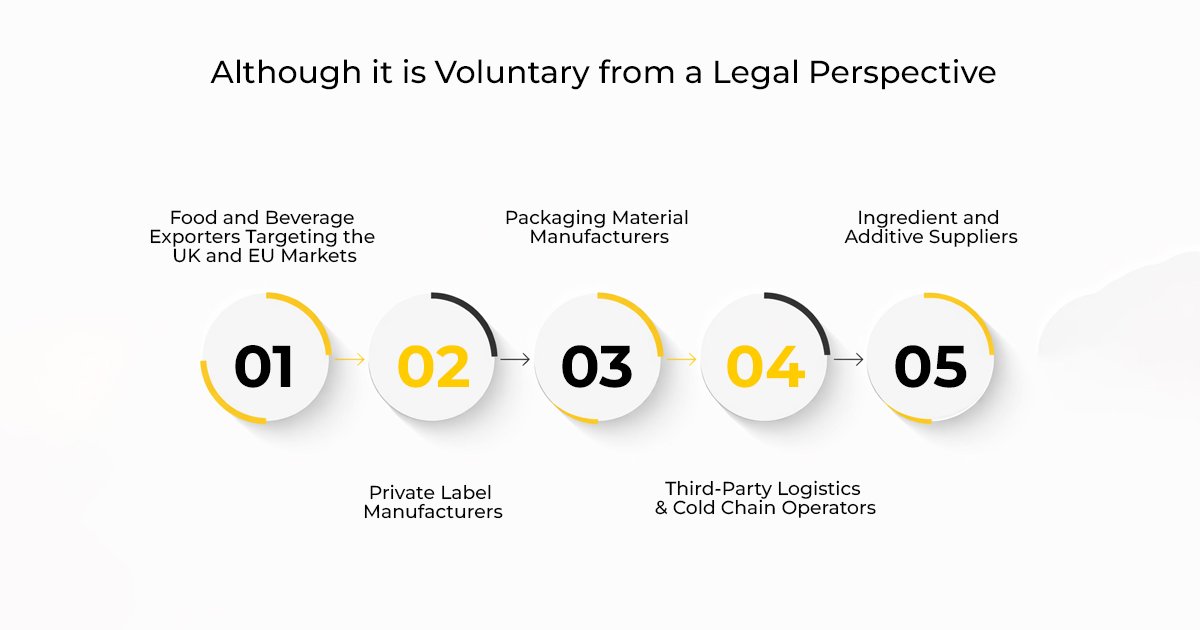
Although it is voluntary from a legal perspective, BRC has effectively required companies in India to treat it as a mandatory requirement based on the nature of the buyer relationships and the scope of their business ambition. Following are the key business categories wherein BRC certification is a practical reality.
- Food and Beverage Exporters Targeting the UK and EU Markets
This is the largest category of BRC required companies in India. Any food exporter of processed food items, spices, snacks, dairy products, seafood, bakery items, and ready-to-eat food items to UK and European supermarket chains will find BRC certification a hard requirement in the buyer’s supplier approval process.
- Private Label Manufacturers
Manufacturers of private label items, wherein a retailer sells a product under its own brand name, commonly found in food processing industries in India, are universally required to hold BRC certification with no exceptions whatsoever.
- Packaging Material Manufacturers
Food packaging manufacturers, including PET bottles, flexible packaging, laminates, cartons, cans, glass, etc., are now being asked by their food industry customers to hold a BRCGS Packaging Materials certification as part of the supplier approval process.
- Third-Party Logistics and Cold Chain Operators
Food storage and distribution companies, especially those providing cold storage facilities for food products, are now being asked by their food industry customers to hold a BRCGS Storage and Distribution certification, especially when they are providing their services to larger FMCG companies or retailers.
- Ingredient and Additive Suppliers
Food manufacturers who are certified to the BRC standard and who source ingredients, flavors, colorants, etc., from their suppliers are finding that their customers are requiring a BRC certification as part of their formal approval process.
BRC Certification Cost in India in 2026
One of the important factors to consider in the planning stage for any Indian business is the cost of BRC certification. Although the fees vary for each case, here is a realistic picture of the cost of BRC certification India in the year 2026.
The major cost factors for BRC certification India:
| Cost Component | Details |
| Certification Body Audit Fees | Charged by the accredited body conducting the formal audit |
| BRCGS Registration & Certificate Issuance | Annual fees payable directly to BRCGS |
| Consultancy Fees (if applicable) | For gap analysis, documentation, and pre-audit support; adds INR 75,000–2 lakhs |
| Internal Costs | Staff time, training, and infrastructure improvements identified during gap analysis |
| Annual Recertification Audit Fees | Payable every 12 months; typically 70–80% of the initial audit fee |
Estimated cost ranges for BRC certification India in 2026:
| Business Type | Estimated Cost (INR) | Notes |
| Small Businesses & Startups | INR 1.5 lakhs – 2.5 lakhs | Single product line, smaller facility |
| Mid-Sized Manufacturers | INR 2.5 lakhs – 4 lakhs | Multiple products or moderate complexity |
| Large Multi-Line Facilities | INR 4 lakhs – 7 lakhs+ | Multiple lines, high product complexity |
| Consultancy Support (Optional) | INR 75,000 – 2 lakhs | Additional to certification body fees |
| Annual Recertification Audit | 70–80% of initial fee | Required every 12 months to stay certified |
These costs will be for the audit fees of the certification body. In addition, consultancy services, if needed, would be in the range of Rs. 75,000 to 2 lakhs depending on the level of consultancy needed. Recertification audits, which need to be conducted every year, would be in the range of 70 to 80 percent of the initial audit costs. Given the level of exports and contracts generated by BRC certification, the ROI would be achieved in the first year.
Key Takeaways
- BRC certification is an international quality and food safety standard that was initially developed by the British Retail Consortium to ensure the safety of consumers and help suppliers access global retail supply chains.
- BRC stands for British Retail Consortium. The BRC certification process is currently operated under the brand name BRCGS – Brand Reputation Compliance Global Standards.
- BRC certification India is in high demand from international buyers, UK/EU supermarket groups, and large domestic food organizations.
- BRC certification follows a systematic process that includes gap analysis, documentation, training, internal audits, and a third-party certification audit by an accredited certification body.
- BRC certification costs for India in 2026 vary from INR 1.5 lakhs for small organizations to INR 6 lakhs or more for large organizations with multiple products.
>Helpful Guide:- BRCGS Certification Cost | Apply With Trusted Experts Today
Frequently Asked Questions
What is BRC certification and its benefits in India for food exporters specifically?
The BRC certification meaning and benefits in India for food exporters basically boils down to market access and credibility, as it is a requirement for major retailers in the UK and EU to approve suppliers, and it also helps in reducing port rejects, gaining trust from buyers, and enhances a company’s competitive position in international trade in the food industry.
Can you walk me through the BRC certification meaning and process in India from beginning to end?
The BRC certification meaning and process in India involves a gap analysis, development of a QMS, training of personnel, internal audits, and a third-party audit by an accredited body, and the whole process from start to finish can take between three to six months, depending on how ready a facility is in the first place.
Why is BRC certification required for food export to countries like the UK, EU, and UAE?
The BRC certification requirement for food export basically boils down to the fact that it is a requirement by major international retailers in those countries as a qualification criterion for their suppliers, and it also aligns with the food import safety standards in those countries as prescribed by the UK Food Standards Agency and the European Food Safety Authority.
Who eligible BRC, and is there any restriction under BRC eligibility India for smaller businesses?
Any organization with an auditable facility is eligible to apply; BRC eligibility There are no minimum size, turnover, or headcount requirements for BRC certification in India, thus making it equally applicable to small food processors, mid-tier manufacturers, and large multinational companies.
Which types of businesses are the BRC required companies in India that cannot avoid this standard?
BRC required companies in India: food exporters serving UK and EU-based food retailers, private label food manufacturers, food-grade packaging manufacturers, cold chain logistics providers, and food ingredients companies whose contract with their buyer clearly states BRCGS compliance as a vendor selection criterion.
What are the BRC required documents for certification?
The essential documents that are required to be maintained under BRC are the HACCP documents, food safety policy, SOP documents, cleaning schedules, allergen procedures, supplier approval documents, training documents, and product specifications.
How long does it take to prepare all BRC certification documents?
Most businesses typically take three to nine months to prepare a comprehensive BRC audit checklist, depending on existing food safety systems, operational complexities, and product lines.