
The dynamic nature of the global food business makes compliance not just an imperative but an essential advantage in today’s marketplace. As per 2026, the FSSC 22000 (Food Safety System Certification)has successfully established itself as the preferred choice for Indian food manufacturers and packagers seeking international expansion. In contrast to mere adherence, the GFSI-approved protocol addresses the difference between domestic FSSAI regulations and international requirements through an effective combination of ISO 22000 and relevant PRP, as well as the latest Version 6 requirements.
This detailed blog delves into the elements of the system, along with the vital changes that include a discussion on food safety culture and waste management systems. This blog will also outline a clear step-by-step process involved in the certification process in India, beginning from the gap assessment to the final stage of auditing. Moreover, this article also gives insight into the 2026 cost structure, particularly auditor charges and consultancy fees.
What is FSSC 22000 Certification
FSSC 22000 represents Food Safety System Certification 22000. Just from the FSSC full form, one can tell that this certification is not about products but rather a food safety management system. Developed by the non-governmental Foundation FSSC based in the Netherlands, FSSC 22000 was initially published in 2009 and received GFSI recognition later. The latest version, FSSC 22000 Version 6, was published in 2023 with additional requirements for food safety culture, food fraud, and environmental monitoring.
There are three pillars on which FSSC 22000 is based:
- ISO 22000:2018: international standard on food safety management system
- ISO/TS 22002-series: prerequisites programme standards for various sectors such as food production, catering, retail, packaging, etc.
- FSSC Additional Requirements: specific requirements related to food safety culture, food fraud vulnerability assessment, food defense, allergen control, and food defense.
In conclusion, FSSC 22000 consists of three parts: ISO 22000, sector-specific ISO/TS 22002 series, and FSSC Additional Requirements. Together, these three components define the criteria for FSSC 22000 certification.
>Helpful Guide:- Think You Don’t Need FSSC 22000? Think Again
What Does FSSC 22000 Certification Mean for Your Business
FSSC 22000 certification is the highest level of endorsement possible by an impartial auditor. It shows that your food safety management systems are globally accredited, effectively designed, and implemented.
For an Indian firm wanting to export its goods, it is a great competitive advantage as follows:
- Access to International Marketplaces: It becomes your ticket to supply the big names in international retail.
- Saving Time & Money: Since this certification is accepted globally, you will not need to undergo various separate audits mandated by different customers.
- Improved Safety: It reduces instances of food safety issues, complaints from consumers, and costly recalls of products.
- Meeting Regulations: You will be compliant with all the food safety regulations of the countries you are exporting to.
Basically, it tells the rest of the world that your company does not just claim food safety but ensures it.
>Helpful Guide:- FSSC 22000 Certification Documents Required: Complete Checklist for Food Businesses in India (2026)
What is FSSC 22000 Certification Worth
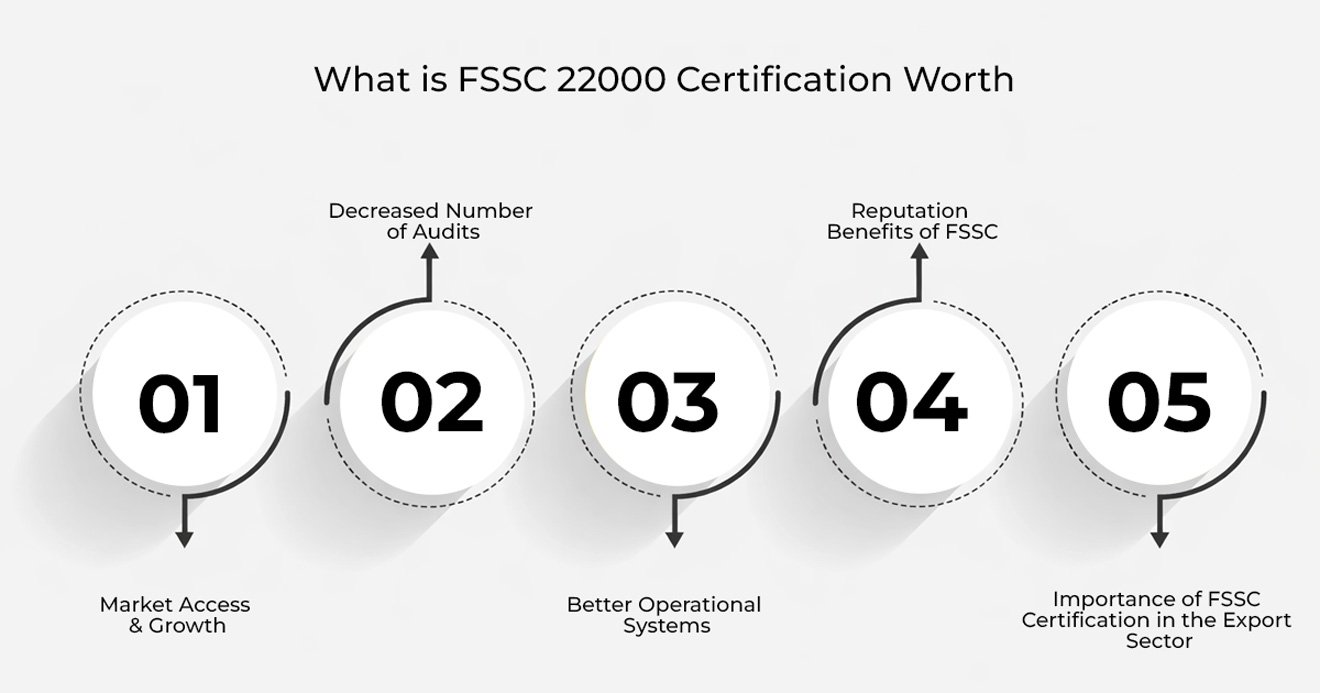
The FSSC benefits India food manufacturers receive are both strategic as well as operational. Some of the major benefits include the following:
- Market Access & Growth
Being able to get an approval by the GFSI organization is one of the key commercial advantages associated with obtaining FSSC in India. The leading international buyers, especially those in the UK, European region, the USA, and the Middle East, insist that their suppliers have some GFSI-approved certification in place. If not, even if the offer made by the Indian exporter is attractive in terms of both price and product quality, such supplier is not considered eligible for such contracts.
- Decreased Number of Audits
One of the least known FSSC India benefits is that it allows reducing the number of duplicate audits performed for specific customers.
- Better Operational Systems
The very process of certification, which requires systematic hazard analysis, PRP identification, and corrective actions, makes companies adopt better operational systems. In doing so, there are tangible benefits in terms of increased yield, lower waste generation, and higher compliance rates among employees regarding hygiene standards.
- Reputation Benefits of FSSC
In today’s world of social media and instant news updates, one mistake can make or break your brand. An FSSC certification helps you send a message that your company is reliable.
- Importance of FSSC Certification in the Export Sector
The importance of FSSC certification in India cannot be understated for food exports. As India aims to export more food products each year, the FSSC certification importance is increasing day by day. The Indian government promotes several export promotion agencies, such as APEDA, that consider FSSC 22000 as an additional value added certification.
What is FSSC 22000 Certification Process: A Step-by-Step Overview
The steps for FSSC certification process in India have been laid out below:
Step 1: Gap Analysis
The first step in the process entails carrying out a gap analysis. In simple terms, a gap analysis is a systematic review of the existing food safety management system within the organisation and comparing it with FSSC 22000 Version 6. The process will help determine what needs to be established and how. Most organisations in India seek the services of a consultant or certification body for gap analysis.
Step 2: Development and Implementation of System
The second step involves development and implementation of the entire food safety management system based on findings from the gap analysis. This will involve creation of policies and procedures, including food safety policy; HACCP; PRPs; food fraud vulnerability assessment; food defence; allergen management programme; and food safety culture activities.
Step 3: Internal Audit
Prior to engaging an external certification body, an internal audit must be carried out against all the requirements of FSSC 22000. An internal audit helps to ensure that any outstanding gaps are identified and rectified before seeking certification. Internal auditors should be adequately trained and impartial to the area being audited.
Step 4: Stage 1 Audit (Document Review)
The approved certification body undertakes the stage 1 audit process that is largely a desk review of documentation of your food safety management system. An auditor evaluates whether the system is adequately documented to determine whether your site is prepared for the stage 2 on-site audit.
Step 5: Stage 2 Audit (On-Site Verification)
The stage 2 audit involves conducting the entire on-site verification procedure. The auditors come to your place and spend between one and several days evaluating the implementation of documented procedures. Auditors look into your manufacturing facility, conduct interviews with your personnel across all levels, check monitoring documents, and perform traceability exercises. Non-conformances discovered by the auditors will have to be remedied.
Step 6: Certification Outcome
Upon successful completion of the stage 2 audit and resolution of non-conformances, the certification process is completed and an approval is made by the technical reviewer of the certification body. You are granted a certificate that is valid for three years.
Step 7: Surveillance Audits and Re-certification
Surveillance audits every year help maintain continuous compliance. Three years after certification, there is a need for a complete re-certification audit to extend the certificate. The maintenance of the food safety management system and internal audit program will contribute to the process of re-certification.
>Helpful Guide:- Most Common Non-Conformities Found in FSSC 22000 V6 Audits
What is FSSC 22000 Certification Cost in India
FSSC certification india cost depends on certain parameters like company size, employee strength, company complexity, certification scope, and the certification agency selected. Below is an example of an approximate cost model that will enable companies in India to budget for the procedure:
| Cost Component | Estimated Cost (INR) | Notes |
| Gap Analysis and Consultancy | ₹50,000 – ₹2,50,000 | Varies by scope and consultant experience |
| Documentation Development | ₹30,000 – ₹1,00,000 | May be included in consultancy; lower if done in-house |
| Training Costs | ₹20,000 – ₹80,000 | Per programme; covers internal auditor and food safety team training |
| Stage 1 and Stage 2 Audit Fees | ₹1,50,000 – ₹5,00,000 | Depends on certification body chosen and facility complexity |
| Annual Surveillance Audit | ₹80,000 – ₹2,50,000 | Per audit; conducted annually to maintain certificate validity |
Although this is a substantial financial outlay, Indian firms that have attained FSSC certification india have stated that the payback period, in terms of winning new business and decreased audit requirements by buyers, far outweighs the cost of investment over a two-year period from certification onwards.
Key Takeaways
- The FSSC 22000 certificate is a food safety system certification that integrates ISO 22000, sector-specific PRPs, and additional FSSC specifications.
- Any food company in India seeking to enter into export markets or higher-end retail requires understanding of the FSSC certification meaning.
- More and more food companies in India are obtaining the FSSC certification in India due to rising pressure from their foreign buyers.
- An FSSC certification needs certain internal preparations for documentation, two-step audit, and continuous surveillance.
>Top Trending Guide:- BRC Full Form: All 3 Meanings Explained – Food, Export and Education (2026 Guide)
Frequently Asked Questions
What is FSSC 22000 certification and benefits India food companies can expect from it?
FSSC 22000 certification definition and its advantages in India is quite simple: It is a globally recognized food safety management system standard that helps in expanding export business opportunities, reduces customer audits, and builds better food safety systems in India.
What does FSSC 22000 certification meaning and requirements cover for a food manufacturer?
FSSC 22000 certification requirements include ISO 22000:2018, prerequisite programs according to the sectors, and additional FSSC requirements such as food fraud vulnerability assessments, allergen management, food defense, and food safety culture.
What is the food safety FSSC certification process and how long does it take in India?
The time it takes for the food safety FSSC certification varies between 6-12 months, from the gap analysis to certification. The time period depends on the food safety management system maturity at the company at the start and how quickly corrective actions are implemented.
Why is FSSC needed when Indian companies already hold FSSAI licences?
While FSSAI addresses the national regulatory standards, FSSC 22000 guarantees international food safety standards, which are necessary for the global buyers and retailers to certify the Indian manufacturers.
What are the main FSSC benefits India exporters gain in 2026?
The main FSSC advantages for India’s export sector involve gaining entry into the global retail chains, recognition by the buyer companies who are members of GFSI, elimination of duplicate buyer audits, and an organized system that reduces the risk of recalls.
What is the FSSC certification importance for small food businesses in India?
The necessity of the FSSC certificate for SMEs depends on the ability to differentiate themselves in the market through the FSSC 22000 certificate that will be perceived as credible by their high-end domestic or overseas buyers.
What is the FSSC full form and who issues FSSC 22000 certificates?
The FSSC meaning stands for Food Safety System Certification, which can be obtained from the certified bodies of FSSC but not from the organization itself after successful completion of the two audit steps.