If you have encountered the abbreviation WRAP while studying ethical production or responsible sourcing, then congratulations; you are not alone in your endeavors. The WRAP full form refers to Worldwide Responsible Accredited Production, which is an internationally recognized accreditation program that guarantees that the factory complies with ethical and legal business practices during its manufacturing processes. Whether you are a factory owner, an international sourcing agent, or just interested in global trade regulations, learning more about WRAP is key to success.
WRAP Full Form: What Does WRAP Stand For
The abbreviation of WRAP is Worldwide Responsible Accredited Production. This is a not-for-profit organization that specializes in certifying fair, legal, and responsible production worldwide. Created in the late 1990s, WRAP was the response to the increased attention of brands, consumers, and governments regarding working conditions in overseas factories, especially those in developing nations supplying goods for the Western market.
To begin with, the meaning of WRAP stands for the concept of accountability. The program is a voluntary initiative for factories manufacturing sewn products like clothing, footwear, and other accessories to prove their adherence to socially and environmentally responsible production methods.
WRAP Meaning in Business: Why It Matters
However, in a corporate setting, WRAP meaning extends much further than simply obtaining a certificate. WRAP meaning in a business context refers to the willingness and determination of a manufacturing plant to ensure its operations comply with legal, ethical, and humane standards of production.
In times when consumers are becoming more interested in the process of creating various goods and services, having a WRAP certified supplier can be advantageous for any brand. In fact, it reduces legal and reputation risks, provides for an easier process of due diligence, and builds a trustworthy image for the company within the entire chain of suppliers.
For retailers and manufacturers who are active in the European Union or North America, it is essential to have WRAP certification to operate. Thus, it is crucial to know the meaning of WRAP in a supply chain management context.
WRAP Certification: Full Form, 12 Principles & Global Business Importance
Build ethical manufacturing standards & gain global buyer trust with WRAP certification.
WRAP Certification 12 Principles Explained for Beginners
The core of WRAP certification is made up of the 12 principles it follows. The principles represent the standards a manufacturing plant must follow to become certified and maintain the status. Below, one can find a brief description of each of the 12 principles of WRAP certification for newcomers.
- Compliance with Laws and Workplace Regulations: Each factory is required to obey all national laws in the country where it operates, both labour and other types.
- Prohibition of Forced Labour: No factory is allowed to employ any kind of forced labour (such as prison or bonded labour).
- Prohibition of Child Labour: WRAP does not tolerate employment of any workers younger than the legal minimum age or 14, whichever is greater.
- Prohibition of Harassment or Abuse: Employees shall be treated respectfully and courteously. Neither physical, sexual, psychological nor verbal abuse of workers is acceptable.
- Compensation and Benefits: Workers shall be compensated adequately (at least at the local minimum wage), and they shall receive the benefits established by law.
- Hours of Work: The amount of working time must not exceed 60 hours a week.
- Non-Discrimination: The factories should not discriminate against employees based on gender, race, religious beliefs, age, physical disabilities, among others.
- Health and Safety: The facility should provide a safe working environment for all workers without any accident and occupational hazards.
- Freedom of Association and Collective Bargaining: Workers should have the right to association and collective bargaining according to the local labor law.
- Environment: Factories should be environmentally responsible and observe environmental laws.
- Custom Requirements: The factories should follow custom laws and cooperate with the customs officials.
- Drugs and Security Policy: Factories should be able to implement programs that help in eliminating drugs trafficking and supply chain security.
All the above-mentioned principles are evaluated when carrying out a WRAP audit using an independent third party auditor.
WRAP Compliance: What It Takes
Compliance with WRAP is not a one-off process; it is a continuous process. The factory needs to comply with all the 12 principles during the certification period. WRAP compliance entails maintaining correct records, having the right policies in place, training the employees and constantly evaluating their activities in the factory.
There are different levels of the certification, such as Platinum (two years validity), Gold (one year validity) and Silver (six month validity). The higher the level of the certification, the better the record of compliance.
For newly certified factories, the process of achieving WRAP compliance may begin with a self-assessment, where they compare themselves with the 12 principles and determine the gaps they have.
WRAP Audit: How the Process Works
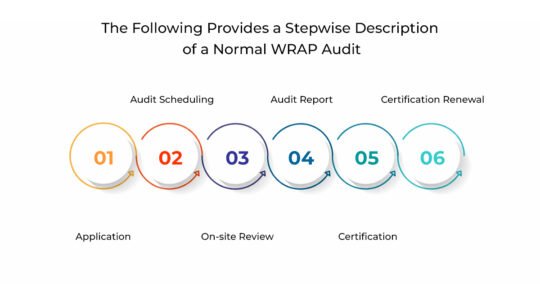
The WRAP audit refers to the formal auditing process whereby an independent and certified auditor examines whether the factory adheres to the 12 WRAP principles. The following provides a stepwise description of a normal WRAP audit:
- Application: Factory owners complete an online application on the WRAP website together with a self-assessment questionnaire.
- Audit Scheduling: An approved monitoring company is appointed by WRAP to carry out the audit, which may be unannounced or scheduled.
- On-site Review: Auditors conduct interviews with workers, check documents, inspect facilities, and assess compliance.
- Audit Report: After carrying out their assessment, auditors prepare an audit report covering all 12 principles.
- Certification: According to the findings from the report, WRAP will then award platinum, gold, or silver certification or demand that the factory take corrective action before issuing any form of certification.
- Certification Renewal: Certification expires after some time, and factories are monitored periodically without any prior warning.
WRAP audits are meant to be challenging yet attainable.
WRAP in Supply Chain Management
In the present scenario, it has become increasingly necessary for organizations to understand the complete concept of WRAP in their supply chain processes due to the complexity involved in sourcing products globally. Organizations do not manufacture their entire range of products themselves but rely on their network of supply chain that consists of many suppliers and sub-suppliers from several nations.
The concept of WRAP can be said to be a global nomenclature for the compliance of global supply chains. When an organization has WRAP certification in their manufacturing facility, other organizations from all around the world know for sure that they comply with global ethical standards without undergoing any lengthy and costly audits. This will help streamline the procurement process and eliminate any duplication of audits by the same organization.
For any brand that is accountable for ESG (environmental, social, and governance) practices, having a WRAP certification for their supply chain makes things easier for them.
How Do I Apply for WRAP Certification
Getting WRAP certified is easy. The first step is registration on the WRAP website, www.wrapcompliance.org. After the factory gets registered, it is supposed to fill out the self-assessment form that has questions based on the 12 principles. WRAP will then designate a monitoring organization that is accredited to do the site visit audit. Upon review and evaluation, WRAP will certify the factory at the right level.
How Many Factories Are WRAP Certified
WRAP is one of the biggest independent factory certification schemes in the world, having thousands of accredited factories in over 50 countries. Most of the factories accredited by WRAP are situated in South and South-East Asia, namely Bangladesh, India, Pakistan, Sri Lanka, and Vietnam, which constitute the core areas of apparel manufacturing in the world. Nevertheless, there has been a trend towards WRAP accreditation for factories in Central America, the Middle East, and Sub-Saharan Africa in recent years.
Can Small Factories Get WRAP Certified
Absolutely. One of the most crucial things about the WRAP program is that it’s accessible to factories of all sizes. It’s possible to get WRAP certification, regardless of whether you run a small factory or not, as long as you comply with all 12 of the principles. The WRAP certification fee scale takes into account the size of the facility and allows even small facilities to become WRAP-certified.
Key Takeaways
- WRAP stands for Worldwide Responsible Accredited Production and is a recognized certification for responsible and legal manufacturing across the world.
- WRAP Certification includes 12 principles relating to issues of labor rights, health and safety, environment, and customs.
- WRAP Audit is done by an accredited third-party monitoring company and leads to Platinum, Gold, or Silver certification.
- WRAP in logistics stands for a standard certification across the globe used in supply chain management to avoid unnecessary auditing procedures and simplify vendor qualification process.
- Whether you have large-scale or small-scale manufacturing facilities, you can go for WRAP Certification.