

For food producers and entrepreneurs who are starting their business ventures in India, the concept of taking their delicious foods to the world stage is indeed exciting but equally challenging too. Even though India is flourishing under the stringent control of FSSAI, exporting the foods to countries like the USA, which is a global giant itself, involves a different level of challenges and obstacles, especially in the form of FDA, which is a US organization.
The difference between USFDA and FSSAI is not merely confined to compliance; rather, it includes forming the link of trust and assuring the hassle-free journey of your food product. In this blog, USFDA VS FSSAI have been analyzed in detail with respect to their jurisdiction, cost, process, and more importantly, who really needs them both!
What is the FSSAI
FSSAI (Food Safety & Standards Authority of India) is the statutory body formed by Food Safety & Standards Act 2006. This body operates within the Ministry of Health & Family Welfare, Government of India. There were many food laws in India prior to FSSAI (such as PFA Act, Fruit Products Order). The primary objective of forming the FSSAI was to consolidate all these laws within one single document.
The Prime Responsibility: The FSSAI is responsible for the formulation of standards for food products, and the regulation of manufacturing, storage, distribution, sale, and import of food products.
The Significance: No food industry, whether a petty hawker or a large multinational company, can begin operations in India without having an FSSAI License.
The Core Issue: Sanitation, no adulteration, and ensuring that the consumer in India is not duped by any claim regarding the food product.
What is the USFDA?
United States Food and Drug Administration (USFDA), popularly known as FDA, is a federal government organization that belongs to the Department of Health and Human Services in the United States of America. It is the oldest and one of the most powerful consumer protection agencies globally. Contrary to FSSAI, FDA has a broad mandate as a watchdog.
Main Mandate: Protecting the health of the people through safety, effectiveness, and security of all drugs, biological products, and devices intended for humans and animals. In addition, it regulates the safety of the food, cosmetics, and radiation-emitting products in the USA.
Global Impact: Although FDA is a US agency, it is well known for conducting international inspections. Any Indian organization that wants to export spices, medicines, or medical devices to the USA will have to face inspection from the FDA itself.
Areas of Concentration: Safety evidence and prior approvals. For example, whereas food facilities must register with the FDA, drugs or medical devices must get approval from the FDA first.
Common Questions on USFDA vs FSSAI
- Would it be required to have either the FDA or food license to export my pickles to America?
- If I was exporting from India to the USA, then which would take preference?
- Would one be tougher to adhere to than the other?
- How do I cope up with the complications of both without overstressing my production time and workforce?
- Would the compliance to the USFDA standard automatically mean compliance to the FSSAI standard or vice versa?
When evaluating USFDA vs FSSAI requirements, it is important to note that complying with one does not mean compliance with another. Each of them has different standards with respect to use of additives and hygiene documentation, and understanding this USFDA and FSSAI difference at an early stage can benefit the exporters greatly.
USFDA vs FSSAI
Understanding the difference between FDA and FSSAI is crucial for strategic planning. Below is a reference table to help you compare the two:
| Feature | FSSAI (India) | USFDA (United States) |
|---|---|---|
| Full Form | Food Safety and Standards Authority of India | United States Food and Drug Administration |
| Jurisdiction | Territory of India | United States (Global inspections for exporters) |
| Regulatory Scope | Almost exclusively Food | Food, Drugs, Medical Devices, Cosmetics, Tobacco |
| Primary Legislation | FSS Act, 2006 (Amendments 2026) | FD&C Act (1938) & FSMA (2011) |
| Approval Type | License/Registration based on turnover and capacity | Facility Registration (food), approval for new drugs/devices |
| Validity | Permanent (New 2026 rule), subject to annual fee and compliance | Biennial renewal required every even-numbered year |
| Labeling Symbol | Mandatory Green/Brown Dot (Veg/Non-Veg logo) | FDA logo on packaging is generally prohibited |
| Nutrition Panel | Per 100g/100ml or per serving | Strict Nutrition Facts format including Added Sugars |
| Allergen Rules | Mandatory declaration of 8 major allergens | Includes Sesame as the 9th major allergen (FASTER Act) |
| Enforcement | FBO-centric; periodic audits and surprise inspections | Risk-based; Warning Letters and Import Alerts for foreign facilities |
| Cost (Registration) | Scaled based on turnover (₹100 – ₹7,500+) | $0 for Food Facility Registration (requires paid U.S. Agent for exporters) |
Understanding The Requirements of both the certifications
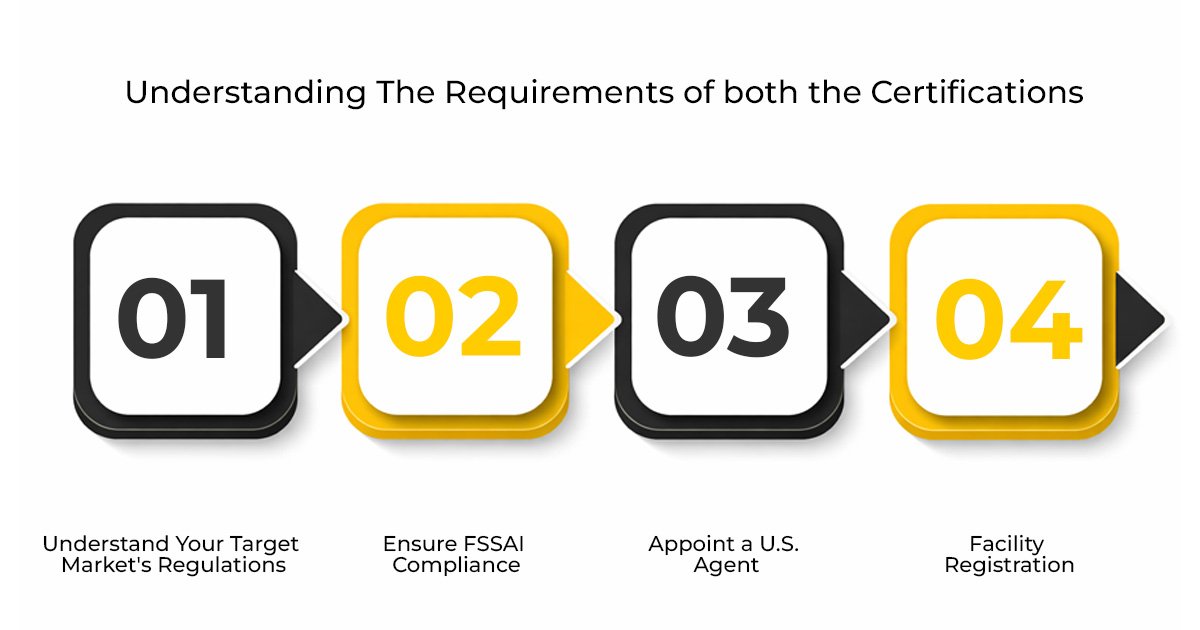
A structured process to comply with USFDA vs FSSAI certification requirements when exporting to the US market is as follows:
- USFDA Export Regulations: Firstly, you must be aware of the USFDA export regulations for your product category, including commodity, labelling, and food additive regulations.
- FSSAI Compliance: Another thing to take note of is FSSAI compliance in your operations, since having robust FSSAI compliance can help you to achieve some of the best international practices too.
- Appoint a U.S. Agent: According to USFDA regulations, you need to appoint a US Agent to contact FDA, which is a mandatory process for FDA export.
- Registration of Your Food Facility: You also need to get the registration of your food manufacturing facility done at USFDA – getting the USFDA certification is mandatory for any Indian facility willing to export food products to the USA, and otherwise, your shipment may be detained.
- Implementation of Food Safety Modernization Act’s Preventive Controls: It is important that if you are manufacturing food products for consumption in the USA, you implement Food Safety Plan controls, which can only be achieved by a Preventive Controls Qualified Individual.
- Development of Robust Traceability System: Traceability is one of the other areas where both authorities are emphatic. You need to develop a robust traceability system to track your raw materials and finished products.
- Systematic Documentation: You should maintain systematic documentation of all your processes, quality control, raw material procurement and employee training. This is another area where the USFDA has put a lot of stress on.
- Compliance with Foreign Supplier Verification Program: In case your product is meant for export, then you have to comply with FSVP requirements according to which your importer in the USA has to verify that your food products comply with the USA food safety regulations and you have to give them the necessary documentation for it.
- Labelling Compliance: Another aspect is that of labelling, which should be compliant with the USFDA regulations that are vastly different from the FSSAI regulations in terms of nutrition information, allergen information, and ingredient listing.
- Expert Guidance: Seek expert guidance in FSSAI and USFDA regulations because USFDA certification is compulsory before placing your food products into US commerce.
Key Takeaways
- It is an investment in the future of your brand as well as its market coverage and not just another obligation.
- Accuracy of the documentation process becomes your first line of defense.
- Don’t shy away from professional help when it comes to dealing with FSSAI & USFDA rules.
- There is always something new about food laws and rules; make sure you know about the latest FSSAI & USFDA rules.
- Real compliance can only be ensured through a culture of commitment to food safety.
>Helpful Guide:- USFDA Certification Cost 2026 – Full Fee Breakdown & What You Must Know
Frequently Asked Questions
The FSSAI regulates food safety in India based on the FSS Act, whereas USFDA regulates the food, drugs, and devices for the US market and is applicable for Indian exporters selling in the US market.
In general, both are needed; FSSAI for domestic operation and USFDA registration /compliance for all the products entering the US Market.
In reality, food exporters would be complying with the FSSAI requirement in the domestic market and in addition registering their facilities and having FSVP and US Agent for US exports.
Yes. Food facilities exporting to the US need to register with the USFDA.
It includes registration of facilities, designation of U.S. Agent, preventive controls under FSMA, traceability, and proper labeling.
Can you outline the FDA export process for food manufacturers?
It usually involves registration of the facility, development of food safety plan documentation, coordination of FSVP with the US importer, and regular biennial renewals.
FSSAI food license is required for domestic business operations, while FDA registration is a different requirement for exports to the US market.