
All Indian food manufacturers or exporters exporting food items to the US are required to obtain USFDA certification for food export which would include FDA facility registration, designation of US Agent, Prior Notice filing, FDA compliant labeling and FSVP. This blog will give you a complete insight on every single process, documentation, cost, and timeline for USFDA certification in 2026 of Indian food exporters.
Being the most resourceful country in terms of agriculture with the best food processing industry, India is at the brink of being crowned the food superpower of the world. The prospect of venturing into the lucrative food market of the US is something that many food business owners in India can ill-afford to let slip away. However, the stringent FDA regulations might make it seem like a feat unachievable by many. From USFDA Registration to labeling and the crucial FSVP, every single step in the approval process needs to be done right. This blog will take you through all the basic USFDA requirements for food exporters who are interested in securing export approval.
What is the USFDA?
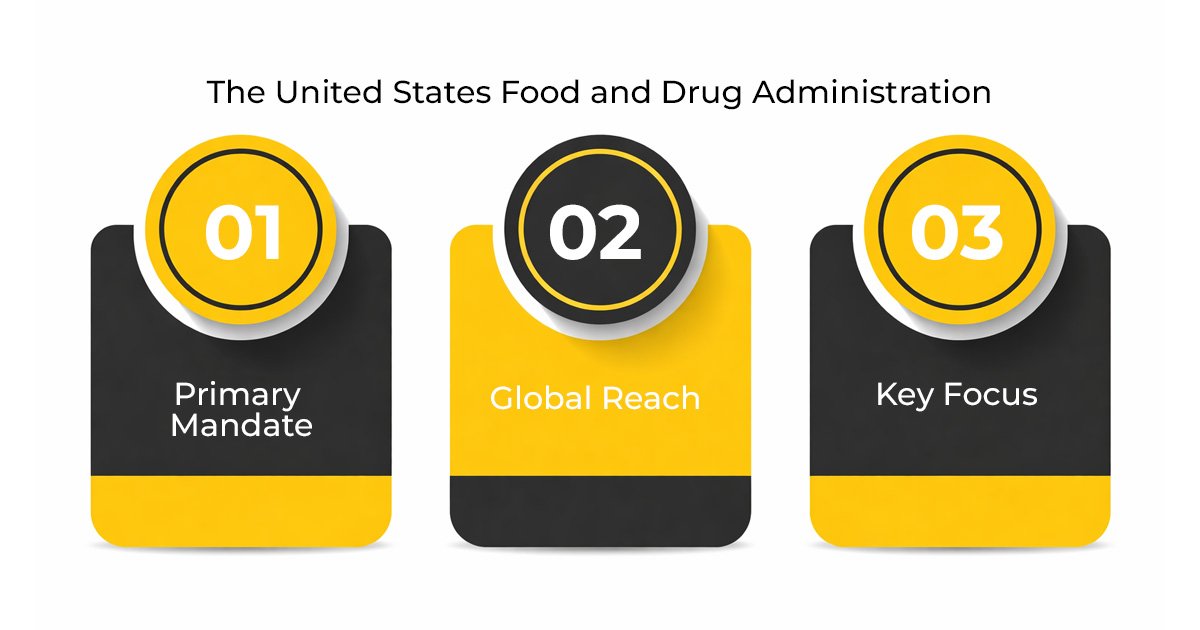
The United States Food and Drug Administration, often abbreviated FDA, is an agency of the Department of Health and Human Services in the United States. It is one of the oldest and most powerful consumer protection bodies in the world.
Core Function: To safeguard the health of the general public through the regulation of the safety, efficacy, and security of human and animal products such as drugs, biologics, and medical devices, as well as ensuring that the food supply in the US is safe.
International Role: Even though it is an organization based in the US, it is known to carry out international inspections. In case an Indian organization wishes to export its spices, medicines, or medical devices into the US, the FDA is capable of inspecting the Indian firm as well.
Focus Areas: Safety and prior approval. For example, though food processing firms have to register with the FDA, drugs and medical devices have to be approved by the FDA before being put on the market.
>Helpful Guide:- Documents Required For USFDA Certification In India 2026 | Complete Checklist
Frequent Questions from Founders about USFDA Certification for Food Export
- Is FDA export certification truly required for my particular food item, or are there any exceptions to it?
- Is the FDA export registration process going to increase my expenses and create additional bureaucracy for me?
- How do I know that my food item’s labeling is in compliance with all FDA regulations, however minor they may be?
- What are the real effects of having my food item detained by US Customs at the border, and how can I prevent this from happening?
- Is FDA export licensing possible without the assistance of an American agent or a big law firm?
USFDA Export Certification Requirements
Food Facility Registration (FFR)
Every Indian facility that is engaged in the manufacturing, processing, packing, or holding of food for human consumption intended for export to the United States must register with the USFDA.This is the first step toward securing your FDA export license, and it forms the backbone of the entire USFDA registration process.
- DUNS Number: Without the Data Universal Numbering System (DUNS) number assigned by Dun & Bradstreet, no registration is possible, and that number needs to be assigned to your organization. Not only does it need to match the name and address of your organization as registered with DUNS, but the name and address needs to match exactly that registered with the FDA as well — even an omission or alteration in the spelling of the word “Street” or “St.” may lead to rejection of your application.
- U.S. Agent: Since the FDA won’t just come visiting you at your Indian establishment every time it has a query, the appointment of a U.S. Agent becomes imperative. This agent needs to be physically present in the U.S.A at all times for receiving any emergency message from the FDA.
- Biennial Renewal: This isn’t something you do once in a lifetime, but you need to renew it biennially, i.e., from October 1st to December 31st, of every other year.
Mandatory Labeling Requirements (21 CFR 101)
The US has very stringent rules regarding labeling. Failure to have all the following on your label will make your whole shipment considered misbranded and put your USFDA approval for food export at risk.
Nutrition Facts Panel: Your label must reflect the latest FDA-mandated design.
- Calories: Should be shown in bold letters.
- Serving sizes: These should reflect actual consumption rather than ideal consumption.
- Added Sugars: Should be declared in gram measure and percent daily value (%DV).
- Allergens: Should disclose whether the food product contains milk, eggs, fish, crustacean shellfish, tree nuts, peanuts, wheat, soybeans or sesame.
- Quantity of net contents: Should be displayed in the bottom 30 percent of the package, in both metric units (gram/kg) and U.S. customary units (oz/lbs).
- Language: Information should be provided only in English. In case there is any other language, the translation should be the same as the English information..
Prior Notice (PN) of Imported Foods
Prior Notice ensures that the FDA knows what is coming even before it arrives. Prior Notice is used for this purpose since it enables the FDA and CBP to intercept possible risky loads.
- Submission Window for PN: It should be submitted through the electronic process via the Automated Broker Interface (ABI) and the FDA Prior Notice System Interface (PNSI).
- Timeline Depending on Mode of Shipment:
- Air: No later than 4 hours before arrival.
- Sea: No later than 8 hours before arrival.
- Failure to Meet Deadlines: In case you fail to bring the PN confirmation number, your food becomes liable for Refusal of Admission and will be secured in a safe place at your own cost.
The FSVP (Foreign Supplier Verification Program)
This is one of the most crucial parts of the Food Safety Modernization Act (FSMA). It makes the importer responsible for the evidence, but the data comes from the Indian exporter – making it a core piece of the broader USFDA requirements for food exporters.
Role of the Importer: The US-based importer needs to ensure that the Indian exporter produces food safe for public consumption equivalent to that of the US.
What You Must Provide to Your Importer:
- Hazard Analysis: Document that outlines biological, chemical (pesticide), and physical (glass and metal) hazards.
- Preventive Controls: Information on how the Indian exporter manages these hazards.
- Supply Chain: In case the Indian exporter uses raw materials sourced from another Indian farm, what is the verification of such raw materials?
- The PCQI: These documents should be created by a Preventive Controls Qualified Individual (PCQI) trained in standard training.
>Helpful Guide:- Is USFDA Certification Mandatory for Exporting Food from India to the USA? — Complete Answer
The Advantages of USFDA Certification for Food Export
Embracing USFDA certification for food export is not just another regulatory box to tick – it’s a strategic decision that opens up real opportunities for Indian food exporters:
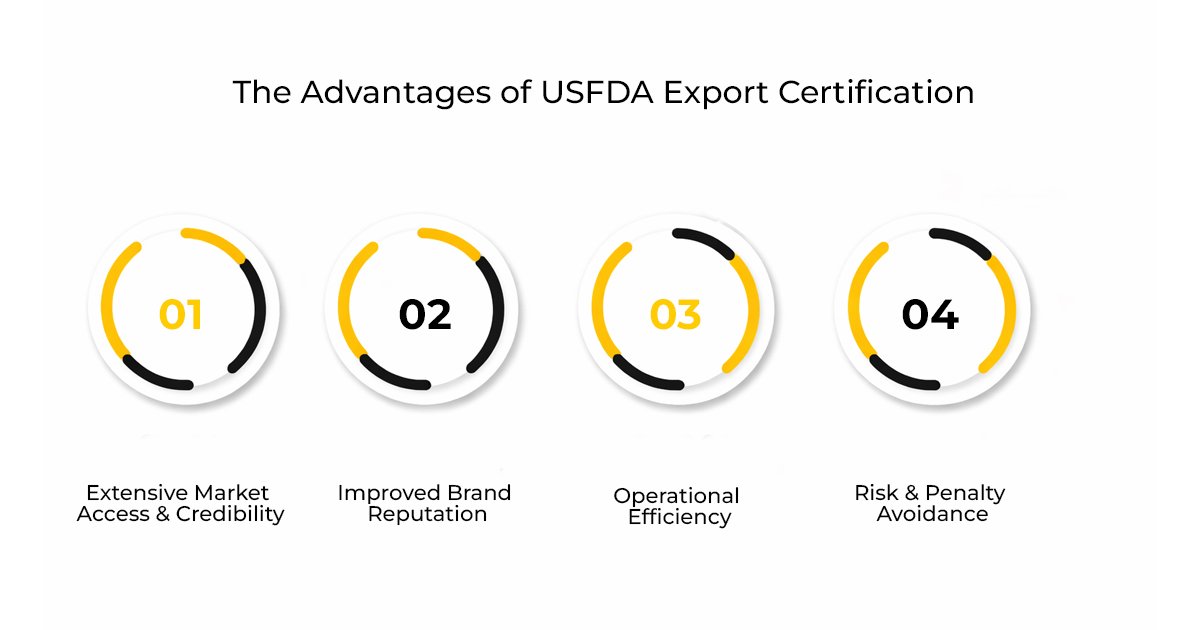
- Access to Extensive Markets & Credibility: It provides you access to the biggest consumer market and thus adds immediate credibility and trust to your brand in the USA.
- Improved Brand Reputation: Your brand becomes associated with excellence and quality in terms of safety and regulations, making it unique from its competitors all across the globe.
- Efficiency: The entire procedure to get FDA compliance can make a business introspect and thus be more efficient in terms of cost and quality management.
- Avoiding Penalties: It ensures that your brand remains away from all risks and penalties associated with rejection, import detention, and recalls.
Key Takeaways
- Regards compliance with the USFDA as investment in a future-proof quality management system.
- Make sure to document every process, quality inspection and corrective measure – this is essential for proving your compliance.
- The US Importer is your partner. Make sure that you give all the necessary FSVP documents.
- The USFDA requirements change with time and development. Be up-to-date and keep on improving your USFDA registration for food export.
- Software for quality management may be considered in order to make compliance more efficient and reliable.
>Top trending Guide:- BRC Full Form, Meaning, Certification Process & Cost in India (2026 Guide)
Frequently Asked Questions
This would normally consist of FDA facility registration, FSVP food safety plan, prior notice of the shipment, etc.
Register FDA exports, make sure that your products along with the facility meet the regulations of FDA, develop FSVP, and give prior notice for the shipment.
For Indian facilities, the registration is done online by means of the FURLS system of FDA, which is concerned with information regarding the facility as well as the U.S. Agent.
Requirements normally involve FDA facility registration, product labeling, prior notice of the shipment, as well as FSVP of the importer in U.S.
Important documentation includes FDA facility registration, product specifications, your HACCP/PCHF food safety plan, test results, and label designs.
Although there are no such checklists available, it may include facility registration, FSVP, labeling, prior notice, and records keeping.
Yes, definitely. The USFDA guidelines hold true irrespective of the size of the company, and it is all about food safety and compliance.