

If you are running a food business in India, whether it is a small-scale food processing business, a mid-scale food export business, or a large-scale food manufacturing business, it is quite probable that you have come across the terms ISO 22000 vs HACCP being thrown around together. Both of these terms relate to food safety management systems. Both of these systems are widely accepted and implemented around the world. And both of these systems can be equally perplexing when it comes to deciding which of the two systems your business actually needs.
This blog will aim to simplify the whole process for you by explaining the meaning of both the systems, the difference between the two systems, which of the two systems your business needs, and whether it is possible for your business to adopt both systems simultaneously.
What is HACCP?
HACCP is an acronym for Hazard Analysis and Critical Control Points. It is not a certification, but a methodology to control and identify food safety hazards during production.
Created in the 1960s for NASA’s space food project, HACCP is now a global standard in food safety, and in many countries, including the United States, European Union, and increasingly in India, it is a legal requirement.
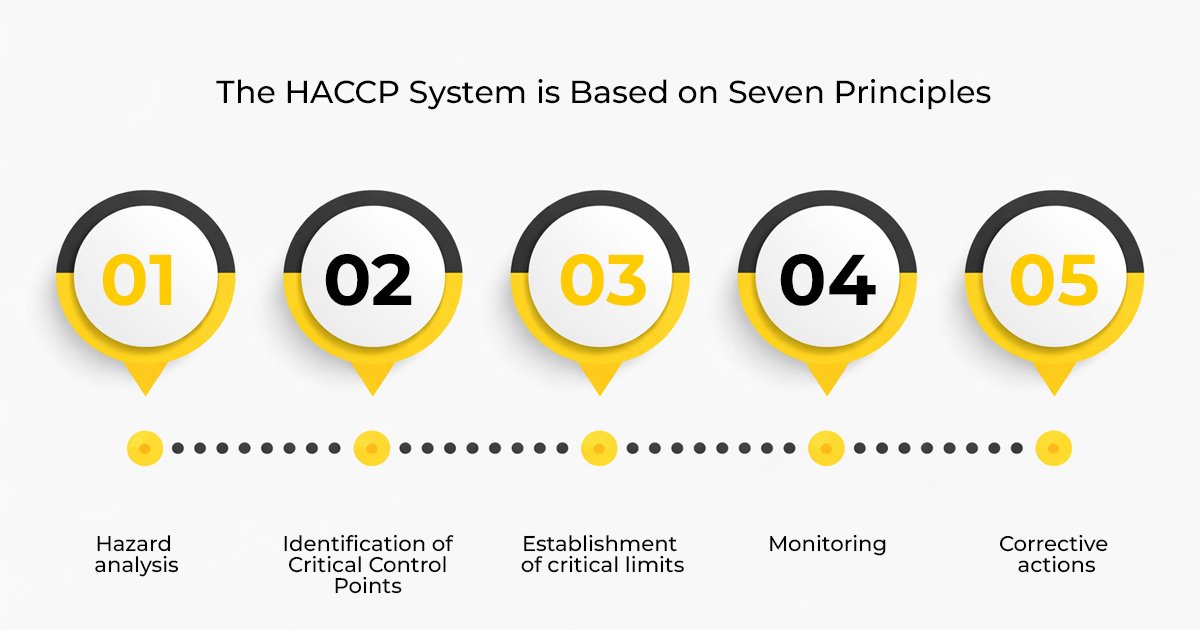
The HACCP system is based on seven principles, namely:
- Hazard analysis
- Identification of Critical Control Points (CCPs)
- Establishment of critical limits
- Monitoring
- Corrective actions
- Verification
- Document and record maintenance
What is ISO 22000?
ISO 22000 is a full Food Safety Management System (FSMS) standard, developed by the International Organisation for Standardisation (ISO). It is currently in its 2018 version, known as ISO 22000:2018.
While HACCP is a management system based on hazard control, ISO 22000 is a complete management system, incorporating HACCP principles in the form of a Hazard Analysis component, together with other management system elements such as communication, leadership, planning, and improvement, based on the High Level Structure of ISO 9001 and 14001 management system standards.
ISO 22000 is applicable to all sectors of the food supply chain, from farm to fork, and to any organisation that is directly or indirectly involved in food production, processing, packaging, distribution, retail, and service.
>Helpful Guide:- ISO 22000 Validity in India , How Long It Lasts, Renewal Process & What Happens If It Lapses
ISO 22000 vs HACCP – Key Differences
The debate between haccp and iso often confuses businesses since both standards are concerned with food safety. However, they differ significantly in terms of level. This is a clear comparison:
ISO 22000 vs HACCP – Which is Better for Your Food Business?
This is arguably the most searched question: iso 22000 vs haccp which is better for food business, and the honest answer is: it depends on where you are in your food safety journey and what your business goals are.
| Parameter | HACCP | ISO 22000 |
|---|---|---|
| Nature | Methodology / Approach | Full Management System Standard |
| Scope | Process-level hazard control | Entire food safety management system |
| Certification | Not always formally certified; some schemes offer HACCP certificates | Internationally accredited third-party certification |
| HACCP Integration | Is the foundation | Incorporates HACCP as a core component |
| Documentation | Moderate – focused on CCPs and records | Extensive – covers all FSMS processes |
| Applicability | Primarily production/processing | Entire food supply chain |
| Management System | Not required | Required (leadership, planning, improvement) |
| International Recognition | High in regulatory contexts | High in trade and B2B contexts |
| Complexity | Relatively simpler to implement | More comprehensive, requires system-level changes |
| Mandatory in India? | Required under FSSAI for some categories | Voluntary, but increasingly preferred for exports |
Select HACCP if:
- You are a small to mid-size food processor with a goal of making your production line safe
- You need to meet FSSAI regulations that require a HACCP-based plan
- You are just starting out on your food safety journey and need a focused approach
- You need a food safety plan for buyers or retailers that do not require a management system
- You need a cost-effective entry point for a small business
Select ISO 22000 if:
- You export food products and need international certification
- You have B2B businesses, large retailers, or global buyers that require you to be an ISO 22000 company
- You wish to have a complete food safety management system, not just a hazard control system
- You plan to integrate food safety with other ISO standards, such as ISO 9001
- You wish to prove your company’s governance and improvement capabilities to stakeholders
In most instances, the deciding factor between ISO 22000 and HACCP certification in India is market access. If you are selling in the domestic market or need to comply with local regulations, HACCP is likely adequate. However, if you need to export or have high-value buyer contracts, you should select ISO 22000 certification.
>Helpful Guide:- ISO 22000 Certification Mistakes: 10 Common Causes of Certification Failure in India and How to Avoid Them
Can ISO 22000 vs HACCP Be Implemented Together
Yes and in fact, that is exactly what they are intended to do.
As a matter of fact, ISO 22000 already includes the principles of HACCP as a fundamental element of the system. Section 8.5 of ISO 22000:2018 actually deals with the issue of hazard analysis and the development of a HACCP plan in line with the Codex Alimentarius system. So, in fact, when you implement ISO 22000, you are actually implementing HACCP as well.
This is a very important point in the iso comparison: HACCP is actually a constituent of ISO 22000.
This is how the two systems actually fit together:
| Factor | HACCP | ISO 22000 |
|---|---|---|
| Implementation Time | 2–4 months | 4–8 months |
| Certification Cost (Approx.) | ₹50,000 – ₹1,50,000 | ₹1,50,000 – ₹5,00,000+ |
| Ongoing Surveillance Audits | Annual (if certified) | Annual (mandatory) |
| Resource Requirement | Moderate | Higher |
| Renewal Cycle | 1–3 years | 3 years |
Many food businesses in India begin with HACCP implementation and gradually move towards achieving ISO 22000 certification.
Food Safety Certification Comparison ISO 22000 vs HACCP in the Indian Context
The food safety certification comparison iso vs haccp appears to be quite specific when considering the Indian regulatory and business environment.
With respect to the Food Safety and Standards Authority of India (FSSAI):
- Large food manufacturers are required to adhere to HACCP-based Food Safety Management Systems as part of Schedule 4 compliance
- The requirements for FSSAI’s Food Safety Management System (FSMS) are compliant with HACCP
- The ISO 22000 certification is accepted and may be advantageous in terms of audit and renewal processes
- In the case of export-oriented food businesses, APEDA and EIC suggest and/or enforce internationally accepted certifications, and ISO 22000 and FSSC 22000 are the preferred choice
The difference between ISO 22000 and HACCP certification is gaining significance as Indian food businesses expand and seek to enter new, global markets. For businesses looking to export to the EU, USA, Middle East, and Southeast Asia, ISO 22000 is more marketable than HACCP certification.
ISO 22000 vs HACCP: Cost and Timeline
| Factor | HACCP | ISO 22000 |
|---|---|---|
| Implementation Time | 2–4 months | 4–8 months |
| Certification Cost (Approx.) | ₹50,000 – ₹1,50,000 | ₹1,50,000 – ₹5,00,000+ |
| Ongoing Surveillance Audits | Annual (if certified) | Annual (mandatory) |
| Resource Requirement | Moderate | Higher |
| Renewal Cycle | 1–3 years | 3 years |
The costs vary depending on the certification body, the size of the facility, the number of product lines, and whether you work with a consultant or not. These are approximate costs, and the figures are meant for planning purposes only.
>Helpful Guide:- ISO 22000 Certification Cost In India – Expert Cost Breakdown
Conclusion: ISO 22000 vs HACCP
There is no general answer to the iso 22000 vs haccp debate, but there is a logical one:
Select HACCP, if you have a particular, process-oriented food safety system required, such as one required to meet FSSAI or domestic market requirements.
Select ISO 22000, if you have a comprehensive food safety management system required, such as one required to support international trade, buyer needs, and long-term food safety governance.
Note that both of these standards are not in direct competition with one another, but rather are complementary to one another. They are inclusive, and one is built into the other, namely, ISO 22000 is built into FSSC 22000, and HACCP is built into ISO 22000 and FSSC 22000, and so on, in a step-like progression in a food safety system.
>Top Trending Guide:- BRC Full Form, Meaning, Certification Process & Cost in India (2026 Guide)
Frequently Asked Questions
What is the main difference between ISO 22000 and HACCP certification india?
HACCP is a system of hazard control while ISO 22000 is a complete system that includes hazard control, leadership, documentation, and improvement elements.
ISO vs haccp which is better for food business?
ISO 22000 is a universally accepted standard and is acceptable to importers in the EU, USA, and Middle East countries. If you are considering which is best for a food business that wants to export, then ISO 22000 is the answer.
Is HACCP a part of ISO 22000?
Yes. ISO 22000:2018 includes HACCP as a requirement in Clause 8.5. Therefore, when you implement ISO 22000, you are also implementing HACCP.
What is the ISO vs FSSC difference?
ISO 22000 is the base standard, and FSSC 22000 is adding sector-specific PRPs and GFSI recognition on top. For the difference: ISO 22000 is adequate for most markets, while FSSC 22000 is required if your buyers specify GFSI benchmarked certification
Is HACCP certification mandatory in India?
HACCP-based plans are required for large manufacturing companies by FSSAI Schedule 4, but a HACCP certificate is not necessarily required by law. However, it is required by most markets and buyers.
Which is better FSSC or ISO?
If you are working with GFSI-aligned buyers, then you should select FSSC 22000.
In most other export markets or B2B industries, ISO 22000 is perfectly adequate and much easier to implement.
Can a small food business in India get ISO 22000 or HACCP certified?
Yes, both standards are available to businesses of any size. Most small businesses start with HACCP because it is less expensive and then migrate to ISO 22000.