
If you are in the export business or manufacture goods for export, there is a high possibility that you have come across the term SEDEX. You may have even been asked by your foreign buyers to undergo a SEDEX audit or register on the SEDEX site before they place a purchase order. The first thing that comes to mind for most exporters, especially new ones, is whether SEDEX certification for export is mandatory or simply a nice-to-have. This guide answers this question in full. It also explains what SEDEX is, how it works, the SEDEX export requirements, and what Indian exporters need to know.
What Is SEDEX Certification for Export
SEDEX is a global membership organisation that facilitates businesses in sharing data on four key areas: Labour Standards, Health and Safety, Environment, and Business Ethics. It is a shared platform where businesses can exchange information on working conditions, environmental practices, and ethical performance.
SEDEX is not a certification in itself; rather, it is a platform where buyers can access audit reports, self-assessment questionnaires (SAQs), and corrective action plans. When people refer to SEDEX certification in the context of exporting goods, they are referring to SEDEX membership and a SMETA (SEDEX Members Ethical Trade Audit) report.
This is important to exporters as global brands and retailers across the world, particularly in the UK, Europe, US, and Australia, are under regulatory and consumer pressure to prove that their supply chain is ethical and sustainable in nature. SEDEX is a tool employed by these brands and retailers to achieve this objective; hence, a supplier who is not a part of SEDEX is not in a position to share information on these four areas.
>Helpful Guide:- Urgent Buyer Requirement: Sedex / SMETA Audit Needed Immediately—What’s the Solution?
Is SEDEX Certification for Export Legally Mandatory
The short answer is no, SEDEX certification for export is not a legal requirement. There is no government body, whether it is the DGFT, the Ministry of Commerce, or any customs body, that requires exporters to have a SEDEX membership for export.
But the reality of the situation is far from that. The fact of the matter is that though there is no legal requirement for SEDEX certification, several large international buyers have made SEDEX registration and having a valid SMETA audit a requirement for doing business. What this means for you is that if your buyer has made it a requirement, then you have to do it in order to retain that buyer.
When Do SEDEX Export Requirements Become Effectively Mandatory
The following scenarios make the SEDEX export requirements non-negotiable for suppliers:
- You are a supplier to large retailers in the UK or EU, like Marks and Spencer, Tesco, or ALDI, and other similar retail groups.
- Your buyer is a member of the Consumer Goods Forum or a signatory to the UN Global Compact and has established responsible sourcing policies.
- You export food and beverages, textiles, garments, personal care, or household items, which are sectors with high ethical sourcing risks.
- You are in the process of bidding for government-linked procurement entities in regulated markets.
- You have an existing buyer who has recently updated their supplier code of conduct to include registration with SEDEX.
In all these scenarios, even though there is no government mandate, the relationship itself becomes a mandate for SEDEX registration.
>Helpful Guide:- Top Mistakes to Avoid in Sedex SMETA Audits | Social Audit
Understanding SEDEX Certification for Export Standards
SEDEX compliance export means meeting the SEDEX standards assessed during the SMETA audit. It also means having an active profile on the SEDEX site. There are several parts of SEDEX compliance export.
Self-Assessment Questionnaire (SAQ)
The first part of SEDEX compliance export is to fill in the SAQ on the SEDEX site. SAQ is a detailed questionnaire on your company’s labour practices, worker welfare, health and safety, environmental practices, and ethical business practices. It should be filled in honestly.
SMETA Audit
The most vital part of SEDEX compliance export is the SMETA audit. It is carried out by a third-party auditing company approved by SEDEX. The audit can be a two-pillar audit on Labour Standards and Health and Safety or a four-pillar audit on Labour Standards, Health and Safety, Environment, and Business Ethics. After the audit, the report is uploaded onto the SEDEX site and sent to your buyers.
Corrective Action Plans (CAPs)
Even in cases of minor non-conformities found in the audit report, you need to submit a Corrective Action Plan. CAPs need to be addressed in time for SEDEX compliance export.
SEDEX Certification for Export Rules: What You Must Know Before Applying
There are some rules that need to be understood when it comes to exporting, and they include the following:
- You must have a formal labour policy in place, along with employment contracts for all employees, including contract and casual employees.
- The wages must be at least at a minimum wage level set by your state, and many buyers will be looking to see if you pay at least a living wage.
- The working hours must be documented, and they must be at a level that meets the Factories Act or other applicable labour law.
- There must be health and safety records, fire safety certificates, and emergency procedures in place.
- The environmental practices, such as waste disposal, water usage, and chemical handling, must be documented.
- There must be no forced, bonded, or child labor, and if you fail in this area, you will be terminated.
Understanding these rules will allow you to address them before you even start, as opposed to after a non-conformance has been raised.
>Helpful Guide:- Benefits Of SEDEX Certification For Your Supply Chain
SEDEX Certification for Export Across Different Industries
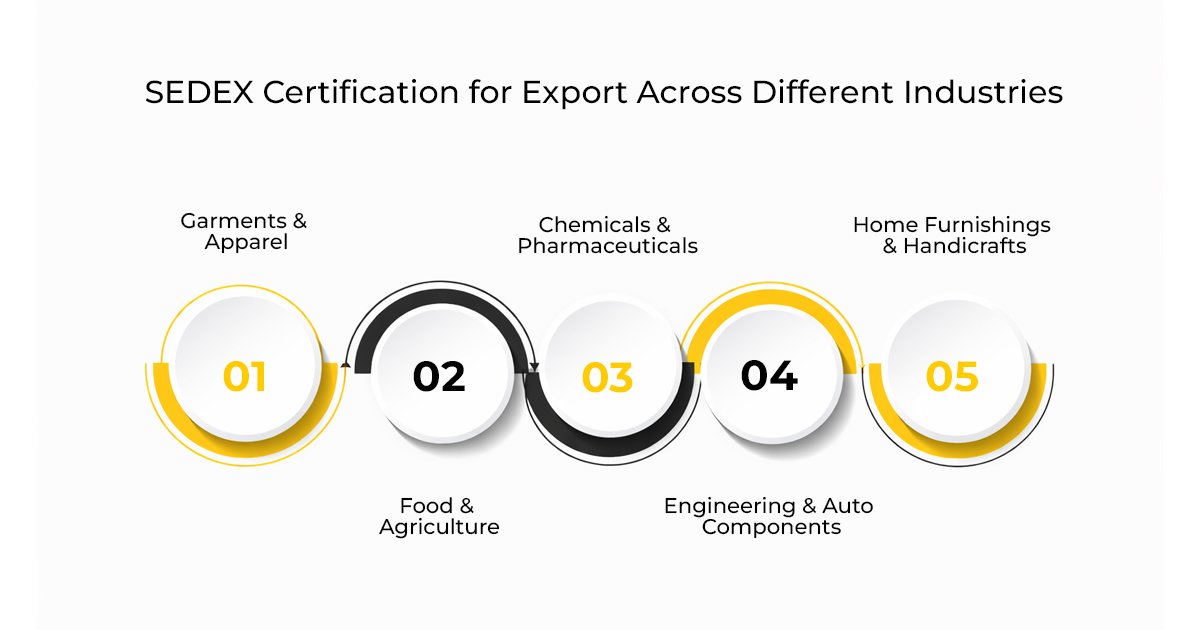
Although the main requirements for SEDEX export remain the same for everybody, the experience gained in the pursuit of SEDEX compliance export differs considerably depending on the industry. Take a glimpse at the different industries and the challenges they face in the pursuit of SEDEX certification for export.
Garments & Apparel
- Status: Mandatory for major global brands.
- Core Audit Focus: Labour practices, working hours, overtime pay, and sub-contracting transparency.
- Primary Compliance Challenge:
Audit Fatigue – Exports may have to go through several redundant audits for different buyers. The industry is also pushing for a new initiative called shared reports.
Food & Agriculture
- Status: Critical for supply chain transparency and food safety trust.
- Core Audit Focus: The 4-Pillar SMETA is standard here, focusing on pesticide use, water consumption, and land ownership.
- Primary Compliance Challenge:
Supply Chain Depth- The scope of compliance is not limited to the factory but extends to hundreds of small-scale farming partners and raw material suppliers.
Chemicals & Pharmaceuticals
- Status: High priority for environmental and safety-conscious markets.
- Core Audit Focus: Environmental standards, chemical storage, effluent treatment, and emergency response.
- Primary Compliance Challenge:
Regulatory Overlap – Exports may already have ISO 14001 or REACH compliance in place, and SMETA may seem like an additional level of reporting.
Engineering & Auto Components
- Status: An emerging requirement for Tier-1 and Tier-2 suppliers to European automotive groups.
- Core Audit Focus: Social compliance and welfare documentation for contractual and migrant workers.
- Primary Compliance Challenge:
Documentation Gap – Organizations familiar with technical quality audits such as ISO 9001/IATF 16949 must create a new system of social/ethical documentation.
Home Furnishings & Handicrafts
- Status: Often co-exists with Fair Trade certifications for the US/EU markets.
- Core Audit Focus: Adapting factory-based labour rules to the cottage industry (home-based workers).
- Primary Compliance Challenge:
Structural Mismatch – SMETA was originally developed to audit centralised factories, making it difficult to audit a decentralised, artisan-based approach to production.
Textiles & Home Textiles
- Status: High priority for global retailers of bed linen and towels.
- Core Audit Focus: A hybrid of labour (wages/overtime) and environmental (dyeing and finishing chemicals) standards.
- Primary Compliance Challenge:
Sustainability Investment – These exporters must invest in cleaner technologies to meet both SMETA results and the growing Green commitments of their buyers.
>Helpful Guide:- Cost Of SEDEX Certification 2026: Full Pricing Breakdown
Key Takeaways on SEDEX Certification for Export
- SEDEX certification for export is not required by law, but it is becoming a requirement for major international buyers.
- The majority of SEDEX export requirements come from buyers in the UK, EU, and US, who use SEDEX to check for ethical and responsible sourcing.
- For Indian exporters who work with large retailers or FMCG brands, SEDEX compliance export standards are a requirement to stay on the approved vendor list.
- The SEDEX renewal process has to be carried out on a yearly basis to stay a current member of SEDEX and share audit information with buyers.
- Non-compliance with SEDEX export regulations can lead to losing international business contracts, especially from buyers in regulated countries.
>Top trending Guide:- BRC Full Form: All 3 Meanings Explained – Food, Export and Education (2026 Guide)

Launch Your Business with Zero Compliance Hassles
Frequently Asked Questions
Is SEDEX certification mandatory for export India?
Although not legally compulsory in India, SEDEX certification for export purposes can be a necessity for international buyers, especially those in the UK, EU, and US, to conduct business.
What are the SEDEX export requirements for indian exporters?
The export requirements for Indian exporters to meet the SEDEX export requirements include registration with the SEDEX website, filling out the SAQ, and undergoing a SMETA audit by an accredited third-party organization.
What are the SEDEX compliance rules for export companies?
The SEDEX compliance regulations for export companies include labor standards, health and safety, environmental practices, and business ethics, which can be conducted through the SMETA audit.
How renew SEDEX membership after it expires?
Renewing your SEDEX can be done by simply logging in to your account prior to the expiration date and following the renewal procedures to pay the fees and update your SAQ.
What is the SEDEX renewal cost for Indian exporters?
The annual SEDEX renewal cost for Indian exporters is £215 (approximately ₹24,500) for a Standard membership or £365 (approximately ₹45,500) for Supplier Plus per site. billed in GBP directly through the SEDEX platform.
What does the SEDEX renewal process involve?
The process for the SEDEX renewal includes the payment of the membership fee, the update of the SAQ, and the arrangement for another SMETA audit, provided your existing audit report is about to expire.
Can a small exporter apply for SEDEX certification for export?
Yes, exporters of all sizes can register with SEDEX. The site is open to businesses of all sizes, and the cost for the renewal process varies depending on the size of the company.