

The global food trade is no longer governed by price and quantity; safety, traceability, and quality standards have become the parameters for manufacturers to play in the global arena. For Indian food manufacturers looking to break into the global market, it is a must for them to have BRC certification for the food industry. It does not matter if you are supplying some of the biggest retail giants in Europe, the UK, or North America; they will not open their doors for you unless you have BRCGS certification.
This blog will walk you through everything you need to know about BRCGS, what it is, why it is important for Indian food manufacturers in 2026, and what you stand to gain from it.
Understanding BRC Certification for Food Industry
BRCGS stands for Brand Reputation Compliance Global Standards. While it was first developed by the British Retail Consortium, it is now one of the world’s most recognized and respected food safety standards. The BRC food industry standard is applicable to a broad range of food and beverage processors and packers, and private label food and beverage manufacturers.
In other words, the BRC Certification for Food Industry is a guarantee to food and beverage manufacturers that their business is committed to the highest standards of product quality, food safety management, operational standards, and employee practices. BRCGS is a food industry standard that is benchmarked by the Global Food Safety Initiative (GFSI), and this means that BRC food safety certification is accepted and recognized by food and beverage buyers all over the world without the need to conduct an audit.
For food manufacturers based in India, BRC food certification India means that their business is meeting the same standards as food factories based in Germany, Australia, and the US.
>Top trending Guide:- BRC Full Form: All 3 Meanings Explained (Food, Education & Export) 2026
Why BRC Certification for Food Industry Matters in India
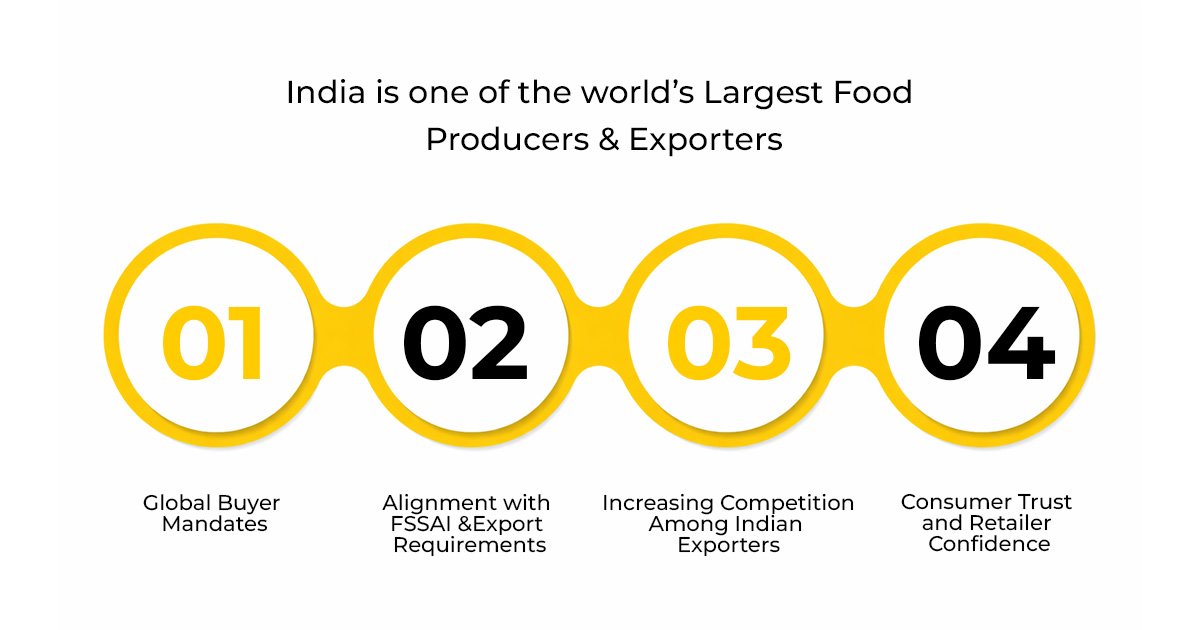
India is one of the world’s largest food producers and exporters. From spices and rice to processed food and nutraceuticals, Indian food businesses are expanding their reach around the world. However, to access developed markets, it is no longer about meeting the bare minimum requirements. It is about showing commitment to food safety culture. Here is why BRC Certification for Food Industry is gaining critical momentum in India:
- Global Buyer Mandates
Major retail groups like Tesco and Walmart require their suppliers to hold BRCGS certification. If you are supplying a product into private label markets like these, then not having BRC certification for the food industry will disqualify you automatically, even if you have a high-quality product.
- Alignment with FSSAI and Export Requirements
Indian domestic food safety regulations, as set by FSSAI, have become more stringent over time. BRCGS is highly aligned with international standards and is an extension of FSSAI regulations. Several export-driven food businesses in India are now utilizing BRC food certification India as an intermediary to meet both domestic and export requirements.
- Increasing Competition Among Indian Exporters
With more and more food manufacturers in India venturing into export markets, differentiation is essential. BRC food safety certification helps your business rise above your competitors who only have domestic certifications and/or lower-level ISO standards.
- Consumer Trust and Retailer Confidence
Consumers in the EU and UK are highly aware of food safety. This is then reflected in what your retailers expect from you. By obtaining BRC food industry certification, your business is able to communicate to your retailers that your manufacturing facility, processes, and staff are audited to world-class standards.
Requirements Of BRC Certification for Food Industry In India
First and foremost, understanding the requirements for BRC certification for food industry India is a prerequisite for a successful journey towards BRC certification. The BRCGS Food Safety Standard (Issue 9) has seven main areas to be considered:
- Senior Management Commitment and Continual Improvement
- Food Safety Plan (HACCP)
- Food Safety and Quality Management System
- Site Standards
- Product Control
- Process Control
- Personnel
In order to achieve BRC Certification for Food Industry, organisations have to develop procedures for operations, corrective actions, supplier approvals, and continuous improvement. Moreover, organizations have to ensure that their HACCP plan is scientifically valid and all personnel within the site are properly trained.
>Helpful Guide:- Emergency BRC Certification: How to Get Approved When Audit Is Due in 15–30 Days?
Step-by-Step Process To Get BRC Certification for Food Industry
The process of getting a BRC Certification for Food Industry involves a specific process that usually takes between three to six months. The duration depends on the current state of your food safety management system.
Step 1: Gap Analysis
This step involves the gap analysis of the BRCGS Food Safety Standard. The gap analysis helps in identifying the areas where your current systems are not meeting the BRCGS Food Safety Standard.
Step 2: System Development and Documentation
This step involves the development or modification of all necessary systems, work instructions, records, and policies. The systems include the HACCP system, the allergen management system, supplier qualification systems, and traceability systems.
Step 3: Internal Audit
Before the actual audit, the organization undertakes an internal audit in all areas.
Step 4: Selection of Certification Body
There are several BRCGS approved certification bodies operating in India and abroad. Select a body that has auditors with experience in your food category.
Step 5: Certification Audit
The BRCGS audit process can be conducted in the form of an announced or unannounced audit. During the audit, the auditor will visit your facility, interview your employees, and audit all the clauses of the standard. Grading will be in the form of AA, A, B, C, or D, where AA represents the highest grading.
Step 6: Corrective Actions and Certification Issuance
After the audit, the audit findings will be closed out by the certification body by issuing a certificate. The certificate will be valid for a period of twelve months.
>Helpful Guide:- Top 5 Mistakes Indian Export Houses Make During BRCGS Audits
Common Challenges In BRC Certification for Food Industry
Many companies ask the question: How do food companies manage to get BRC certification without affecting their business operations? The answer is quite simple: BRC certification involves actual changes in business operations. Some of the challenges faced by companies in achieving BRC certification include:
- Lack of buy-in from the production floor in terms of new hygiene and documentation practices
- HACCP plans that are generic in nature rather than specific to the plant
- Lack of adequate controls in terms of allergen segregation and labelling
- Lack of adequate documentation from suppliers
- Lack of consistency in documentation across shifts and departments
By working with an experienced BRCGS auditor, the process can be significantly reduced and the cost of failure minimized. Many Indian food companies work with BRCGS consultants who understand the Indian operations scenario.
Key Takeaways
BRCGS is a renowned food safety and quality certification accepted worldwide and is a gateway to high-end markets across the globe.
- BRC food certification India is witnessing tremendous growth with Indian food manufacturers increasing their scale to achieve export-oriented production capabilities.
- BRC food certification India follows a process that includes gap analysis, documentation, internal audits, and a third-party audit by a BRCGS-approved certification body.
- BRC is a necessity to export to major retail chains in the UK, Europe, US, and Middle East markets, making it a strategic imperative for the food industry to achieve BRC certification by 2026 and beyond.
- BRC certification to food companies will provide a significant competitive advantage with reduced buyer audits and enhance their brand reputation.
>Helpful Guide:- BRCGS Certification Cost | Apply With Trusted Experts Today
Frequently Asked Questions
What are the BRC certification requirements for food industry India?
The BRC certification requirements for food industry India include the implementation of a documented HACCP system, food safety management system, site infrastructure standards, personnel hygiene standards, control of allergens, and traceability.
How does the BRC food safety certification process India work?
The BRC food safety certification process India includes gap analysis, system development, internal audits, selection of an approved certification body, a formal audit, and closure of nonconformances before the certificate is issued.
How do food companies get BRC certification in India?
Food industry companies can achieve BRC certification by meeting the requirements of the BRCGS Food Safety Standard and undertaking a readiness audit and a formal audit by an accredited certification body.
Is BRC required for export from India?
Although BRC is not included in the legal export requirements in India, it is necessary for export purposes, especially for the UK, EU, and Middle East retail markets, as large buyers in these regions demand BRCGS certification as part of their conditions for trade.
What is the BRC export process for certified manufacturers?
The BRC export process requires you to list your company on the BRCGS directory, which enables global buyers to search for your company while reducing the need for additional audits or inspections.
What are the BRC export benefits for Indian food companies?
The BRC export benefits include increased market access, reduced audit requirements by buyers, pricing power, brand positioning, and import clearance in regulated markets like the UK and EU.
How long does it take to prepare all BRC certification documents?
Most businesses typically take three to nine months to prepare a comprehensive BRC audit checklist, depending on existing food safety systems, operational complexities, and product lines.