
A switch towards organic cultivation in India is a smart decision as it integrates ancient knowledge with the rising world demand for sustainable crops. For Indian farmers, obtaining organic certification is the key link between growing food without chemicals and selling it through high-value channels under the reliable brand names India Organic and Jaivik Bharat. Although obtaining such certification entails a thorough evaluation to maintain soil quality and protect consumers, it can be achieved by complying with two main schemes: NPOP (National Programme for Organic Production) for export purposes and PGS-India (Participatory Guarantee System) for local marketing purposes. The certification process in 2026 requires undergoing the obligatory conversion period within three years when growers should keep records demonstrating that no artificial materials were applied on their lands.
This blog offers detailed instructions about the procedure for registration, necessary Organic System Plan forms, and useful recommendations during inspections.
What Is Organic Certification for Farmers India and Who Governs It
Certification as organic farms in India means that your crop has been cultivated in accordance with the standards of organic farming without using any chemical fertilizers, pesticides, and GM crops for a certain period of time. There are basically two ways for organic certification of farmers in India as mentioned below:
NPOP – National Programme for Organic Production
The NPOP certification of farmers in India is regarded as the highest standard for organic certification; especially for exporting purposes. The NPOP certification is awarded by APEDA (Agricultural and Processed Food Products Export Development Authority) which comes under the Ministry of Commerce. As per the mutual recognition arrangements, products certified by NPOP are eligible for sale to Europe, USA, and Switzerland.
PGS-India – Participatory Guarantee System
The PGS-India is a decentralized and participatory approach to certification which is specifically targeted at the small and marginal farmer group. The certification process involves peer review through the farmer groups. Although the PGS certification is recognized in the Indian market place and few state government programs, it lacks international recognition which makes it suitable for small farmers.
Who Is Eligible for Organic Certification for Farmers India
A farmer and group of farmers in India may get their farms certified as organic based on fulfilling the criteria listed below:
- The plot should not be treated with any banned synthetic materials at least 36 months before harvesting certified crops.
- The farmer needs to agree to keep records of all farming practices.
- The farm will need to establish boundaries and buffer zones to avoid cross-contamination by surrounding farms.
- For NPOP organic certification, the candidate needs to associate themselves with an accredited Certification Body (CB).
- For getting PGS India certification, the candidate needs to be a part of the registered Local Group (LG) comprising 5 or more farmers.
Step by Step Process To Get Organic Certification for Farmers India
Here is a detailed walkthrough of how a farmer can get organic certification in India step by step, covering both NPOP and PGS pathways.
Step 1: Understand the Conversion Period
In order to have the certification granted, your farm must undergo what is known as the conversion period, which lasts three years if you have been using your farm land in conjunction with synthetic substances. You will be required to adhere to the NPOP regulations during this period, and no prohibited substance will be allowed on the farm.
Step 2: Choose Your Certification Route
Choose either NPOP or PGS according to the size of your farm, who your target market is, and what budget you have. Choose NPOP if you wish to export or deal with organized retail chains, but go for PGS-India if you run a small-scale operation and only sell products in local markets. You may also choose PGS first before going to NPOP later.
Step 3: Select an Accredited Certification Body (NPOP)
If you want to be certified for farmers in India using NPOP, you need to employ an APEDA-accredited Certification Body to do it for you. There are about 25 such bodies active in India, which include ECOCERT India, OneCert Asia, and Control Union. You can check the full list at the APEDA website.
Step 4: Submit Your Application
Apply officially to your selected Certification Body. This step requires submission of an Operator Information Document (OID), which is an overall account of how your farm works. Your CB will assess your application and then plan for an inspection prior to that.
Step 5: Prepare and Submit All Required Documents
This step is vital. You need to prepare all documents needed from farmers for organic certification. (The entire list of these documents has been discussed in detail in the subsequent part.)
Step 6: Farm Inspection
An authorized inspector will come for the inspection of your farm from the CB you have selected. This includes verifying your paperwork with the facts in the field, as well as the inspection of inputs storage, water sources, buffer zones, and crop records. In the case of PGS-India, this inspection is conducted by other farmers from the Local Group.
Step 7: Certification Decision
The CB will make the decision regarding the issuance of the certification, which may be approved, deferred, or rejected. Should you qualify for organic certification, your Organic Certificate shall be valid for one year, and will be renewable every year upon inspection.
Step 8: Annual Renewal
Farmers who seek organic certification in India need to undergo this procedure annually because it is not something that is done only once in a lifetime.
>Helpful Guide:- Top Organic Certifying Agents in India and How to Choose
Documents Required for Organic Certification for Farmers India
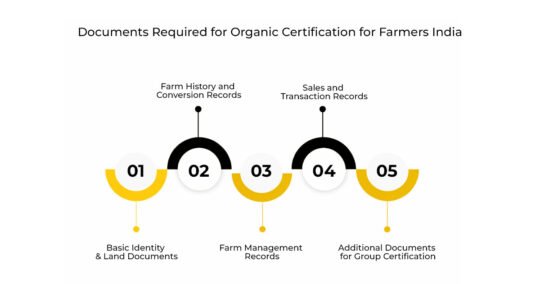
The first and foremost challenge faced by farmers is their lack of knowledge about the documents needed for organic certification in India. Below is a complete list of the same:
Basic Identity and Land Documents
- Aadhaar Card or any government issued identity proof of the farmer
- Land ownership documents
- Land lease agreement
- Farm map or sketch clearly showing field boundaries, buffer zones, and water sources
Farm History and Conversion Records
- Signed affidavit confirming no prohibited substances have been applied for the last three years
- Documentation of the conversion process and schedule including last application of synthetic substances
- Soil or water test results
Farm Management Records
- Diaries or log books documenting all field work undertaken
- Purchase invoices or receipts of all purchased inputs on the farm
- Details of all the inputs used
- Harvest and production record for all crops grown
Sales and Transaction Records
- Sales invoice or receipt from produce sold
- Transaction document from transactions with the organic processor or exporter
Additional Documents for Group Certification (PGS-India)
- Certified membership document from local group
- Group Internal Control System documents
- Peer review documents from other members of the group
Maintaining all documents in both forms is highly recommended. There is an option of submitting documents via the internet in many Certification Bodies nowadays.
>Read Also:- Steps to Get Organic Certification Without Confusion
How Long Does Organic Certification for Farmers India Take
- For lands that have never been worked using any chemicals: The conversion period can either be waived or reduced to 12 months, meaning certification will occur in just 1-1.5 years.
- For lands previously farmed through conventional practices: The entire 36-month (3 year) conversion period will apply. You’ll be able to sell your products once the period elapses.
- Post-submission process: Following submission of required documentation and inspections, it normally takes 4-8 weeks for the CB to release the certification.
- Timeline under PGS-India: Relatively shorter compared to other certification systems, with some taking about 6-12 months following formation of their respective group.
To conclude, it is expected that farmers will require anywhere from 1-3 years for certification based on various factors.
Costs Involved in Organic Certification for Farmers India
The cost of getting an organic farming certification in India varies widely according to the path selected:
NPOP Certification Costs
Certification under the NPOP scheme may range from Rs. 15,000 to Rs. 50,000 or even higher on an annual basis, depending on the scale of farming operation and Certification Body used by individual farmers. This includes application fees, inspection charges, and certificate issuance fees.
PGS-India Certification Costs
In contrast, the PGS-India certification process is quite inexpensive. Since the inspections under the PGS-India scheme are carried out by fellow farmers belonging to the Local Group, any costs associated with hiring an external inspector are avoided. Generally, the Local Groups incur minimal annual fees, ranging from Rs. 500 to Rs. 2,000 per farmer. Moreover, the Indian government subsidizes certification expenses through schemes such as PKVY.
Practical Tips for a Smooth Organic Certification for Farmers India
- Keep a farm diary starting from day one of conversion; lack of records is usually the main cause of delays and failures in certification.
- Only use NPOP-approved inputs throughout the period of conversion; the full list can be found on the APEDA website.
- Register yourself as part of a farmer group or FPO if you are a small-scale farmer; group certification greatly cuts costs and complexity.
- Always keep receipts for input purchases and soil tests organized; the same goes for soil test results; inspectors pay close attention to these.
- Consult your state agricultural department; many states provide technical and financial assistance for organic certification.
Key Takeaways
- Organic certification for farmers India is done according to the NPOP (National Programme for Organic Production) system regulated by APEDA.
- For small-scale farmers, there is an alternative method through group certification via PGS-India (Participatory Guarantee System).
- There are some important documents needed for organic certification of Indian farmers like land documents, farm maps, history of conversion, and inputs used.
- It generally takes around 2 to 3 years to complete the entire organic certification process.
- After certification, farmers have access to premium local and global markets, which helps increase their revenue sources.
Frequently Asked Questions
How can a farmer get organic certification in India step by step?
A farmer can obtain organic certification by converting farmland, selecting certification type (NPOP or PGS), choosing a certifying body, submitting required documents, undergoing inspection, and receiving certification upon approval.
What documents are needed for organic farming certification?
Required documents include land records, ID proof, farm map, conversion history, input details, farm diary, yield records, and sales invoices. For PGS, group participation records and Internal Control System (ICS) documents are also required.
What is the organic certification process for small farmers in India?
Small farmers can opt for PGS-India certification, which is cost-effective and peer-reviewed. They may also benefit from government schemes like PKVY that provide financial support.
What is NPOP certification for farmers in India?
NPOP certification is a premium organic certification regulated by APEDA. It is internationally recognized and required for exporting organic products to global markets.
How long does organic certification take for farmers?
The process typically takes 1 to 3 years depending on land history. Conventionally farmed land requires a conversion period of up to 36 months, while chemical-free land may be certified faster.
How much does organic farming certification cost in India?
Costs vary by certification type. PGS-India is low-cost (₹500–₹2,000 per year for groups), while NPOP certification for individual farmers can range from ₹15,000 to ₹50,000 or more annually.
Can organic certification documents be submitted in regional languages?
Yes, PGS-India and many certification bodies accept documents in regional languages. However, for NPOP certification, key documents like application forms must typically be submitted in English.