

When you produce cartons, labels, flexible packaging or printed literature materials, a buyer has likely requested your Sedex profile by now. What was once a demand of a handful of export clients has become part of the vendor onboarding process for food, pharmaceuticals, FMCG and retail companies who need to demonstrate ethical sourcing of products to their consumers.
What exactly is it? A Sedex audit for packaging suppliers is an ethically traded audit of your print and/or converting operation based on the SMETA methodology. It evaluates how you deal with employees, safety of your premises and, in a 4-Pillar audit, environmental sustainability and business ethics. A report is then delivered to buyers through the Sedex portal.
This guide contains all the requirements that buyers expect, information about what an auditor looks for during a package manufacturing facility inspection and how to be ready for the audit. All the information is provided by the Legal4sure team that assists manufacturers in getting Sedex and SMETA compliant.
Do Packaging Suppliers Need a Sedex Audit?
There is no legal obligation for packaging suppliers to be audited by Sedex. The obligation is set by your buyers. If your brand owner or retail client is monitoring its supply chain through Sedex, you’ll be asked to become a Sedex member and provide the SMETA audit report. Otherwise, the process of vendor approval may get complicated.
The packaging suppliers got involved into the situation since the brand owners started to monitor all the tiers of their supply chains. Packaging printers and converters belong to the tier just below the brand owner and are responsible for that tier to the brand owner. Food-contact and pharmaceutical packaging receive even more attention as the defect in your facility means that the defect belongs to the brand as well.
You can find out about the issue in any of the following ways:
- Your new buyer is requiring a company reference number or a valid SMETA report in its vendor form.
- Your existing buyer transfers all its supplier base to Sedex.
- Your annual vendor tender includes ethical trade criteria.
- Your retailer requires a 4-pillar report instead of a 2-pillar one.
When You Can Wait, and When You Shouldn’t
There’s no need to rush in if your clients don’t employ Sedex or if there are no demands from any of your buyers about ethical trading practices. You should not procrastinate, however, if you are dealing with a multinational corporation, providing your goods to a retailer’s private label collection or exporting your goods abroad. There’s always the danger that you’ll find yourself too late.
Sedex and SMETA: What Buyers Are Really Asking For
Sedex is the online system that stores ethical trade information of the supplier and communicates it to the buyer. SMETA (Sedex Members Ethical Trade Audit) is the auditing method adopted for evaluating the site. Sedex does not provide any certification.
It is that last part that confuses most people. They may come across “Sedex certification” in buyer emails and even websites of consultants, but the one thing that they get is an audit report and not a certificate. What buyers are interested in is the content of this report as well as its closure time.
The standard procedure would be:
- Register at Sedex and fill out your SAQ for the facility.
- Connect your profile to the buyers asking for your report.
- Schedule SMETA audit through an audit company certified to do the audit.
- Get the audit report with all non-conformities mentioned.
- Submit CAPR and close the findings.
- Share the report with the buyers using the platform.
Sedex Requirements for Packaging Suppliers: What Buyers Expect
Buyers don’t send a standard checklist, but the same expectations come up again and again. Here’s how they translate for a print
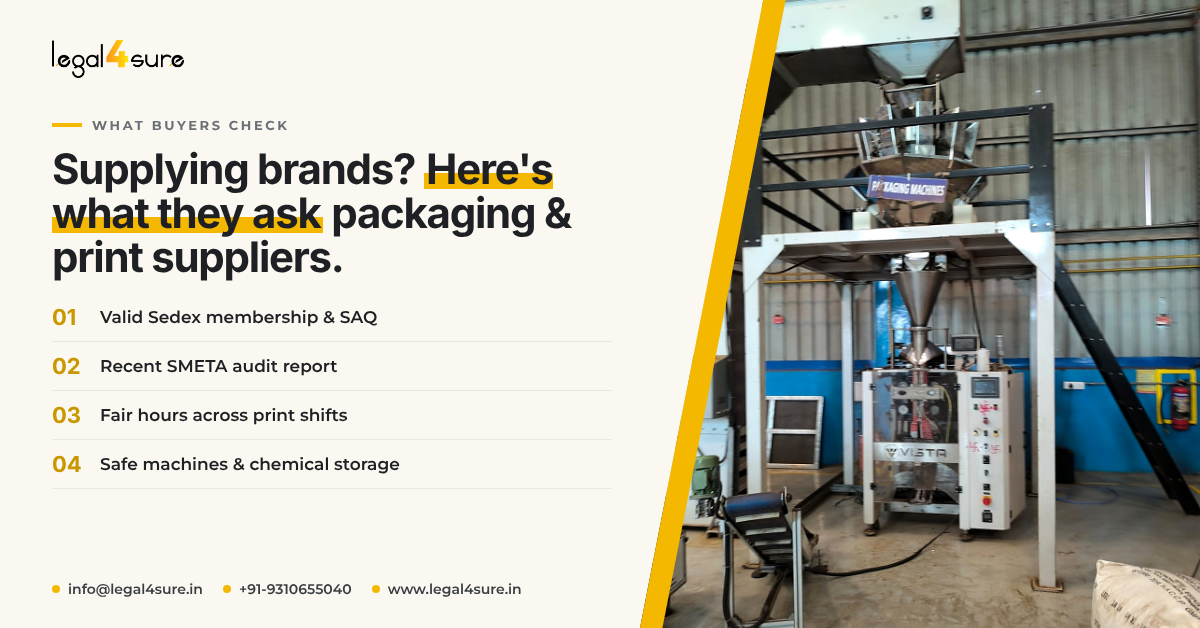
| Buyer expectation | What it looks like in a packaging plant | Typical evidence |
|---|---|---|
| Active Sedex membership and SAQ | Site profile matches reality: headcount, shifts, contract labour | Updated SAQ, correct address and workforce numbers |
| Report at the right scope | 2-Pillar or 4-Pillar, exactly as the buyer specifies | Buyer’s written requirement, SMETA report |
| Timely closure of findings | Fixes completed within the CAPR timeline | CAPR, photos, revised policies, training records |
| Consistent practice | Same conditions in audit week and every other week | Ongoing attendance, wage and safety records |
What Buyers Expect From Sedex-Compliant Packaging Suppliers Beyond the Paperwork
- There will be no zero-tolerance problems. Child labor, forced labor and other equally important issues can bring an end to your business partnership rather fast.
- Outsourced work visibility. Should die cutting, laminating or finishing be sent out to job shops, then buyers expect you to be aware of which ones.
- Owner of Sedex follow-up. This person will be one individual from the HR/compliance department.
- Peak season honesty. It is at holiday time and export seasons that overtime hours are exceeded.
What Does a Sedex Audit Check for Packaging Manufacturers?
Sedex auditing includes labour practice and health and safety as standard audit pillars, while a 4-pillar audit includes environment and business ethics as well. The audit involves document examination, a walkthrough of the production site, and private interviewing of employees. In packaging plants, the issues include wage payment, working time, machine safety, and chemical handling.
Labour Standards
- Proof of age of all employees, whether contracted or through agencies.
- Contracts in writing, wages above the statutory minimum, and PF and ESI contributions.
- Timings of work, rest days, and overtime with evidence that overtime is voluntary.
- Grievance mechanism in place and no discrimination.
Health and Safety on the Print Floor
- Guarding of die-cutting machines, creasing machines, folder-gluing machines, and slitter rewinder.
- Storage and labeling of inks, solvents and adhesives, accompanied by safety data sheets and proper ventilation.
- Fire preparedness: piles of cardboard and paper rolls, dust accumulation, fire extinguishers, evacuation and practice.
- Proper handling of rolls and pallets, proper training of forklift drivers and use of appropriate PPE.
Environment and Business Ethics (4-Pillar Only)
Pillars on the environment will look at how you manage the waste ink, solvent remnants, scraps from the boards, and the energy use. Pillar on business ethics will examine your anti-bribery policy and honesty in record keeping. Both pillars require documented policy procedures.
Sedex Audit for Printing Companies: Where Print Floors Get Flagged
Compliance for print suppliers is largely about practices. Most discoveries arise from routine situations at the work floor, not from outrageous breaches. They include:
- Partial blockages of fire exits by reels or cartons already converted.
- Unprotected nip points in converting machines.
- Overtime beyond allowable hours during rush order periods.
- Lack of safety data sheets around ink and solvents.
- Payroll register discrepancies against attendance records.
- Lack of proof of age of contracted employees.
Not all discoveries are created equal. To know which are more severe, refer to our guide on Sedex Zero Tolerance Issues.
A Typical Scenario
Consider a case where there is an audit at the folding-carton facility that provides products to a branded food product company. The auditor identifies issues of the fire exit being obstructed partially by boxes and overtime hours exceeding the allowable limit during a period when the company needs the extra shift due to the holiday rush. These are not dramatic findings but they will definitely make it to the report.
SMETA Audit for Packaging Manufacturers: 2-Pillar or 4-Pillar?
Your buyer decides the scope, not you. Confirm it in writing before booking, because a report at the wrong scope may not be accepted.
| Aspect | 2-Pillar | 4-Pillar |
|---|---|---|
| Areas covered | Labour standards, health and safety | Adds environment and business ethics |
| Typical buyer | Focused on working conditions | Running wider supply chain due diligence |
| Extra preparation | Minimal beyond core records | Environmental data, anti-bribery and ethics policies |
| Choose it when | Your buyer specifies 2-Pillar | Your buyer specifies 4-Pillar, or you serve several buyers |
Read our comparison of Sedex 2-Pillar vs 4-Pillar audits for the full breakdown.
Sedex Audit Requirements for Packaging Suppliers in India
Your site will be evaluated against both the SMETA standard and the local legislation. In case of discrepancy between the two, the stricter of the two will prevail. With regards to Indian manufacturing facilities, the following items are expected:
- Factory licence and fire clearance certificate.
- Pollution control board clearance, if it pertains to your manufacturing process.
- Statutory labour records and minimum wage compliance.
- Contract labour licences and contractors’ agreement, if any.
Indian labour laws are being upgraded from previous enactments to labour codes, and you must confirm the situation through your lawyer before an audit. If you supply pharma brands, expect more stringent document verification. Our Sedex certification for pharma article discusses the approach of regulated sector purchasers.
How to Prepare: A Six-Step Readiness Plan
- Agree on the scope with your buyer. Request either a 2-pillar or 4-pillar and find out whether the audit is announced.
- Act as an auditor. Look at exits, guards, chemicals, and personal protective equipment during each shift.
- Check your documents. Attendance records, wage payments, overtime and legal registers should tell one and the same story.
- Prioritize physical risks. They are visible in no time and difficult to justify.
- Talk to supervisors but not workers. The auditors interview the workers privately, and their rehearsed answers are easily recognizable.
- Prepare for the audit. The Sedex Audit Consultant may perform the pre-audit check and assist in preparing the CAPR.
Do It Yourself or Get Help?
If you have your own HR lead, clean records and a previous SMETA report, do it on your own. Otherwise, seek external help when you don’t have any previous experience conducting audits, operate several shifts using contract labor, or are under a tight buyer deadline. Legal4sure operates with plants exactly in this case.
There are four main supplier mistakes:
- Conducting audit as a one week-long project.
- Keeping SAQ outdated.
- Failing to meet CAPR deadlines.
- Hiding job work and agency workers.
Key Takeaways
- Sedex audits for packaging vendors are voluntary, not required by law.
- Sedex is the auditing platform, and SMETA is the audit methodology. You get a report, not a certificate.
- Auditors look into pay, working hours, machinery guarding, chemical and fire safety in the print room.
- Your buyer decides on the audit scope, whether 2-Pillar or 4-Pillar, so check that beforehand.
- Quickly addressing the findings is just as important as getting audited.
Conclusion
Sedex audit for packaging suppliers is not an obstacle that you have overcome once and for all. It is documentation of the daily functioning of your factory, and the buyer sees it that way. The vendors that resolve the issues of safety on the floor quickly and maintain consistency in records progress much more smoothly through the vendor approval process.
In case the buyer just requested your document, begin with the scope, then the gap analysis, and then the records. Legal4sure will be able to assist you with it.
Get Your Packaging Facility Ready for Buyer Audits
Prepare your printing and packaging operations for SMETA audits with expert support for Sedex registration, gap assessments, documentation reviews, workplace safety checks, and corrective action closure. Legal4Sure helps packaging suppliers understand buyer expectations and strengthen audit readiness.
Frequently Asked Questions
Do packaging suppliers need a Sedex audit?
By no means. This is demanded by the buyers and if your customers are on Sedex then you have to produce a SMETA report to keep your status valid.
What does a Sedex audit check for packaging manufacturers?
Labour standards, health and safety, and environment and ethics if it is a 4-Pillar audit (wages, working hours, machine safety, fire preparedness).
What are the Sedex audit requirements for packaging suppliers in India?
Correct information about the site, correct scope of the report, quick actions on findings and accurate reporting of contract and job-work labour.
Can you summarise what buyers expect from Sedex-compliant packaging suppliers?
Certainly not! Sedex is a database which allows sharing information between members, and SMETA is an audit methodology that allows evaluating your site.
Is SMETA the same as Sedex?
No. Sedex is the data-sharing platform, while SMETA is the audit methodology used to assess your site.
What happens if a packaging supplier fails a Sedex audit?
You will not receive any grading in the form of pass/fail. You will close listed non-conformities by CAPR.
Should a printing company choose a 2-Pillar or 4-Pillar audit?
Follow your buyer’s written requirement. Ask before booking, since the wrong scope may not be accepted.