
There has never been a better time for food safety certification in India. The Indian food processing sector is thriving like never before, while consumers are also more conscious than ever. For any entity involved in the business of foods, be it a new player entering the food market or an established manufacturer looking to venture abroad, food safety certification India 2026 should be known.
This comprehensive guide includes the entire list of food safety certification India for the year 2026, differentiates between mandatory and voluntary certifications, and assists you in finding out which certification is suitable for your particular business.
Why Food Safety Certification India Matters in 2026
India is the second largest producer of food items globally, and the certification regulations for food safety standards India are changing at an extremely rapid pace. The guidelines set by FSSAI are frequently revised, and additionally, there are regulations from importers such as those from Europe, America, and the Middle East regarding food safety certification.
Food safety certification India is vital for legal compliance, client satisfaction, lower liability, and better market access. Penalties will increase in future years; moreover, inspections will become more frequent after 2026.
Is Food Safety Certification India Mandatory
The certification concerning food safety is a legal mandate in India for all FBOs. As per the provisions of the Food Safety and Standards Act, 2006, any organization that engages itself in the manufacture, processing, packaging, transportation, handling, storage, distribution, sale, and import of foods should register themselves with the FSSAI or apply for FSSAI license prior to carrying out their operations.
Concerning the type of certificate to be taken, it depends upon the turnover or the business operation. Apart from the FSSAI, other certifications such as the Hazard Analysis and Critical Control Points (HACCP), ISO 22000, or the BIS might become necessary depending on the product and the markets in which it needs to be sold. When it comes to export of products, international certificates become almost inevitable.
Complete List of Food Safety Certification India 2026
Below is a list of food safety certification India, including mandatory government certifications and voluntary international programs that have become common among Indian food companies.
FSSAI Registration and License
FSSAI Certification is the basis for food safety compliances in India. All food business operators require either:
Basic Registration: for small food businesses with an annual turnover below INR 12 lakhs.
State License: for medium food businesses with an annual turnover from INR 12 lakhs to INR 20 crores.
Central License: for large-scale manufacturing, importing, exporting companies, and multi-state food business operators.
FSSAI also handles product-specific approvals and the FSSAI Logo license, which indicates consumer compliance. This is the most crucial food certification that India needs before any food business operates.
ISO 22000
ISO 22000 is amongst the most popular voluntary standards in food safety that Indian companies opt for in order to make themselves ready for export and improve their standards. The standard lays out the criteria for the establishment of a Food Safety Management System (FSMS) throughout the whole food chain.
Certification with ISO 22000 is mandatory in India, although its compliance is mandatory on account of many foreign buyers or large retail chains. ISO 22000 incorporates HACCP principles and is applicable to all organizations involved in food chain operations irrespective of size and complexity.
HACCP Certification
The Hazard Analysis & Critical Control Points (HACCP) approach constitutes a preventive food safety system that makes it one of the most significant certifications among those recognized internationally by India for its food safety. HACCP certification is required for food products exported to the US and EU countries according to their import policies.
In India, HACCP certification is highly recommended by the Food Safety Standards Authority of India (FSSAI) and usually a necessary requirement to supply food products to organized retail and Quick Service Restaurant (QSR) chains.
BIS Certification
Certification by the Bureau of Indian Standards (BIS) is mandatory according to Food Safety and Standards (Food Products Standards and Food Additives) Regulations for some food products. Packaged drinking water, infant formula, milk powder, and edible oils are among the products covered by mandatory BIS certification.
In addition, BIS runs the ISI Mark system for standardized food products, guaranteeing customers that their products conform to the established standards in India. BIS continues to be an essential part of food safety certifications in India 2026, particularly for selected categories of products.
Organic Certification
India has two types of organic certification systems that have been certified under India’s food safety standards:
NPOP (National Programme for Organic Production): Approved for exporting to the EU, USA, Japan, and Switzerland. Issued by certified organizations authorized by APEDA.
PGS-India (Participatory Guarantee System): An organic certification program for farmers that can be used only in India.
It is compulsory to get an organic certification if you sell products labeled “organic” in India.
Halal Certification
Halal Certification is voluntary food certification sought by Indian firms mainly for their exports to Middle Eastern, South East Asian countries, and other Muslim majority nations. The certificate is issued by internationally accredited Halal certification organizations.
When it comes to food safety certificates for export of foods from India, Halal certificate is almost a necessity if exporting meat, processed foods, and other ingredients to GCC nations and others. There are many internationally accredited Indian Halal certification institutions such as the Jamiat Ulama-i-Hind Halal Trust.
Kosher Certification
Kosher Certification ensures that the food product is compliant with the dietary rules laid down in Judaism. Although it is a specific food safety certification in India, it holds significance when exporting food products from India to other countries such as the USA, Israel, and certain European countries.
The Kosher Certification is awarded by international Kosher Certification bodies, and it becomes essential when exporting ingredients to global food product manufacturing organizations that require their raw materials to be Kosher-certified.
GMP Certification (Good Manufacturing Practices)
GMP certification guarantees that food products are manufactured and controlled to meet certain quality parameters. Although GMP certification is mandatory as per the FSSAI license requirement, GMP certification offered independently by third parties serves to add an extra layer of validation.
It must be noted that GMP forms the basis of almost all the food safety norms that exist in India.
FSSC 22000
FSSC 22000 is an internationally accepted and GFSI-benchmarked food safety certification program that integrates ISO 22000 with ISO/TS 22002 industry-specific prerequisite programs. FSSC 22000 is becoming more and more sought after worldwide by major multinational purchasers and retail chains.
In the case of Indian food manufacturers exporting products to European supermarket chains or international food corporations, FSSC 22000 is one of the most important food safety certifications available for exports from India.
>Helpful Guide:- FSSC 22000 Certification for Food Industry: Who Needs It and How to Get Certified in India (2026)
APEDA Registration for Export
All exporters of designated agricultural and processed food products are supposed to register under the Agricultural and Processed Food Products Export Development Authority (APEDA). Although APEDA is not a certification related to food safety, getting registered with APEDA is the first step to take advantage of various export benefits and incentives offered by APEDA.
Certification for organic products and authentic basmati rice also falls under the scope of activities of APEDA.
Which Food Safety Certification India is Best for Manufacturers
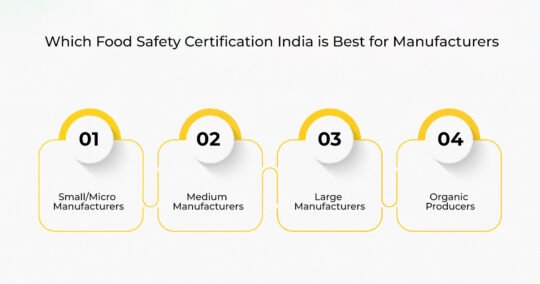
This will depend on your scale, product type, and target market. Here’s a framework for food safety certification for manufacturers in India:
Small/Micro Manufacturers (Domestic Market): Either an FSSAI Basic Registration/State License is enough, alongside GMP compliance.
Medium Manufacturers (Organized Retailers/Institutional Supply): An FSSAI Central License, along with HACCP Certification, is advised.
Large Manufacturers (Export-Driven): An FSSAI License, along with either ISO 22000 or FSSC 22000, HACCP, and market-specific certifications such as Halal/Kosher/Organic.
Organic Producers: The National Program for Organic Production (NPOP), for exports, or Participatory Guarantee System – India (PGS-India), for domestic, in addition to FSSAI certification.
For manufacturers who want to know which food safety certification is best for manufacturers India, FSSC 22000 provides the most widespread recognition internationally and is widely regarded as the industry’s gold standard for export-driven food manufacturing.
What Food Safety Certification India You Need for Export
Food exportation from India needs multi-faceted food certification requirements under the India food certification standards:
- Central License from the FSSAI: It is a must-have license for all food exporters.
- Registration with the APEDA: Necessary for certain types of agri/processed foods for export.
- ISO 22000/FSSC 22000 or HACCP certification: The mandatory requirement for most international buyers and foreign nations.
- Halal Certification: It is a necessary certificate for the Middle Eastern, Southeastern Asian, and certain African countries.
- NPOP Certification: This certificate is compulsory for those who intend to sell their products as organic in the EU, USA, and Japan.
- BIS Certification: It is also required for some product categories.
It is advisable to get acquainted with the requirements of the Indian government as well as those from your market destination country. Consulting an internationally recognized third-party organization will be highly beneficial in this regard.
Key Takeaways
- FSSAI registration/licensing is required for all food operators in India irrespective of their size.
- ISO 22000 & HACCP are international food safety standards that Indian companies follow in order to gain access to the international market.
- For export-oriented companies, there are other certifications such as BIS, Halal, and Kosher, which need to be acquired depending on the destination country.
- There are many food safety certificates available in India ranging from compulsory government certifications to voluntary third-party certifications.
- Food certification in India selection will depend on the size of the company, product type, and whether the target market is domestic or international.
Frequently Asked Questions
What food safety certifications are required in India?
FSSAI Registration or Licensing is mandatory for all Food Business Operators in India. Depending on the product type and target market, additional certifications such as HACCP, ISO 22000, BIS, GMP, Halal, Kosher, or Organic Certification may also be required.
What is the complete list of food safety certifications required in India 2026?
Major food safety certifications in India include FSSAI, HACCP, ISO 22000, FSSC 22000, BIS, NPOP/PGS Organic Certification, GMP, Halal, Kosher, and APEDA Registration for exporters.
Which food safety certification is best for manufacturers in India?
The ideal certification depends on the business scale and market. Small manufacturers may only require FSSAI compliance, while export-oriented businesses generally need ISO 22000 or FSSC 22000 in addition to FSSAI licensing.
What are the food safety certifications required for export from India?
Exporters commonly require FSSAI Central License, APEDA Registration, HACCP, ISO 22000 or FSSC 22000, along with destination-specific certifications such as Halal, Kosher, or Organic Certification.
Is food safety certification mandatory in India?
Yes, every food business in India must obtain FSSAI registration or licensing. Additional certifications such as BIS, Organic, or HACCP may also be mandatory for specific products or export categories.
How long does FSSAI certification take in India?
FSSAI Basic Registration generally takes around 7 working days, while State and Central Licenses may take between 30 and 60 days depending on documentation review and inspection timelines.
Can a small food business get ISO 22000 certification in India?
Yes, small food businesses can obtain ISO 22000 certification. However, many small businesses initially focus on FSSAI compliance and GMP practices, adopting ISO 22000 later as they expand or enter export markets.