
India stands out as among the leading nations when it comes to organic agricultural product manufacturing, having above 44 lakh farmers who practice organics. However, there continues to be a significant number of farmers and entrepreneurs who lack knowledge concerning one of the key issues involved in adopting organic farming: cost of organic certification cost in India. If you are a small-scale farmer who would like to take the PGS India approach or an exporting business that requires NPOP and USDA NOP double certification, learning more about costs is crucial prior to embarking on certification.
This blog will guide you through an in-depth analysis of organic certification cost India including all certification programs and what to expect in terms of costs by 2026.
What Is Organic Certification and Why Does It Matter for Organic Certification Cost India
Organic certification refers to a system whereby a certifying agency certifies farms or food processing plants on their adherence to certain criteria that have been laid down regarding the use of artificial pesticides, chemical fertilizers, GMOs, and sewage sludge among others.
As far as farmers and food exports go, the certification enables one to access high-end markets within and outside India since the price difference between certified organic products and conventional food is anywhere between 20-50%. It would be important to know about the certification process cost beforehand.
Overview of Organic Certification Programs and Their Impact on Organic Certification Cost India
Before delving into figures, it is imperative to establish what programs exist in India, since each one has a unique cost for organic certification in India.
| Certification Body | Type | Applicable For | Recognition |
|---|---|---|---|
| APEDA / NPOP | Government | Farmers & Exporters | India + EU + Switzerland |
| PGS-India | Participatory | Small Farmers | Domestic Market Only |
| USDA NOP (via accredited CB) | International | US Exporters | USA |
| EU Organic (via accredited CB) | International | EU Exporters | European Union |
| Canada COR (via accredited CB) | International | Canada Exporters | Canada |
NPOP is the most common benchmark and is the base upon which organic certification costs in India are determined. The PGS-India approach seeks to minimize the certification cost of organic agriculture for marginal and small farmers.
Organic Certification Cost India Under NPOP: Complete Fee Breakdown
The NPOP framework regulates the way accredited certification bodies (CBs) charge farmers and enterprises. Although the tariff is individually determined by each CB, the ranges below show the feasible costs of organic certification in India in 2026:
| Fee Component | Small Farmers (up to 5 acres) | Large Farmers / Exporters |
|---|---|---|
| Application / Registration Fee | ₹2,000 – ₹5,000 | ₹5,000 – ₹15,000 |
| Inspection Fee (per visit) | ₹3,000 – ₹8,000 | ₹8,000 – ₹25,000 |
| Certification Fee (annual) | ₹5,000 – ₹12,000 | ₹15,000 – ₹50,000 |
| Document Review Fee | ₹1,000 – ₹3,000 | ₹3,000 – ₹10,000 |
| Surveillance / Renewal Fee | ₹4,000 – ₹10,000 | ₹10,000 – ₹40,000 |
| TOTAL ESTIMATED COST | ₹15,000 – ₹38,000 | ₹41,000 – ₹1,40,000 |
Please note that prices differ with different certification bodies like ECOCERT India, Indocert, NCOF, Lacon Quality Certification, etc. It is highly recommended to obtain quotations from at least three CBs.
PGS-India: Reduced Organic Certification Cost for Small Farmers
The Participatory Guarantee System (PGS-India) is a decentralized, community-oriented certification approach which has proved to be extremely cost-effective in case of certification of organic farms. It is particularly suited for farmers who want to market their products locally.
| Component | Estimated Cost |
|---|---|
| Registration with Local Group | ₹500 – ₹1,000 |
| Peer Inspection (Internal) | Minimal / Free |
| Documentation Support | ₹500 – ₹2,000 |
| Annual Renewal | ₹500 – ₹1,500 |
| TOTAL | ₹1,500 – ₹4,500 |
The government bears almost all expenses for obtaining PGS-India certification under PKVY and Mission Organic Value Chain Development for North Eastern Region (MOVCDNER), thereby making organic certification in India practically free of cost.
Organic Certification Cost India: Breakdown for Exporters
For the exporter, the issue becomes even more complicated. For example, when considering the breakdown of the costs associated with obtaining organic certification for exporters in India 2026, we need to consider several factors.
| Cost Head | Estimated Cost | Notes |
|---|---|---|
| NPOP Certification | ₹50,000 – ₹1,50,000 | Depends on volume & certification body chosen |
| NOP (USDA) Certification | ₹80,000 – ₹2,50,000 | Required for US market access |
| EU Organic Certification | ₹75,000 – ₹2,00,000 | Required for EU market access |
| Consultant Fees | ₹20,000 – ₹80,000 | Optional but recommended for smoother approval |
| Lab Testing / Residue Analysis | ₹10,000 – ₹40,000 | Per product batch testing |
| Translation / Notarization | ₹5,000 – ₹20,000 | Required for international certification bodies |
| TOTAL (Multi-Cert) | ₹2,40,000 – ₹7,40,000 | First-year all-inclusive cost |
It is the first-year estimate. In subsequent years, the fees for certification renewal are considerably reduced, to an average of 40-60% of the costs involved in the initial certification.
Organic Certification Consultant Fees India: Do You Need One
Farmers and exporters often wonder if it makes sense to spend money on a consultant’s services. The fees for organic certification consultants in India vary between ₹20,000 to ₹80,000 depending on the scope of the task.
What Does a Consultant Do?
- Prepare and review all paperwork needed for the CB
- Help farmers establish an ICS system
- Communicate with the certification body on behalf of the farmer
- Train the farm workforce in record keeping and traceability
- Minimize chances of a finding during the audit
For first-time applications, particularly for exporters looking for certification from multiple bodies, the involvement of a consultant greatly boosts the chances of passing certification on the first try. The cost is generally covered in the first consignment of premium organic export
>Also read: NPOP Vs NOP Organic Certification | Definitive Business Growth Guide
Factors That Affect Organic Certification Cost India
The following factors influence your cost in the end. Below is an elaboration:
| Factor | Impact on Organic Certification Cost (India) |
|---|---|
| Farm Size | Larger acreage increases inspection scope and certification fees |
| Number of Products | More SKUs require additional documentation and lab testing |
| Certification Body (CB) | Private certification bodies generally charge more than government-linked CBs |
| Target Export Market | Multiple markets (e.g., US + EU) require dual certification, increasing cost |
| Consultant Involvement | Adds ₹20K–₹80K but reduces rejection risk and delays |
| Farm Location | Remote locations increase inspection travel and logistics costs |
Government Subsidies That Reduce Organic Certification Cost India
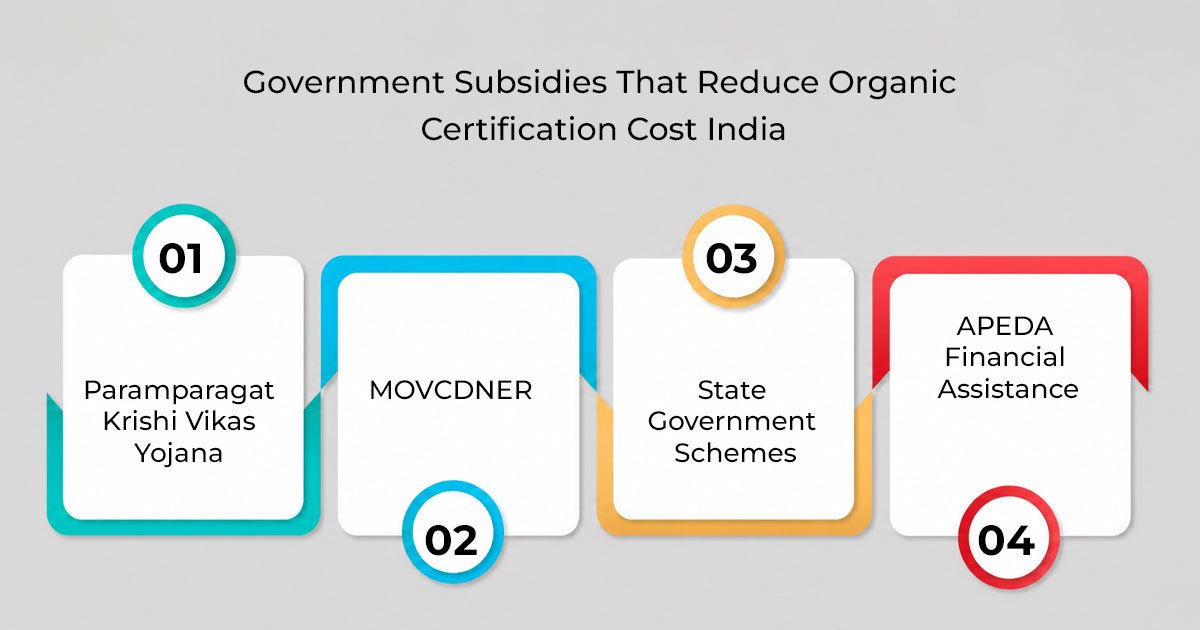
There are several subsidy programs offered by the Indian Government that significantly lower the cost of organic certification for India’s eligible farmers:
-
Paramparagat Krishi Vikas Yojana (PKVY)
This scheme involves farmers forming cluster groups with at least 50 members who are provided a subsidy up to ₹50,000 per hectare in three years, part of which goes toward certification. The PGS scheme ensures free organic farming certification for most participants under this program.
-
MOVCDNER
This scheme is targeted at North Eastern States and helps farmers in developing the value chain. It ensures covering most of the NPOP certification cost for small groups of farmers.
-
State Government Schemes
There are certain subsidies offered by states such as Sikkim, MP, Maharashtra, Karnataka and other states. They help pay between 25-75% of the cost of organic certification in India.
-
APEDA Financial Assistance
Financial assistance from APEDA is provided to exporters for obtaining international organic certification, including CB fee and lab test costs.
How to Choose a Certification Body for the Best Organic Certification Cost India
All accredited CBs in India may not necessarily levy the same cost for organic certification. Here is what you need to do for wise selection:
- Take estimates from at least three CBs accredited under the NPOP scheme
- Request a detailed schedule rather than a single quote
- Review the experience of the CB in your particular category of crop
- Ascertain whether the CB is USDA NOP and/or EU-accredited to avoid additional costs
- Choose CBs that have inspection teams in your local area to avoid extra charges due to travel expenses
>Helpful Blog: Transition To Organic Farming Certification Guide 2026
Year-Wise Organic Certification Cost India: What to Expect Over 3 Years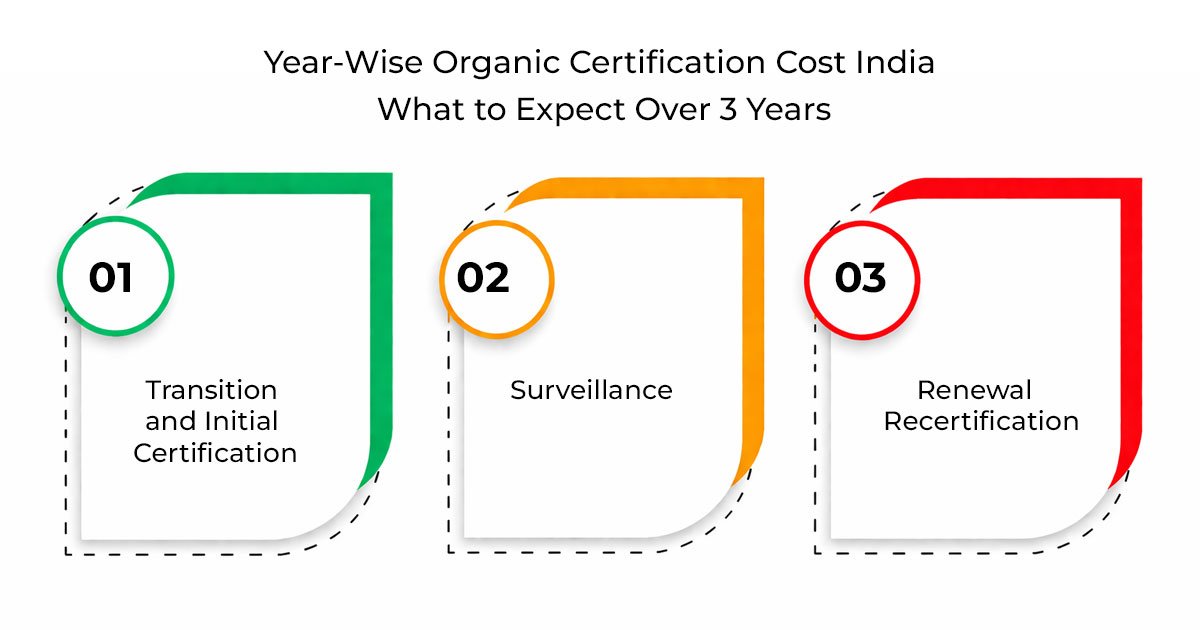
Year 1 – Transition and Initial Certification
The costliest year. The farm needs to undertake a transition period of 12-24 months (depending on crops), where all aspects of organic farming will need to be documented. Application, inspection, and certification costs are incurred here. You can expect to incur all of the above costs listed in the tables.
Year 2 – Surveillance
CBs perform a minimum of one surveillance visit per year. Surveillance fees are usually 50-70% of the first-year certification cost. Documentations are renewed, and non-conformities identified during the first year are sorted out.
Year 3 – Renewal / Recertification
A recertification inspection is undertaken. Costing will be similar to the previous year. At this stage, most farms will have systems in place to make the documentation process easier.
Key Takeaways
Organic certification price India starts from as little as ₹1,500 (for PGS-India small farmers) and goes up to more than ₹7 lakh for multiple standard exports.
- The NPOP (National Programme for Organic Production) is the main government-approved standard for India.
- Small and marginal farmers can avail themselves of subsidised or even free organic certification by PGS-India and government programs such as PKVY (Paramparagat Krishi Vikas Yojana).
- Organic certification cost in India increases for exporters aiming at the American or European markets as a result of needing dual or even triple certifications.
- Organic certification consulting in India will be extra money but ensures success in your certification efforts on the first attempt.
Confused about organic certification cost in India?
Get a clear breakdown of certification fees, inspection charges, export requirements, and the best path for farmers and exporters to go organic profitably.
Frequently Asked Questions
How much does organic certification cost in India for farmers?
It ranges from ₹1,500 (PGS-India for small farmers) to over ₹7 lakh for exporters seeking multiple international certifications. NPOP certification for an average farm typically costs ₹15,000 to ₹1,40,000 in the first year.
What is the fee for organic certification in India under NPOP?
The total fee, including application, inspection, and certification, ranges from approximately ₹15,000 for small farms to ₹1,40,000 or more for larger commercial operations.
Is organic certification free for small farmers?
Under government schemes like PKVY and MOVCDNER, PGS-India certification is effectively free for eligible farmer clusters. Individual NPOP certification still carries a cost, though subsidies are available.
What is the organic farming certification cost breakdown for exporters India 2026?
The organic certification total cost breakdown includes NPOP, NOP or EU certification, lab testing, and consultant fees, totalling ₹2.4 lakh to ₹7.4 lakh in the first year for multi-standard export certification.
What are the organic certification consultant fees in India?
Organic certification consultant fees typically range from ₹20,000 to ₹80,000 depending on the scope, covering documentation, ICS setup, CB coordination, and staff training.
What are the ongoing organic certification fees after the first year?
From the second year, fees reduce significantly. Surveillance and renewal costs are usually 40–60% of initial certification expenses.
Can I get organic certification in India without a consultant?
Yes, you can apply directly to an accredited certification body, especially for PGS-India. However, for NPOP and export certifications, consultants help avoid rejection and delays.