
If you are a manufacturing company in India in the food, pharmaceutical, cosmetics industry, or any other industry requiring regulation, GMP certification India is one thing that you should not overlook. This stands for Good Manufacturing Practices which are internationally accepted standards which guarantee consistent product manufacture and control in accordance with quality standards. In this article, we explore all the necessary information concerning GMP certification from its definition, who requires it, processes involved, documents required, costs, among others.
What is GMP Certification India
To be precise, it means an official acknowledgment that a manufacturing unit adheres to the GMP standards of India, which are rules and regulations related to personnel sanitation, facility layout, machine upkeep, sourcing of raw materials, production process, product testing, and documentation. Such norms have been created by regulatory bodies worldwide, namely, the WHO, US FDA, EU EMA, CDSCO in India, and FSSAI.
Upon receiving GMP certification, it sends across the message to the consumers, purchasers, and regulatory agencies that the goods produced in that particular plant are both safe and reliable. The GMP standards in India conform to Schedule M (drugs), FSSAI’s hygiene norms (food items), and BIS rules (all other industries).
Who Needs GMP Certification India
It is not as limited an issue as many business leaders think. The following industries and organizations will either need to follow GMP guidelines or benefit from them immensely:
-
Pharmaceutical Manufacturers
All businesses involved in drug manufacture, packaging, or distribution are required to adhere to the Schedule M GMP as per the Drugs and Cosmetics Act, 1940. This is mandatory by the CDSCO, and a GMP audit in India is undertaken prior to issuing any licenses.
-
Food Manufacturers & Processors
The GMP certification process in food manufacturers India is becoming essential. Under FSSAI’s Food Safety and Standards (Licensing and Registration) Regulations, all food manufacturers who exceed a certain threshold are required to follow GMP and Good Hygiene Practice (GHP). Apart from legal requirements, food producers seeking export to the United States, European Union, or GCC nations are frequently asked to present third-party certifications like ISO 22000 or FSSC 22000.
-
Cosmetic & Personal Care Manufacturers
According to the BIS and the Cosmetics Rules 2020, manufacturers have to adhere to good manufacturing practices. In case you export your products abroad, it becomes a prerequisite for most foreign customers to ensure GMP certification.
-
Manufacturers of Ayurvedic, Herbal & AYUSH Products
Manufacturers of Ayurvedic, Siddha, Unani, and Homeopathic medicine should strictly comply with GMP or face non-renewal of their manufacturing licenses from State Licensing Authorities under the jurisdiction of Ministry of AYUSH.
-
Manufacturers of Medical Devices
Under the Medical Devices Rules 2017, all manufacturers need to be certified with GMP or Quality Management Systems (ISO 13485).
>Helpful Guide:- FSSC 22000 Certification for Food Industry
Is GMP Certification Compulsory in India
It depends on which sector you are operating in. In the case of drug manufacturing companies, the answer is a definitive yes, since adhering to Schedule M (GMP standard in India for drugs) is mandatory according to the Drugs and Cosmetics Act. Likewise, the GMP standards for AYUSH products and medical devices are also statutory.
As far as food processing companies are concerned, while it is mandatory by FSSAI standards for a food license to be granted, third-party GMP certification in India is contingent on the size of the company and whether it exports its product or not. As for cosmetic products, GMP standards of BIS IS 4011 are increasingly becoming mandatory. Even otherwise, GMP certification makes good business sense for any manufacturing organization.
Required Documentation for GMP Certification India
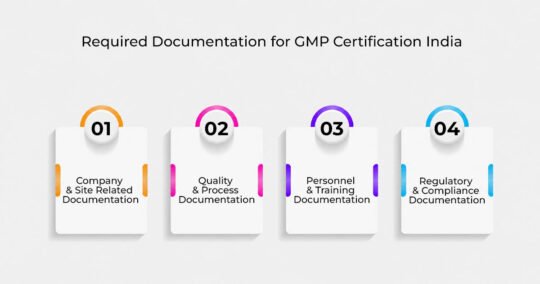
Being aware of the documentation required for GMP certification in India will ensure that your application process is seamless. Here is the list of documents that you require:
Company and Site Related Documentation
- Certificate of Incorporation / Partnership Deed / Declaration of Proprietorship
- Factory License or Establishment Registration Certificate
- Site Master File (SMF) – a comprehensive document providing details about the manufacturing site, processes, and GMP compliance
- Legal Floor Plan / Layout of Manufacturing Plant
- Products manufactured along with product code
Quality & Process Documentation
- Standard Operating Procedures (SOPs) for all critical operations such as production, quality control, cleaning, and maintenance
- Quality Manual that describes the Quality Management System
- Batch Manufacturing Records (BMR) and Batch Packaging Records (BPR)
- Protocol for testing raw materials and finished products
- Validation and Calibration documents for equipment
Personnel & Training Documentation
- The organizational structure along with qualifications of the personnel
- Training documentation for all the manufacturing and QC personnel
- Medical fitness certificates for personnel engaged in production
Regulatory & Compliance Documentation
- The existing licence for manufacturing drugs/food/cosmetics
- The reports of past audits/inspections (if applicable)
- The environmental compliance certificates (e.g., effluent and waste disposal)
Please note that there could be a slight variation in the documentation required for the GMP certification in India based on your business type and certification agency. A gap analysis performed by a GMP consultant will be helpful before filing an application.
>Helpful Guide:- 7 Principles of HACCP: Complete Guide for Food Manufacturers in India
GMP Certification India – Procedure Explained
The first step towards obtaining GMP certification in India would be understanding how to obtain GMP certification in India. The procedure for getting GMP certification in India involves:
Step 1: Identification of Applicability and Selection of Certification Authority
In the first step, you must determine which GMP standard is applicable to your industry and choose the appropriate certifying authority. Drugs manufacturers should go for CDSCO or state drug authorities. If opting for third party certification, you can work with WHO-GMP or other internationally renowned certification standards.
Step 2: Gap Analysis
In the next step, you conduct a gap analysis of your factory against the requirements of the selected GMP standards in India.
Step 3: Implementation of Corrective Action Plan
After the gap analysis is completed, the identified gaps are addressed through various means such as facility upgradation, developing SOPs, training staff members, creating or updating documentation, or calibrating equipment. This step may take a few days, weeks, or even months.
Step 4: Preparation and Submission of Application
Gather all necessary documents for the GMP certification process in India and apply for certification from the respective organisation or authority. In this age, many certification authorities accept online applications through online portals like the SUGAM portal of CDSCO and the FoSCoS portal of FSSAI.
Step 5: GMP Certification in India: The Inspection or Audit
The inspector or auditor from either the government authority or the certified third party will conduct the inspection of your manufacturing facility to check GMP compliance. This process will include documentation, facility inspection, interviews, and other processes, and it can last anywhere between one to three days.
Step 6: Addressing Observations by the Inspector
If any observation or nonconformance (NC) is mentioned by the inspector during his audit, a Corrective & Preventive Action (CAPA) report must be submitted immediately. All observations have to be addressed properly.
Step 7: Issuance of Certificate
After ensuring that your facility is compliant and that your responses to NCs are satisfactory, the GMP certificate will be granted. The GMP certificate will be valid for about one to three years.
GMP Certification India: Cost Breakdown
The GMP certification in India comes at different prices depending on the certification type, certifying organization, industry and even plant size. Below is a general idea.
| Cost Category | Estimated Cost Range | Notes |
|---|---|---|
| Government / Regulatory GMP (CDSCO, State Drug Authority, FSSAI) | ₹5,000 – ₹50,000 | Application fees vary by licence category and state. Additional inspection charges may apply. Fees are prescribed under respective regulations. |
| Third-Party GMP Certification (WHO-GMP, ISO 22000, FSSC 22000, EU-GMP) | ₹40,000 – ₹1,50,000+ | Depends on certifying body, scope, and audit man-days. Annual surveillance audit fees are charged separately. |
| GMP Consultant Fees | ₹20,000 – ₹2,00,000 | Covers gap analysis, documentation support, and audit preparation. Varies with facility complexity and current compliance status. |
| Implementation Costs (Facility, Equipment & Training) | Varies significantly | Facility upgrades, equipment calibration, and staff training. These are long-term quality investments, not just one-time certification costs. |
Remember: All figures are estimates only. The real cost will depend on your business type, plant size, certification agency used, and level of non-conformity discovered during the GMP Audit India process.
>Helpful guide:- HACCP Certification Cost in India: Complete Fee Breakdown 2026
Benefits of GMP Certification India for Your Business
GMP Certification in India can bring you the following commercial and operational advantages:
- Access to Export Markets: GMP Certification in India is an internationally recognized certification that helps in gaining access to international markets like the USA, Europe, GCC, etc. where buyers or even regulating agencies may ask for the evidence of GMP certification.
- Regulatory Compliance: Stay out of legal trouble, license revocations, and product recalls through strict adherence to the required GMP standards in India.
- Quality Improvement: Strict GMP practices will help in reducing number of batch rejects and improve overall product quality leading to profits.
- Tender Qualification: Increasingly, the government tender offers for medicines or food items are requiring GMP certificate as a mandatory pre-condition.
- Greater Customer Satisfaction: GMP certification will increase the trust level among distributors, retailers, and end consumers about your brand.
- More Investment: Banks and financial organizations consider GMP as an important indicator while making investment decisions.
Key Takeaways
- GMP certification India guarantees that your manufacturing site meets specific quality and safety criteria accepted worldwide.
- Even though GMP is compulsory for all drug producers through CDSCO, food producers are becoming increasingly dependent on GMP certification India to access foreign markets and major retailers.
- The GMP certification procedure in India starts with a document check, which is then followed by an actual GMP audit India of your manufacturing plant.
- Fees differ depending on the certification authority, industry sector, and facility capacity and usually lie between ₹15,000 and ₹1,50,000 or higher.
- Possessing a GMP certificate makes you eligible for tenders, exports, investments, and credibility in the market.
>Read Also:- HACCP Certification in India: Meaning, Process, Cost & Who Needs It
Frequently Asked Questions
What is GMP certification in India?
GMP certification in India is approval from an authorized regulatory or certifying body confirming that a manufacturer complies with Good Manufacturing Practices, including sanitation, production processes, documentation, testing, and quality management systems.
Is GMP certification mandatory in India?
GMP compliance is mandatory for drug and AYUSH manufacturers under Indian law. For food and cosmetic manufacturers, adherence to GMP guidelines is required, and third-party certification may be necessary for export.
Who needs GMP certification in India?
Organizations in pharmaceuticals, food processing, cosmetics, medical devices, and Ayurvedic manufacturing typically require GMP certification.
How to get GMP certification in India?
The process involves conducting a gap analysis, correcting non-conformities, preparing documentation, submitting an application to the relevant authority, and successfully passing a GMP audit.
What is the GMP certification process for food manufacturers in India?
GMP certification for food manufacturers in India is governed by FSSAI and requires compliance with Schedule 4 of the Food Safety and Standards (Licensing and Registration) Regulations.
What are the GMP certification documents required in India?
Documents include the Site Master File, SOPs, Quality Manual, Batch Manufacturing Records, equipment calibration records, training records, factory license, and facility layout plan.
How long does it take to get GMP certification in India?
It usually takes 3 to 6 months if the facility is well prepared. If significant improvements are required, the process may take longer than a year.